এই বইটি এখনো বাংলা ভাষায় পাওয়া যায় না। সংস্করণ: English।
High School Economics · শ্রেণি 10–12
25Money and Banking
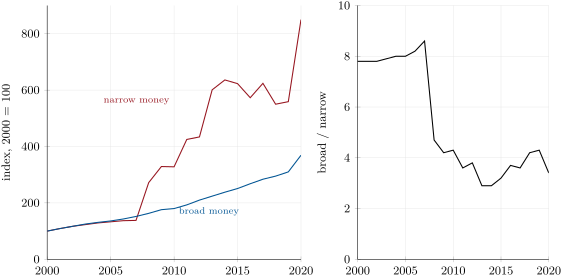
In 2007 the narrow money of the United States, essentially the money issued by its central bank, was 847 billion dollars. By 2019 it was 3426 billion, four times as much. Broad money, mostly the deposits that people and firms hold at banks, grew from 7294 billion to 14 836 billion: it doubled. From 1995 to 2007 broad money was about eight times narrow money (since 1950 the ratio had ranged from about 5 to 11); after 2008 it fell to under five.
A textbook model said that broad money is a fixed multiple of central bank money. This chapter shows where that model comes from, why it broke, and how money is really made: mostly by banks, when they lend. It then turns to what can go wrong with banks, and to the rules built after it did.
You already know
From the grades 6–9 volume: money as a means of payment, a unit of account and a store of value; banks, deposits, loans and interest. From Chapter 20: moral hazard. From the mathematics volumes: the sum of a geometric series, for .
25.1 A bank’s balance sheet
Definition 25.1 (Balance sheet and bank capital)
A balance sheet lists, at a date, what an organisation owns (its assets) and what it owes (its liabilities). A bank’s bank capital
is its assets minus its liabilities: what would be left for its owners if every asset were sold at its recorded value and every debt paid.
Definition 25.2 (Reserves and central bank money)
A bank’s reserves are the deposits it holds at the central bank, plus its cash. Central bank money
is the money the central bank issues: notes and coins, and banks’ reserves at the central bank.
Definition 25.3 (Broad money)
Broad money is the money held by households and firms: notes and coins in their hands, and their deposits at banks.
A bank’s assets are its reserves, its loans and the bonds it holds; its liabilities are mainly its customers’ deposits. Capital is the cushion between them: a bank with assets of 220 and deposits of 200 has capital of 20, and can lose 20 on its assets before it owes more than it owns.
25.2 Loans create deposits
Definition 25.4 (Money creation)
Money creation is the increase in broad money that happens when a bank makes a loan and credits the borrower’s account with a new deposit. Money is destroyed when a loan is repaid out of a deposit.
What limits lending, then, is not the deposits a bank already has but whether it can find borrowers it trusts at the interest rate it charges, whether it has enough capital, and the rate at which it can borrow reserves when payments flow out. A study by the Bank of England put it plainly: most money is created by commercial banks making loans, banks do not multiply up central bank money, and how much money they create depends in the end on the central bank’s policy.
How it is measured — Measures of money
Central bank money (the monetary base) is notes and coins plus banks’ reserves at the central bank. Narrow money adds to the notes and coins in circulation the deposits that can be spent at once. Broad money adds savings deposits and other near-money. Each country defines its measures in detail, so comparisons across countries use the definitions of one source. The series called narrow money in the opening chart is the database’s own; for the United States it moves with the monetary base, not with the narrow money defined here, so the chart’s ratio stands for broad money over central bank money.
25.3 The money multiplier, a toy model
Definition 25.5 (Money multiplier)
The money multiplier is the ratio of broad money to central bank money.
Proposition 25.6 (The multiplier of the toy model)
Suppose the public holds cash equal to a share of its deposits, banks hold reserves equal to a share of deposits and lend the rest, and central bank money is . Then deposits are , broad money is , and the multiplier is .
Proof. Central bank money is held either as cash by the public or as reserves by banks: , so . Broad money is cash plus deposits, . The same result comes as a geometric sum: a new unit of central bank money ends up partly as cash and partly as reserves; at each round, banks lend the part of new deposits they do not keep, a fraction of it returns as a new deposit, and the deposits created add up to times the first. ∎
Model — The money multiplier (toy)
Assumes. Banks lend every reserve beyond the share they keep; the public holds a fixed share of its money in cash.
Predicts. Broad money moves in proportion to central bank money: the central bank sets the quantity of money through .
Tested. Consistent with it, roughly, in years when banks held few excess reserves; in the United States the ratio of broad to narrow money was 7.8 in 2000 and 8.6 in 2007.
Breaks. After 2008, when the central bank quadrupled its money and banks held the new reserves instead of lending them: the ratio fell to 2.9 by 2014. When reserves earn interest and good borrowers are scarce, banks need not lend reserves out.
25.4 The central bank
Definition 25.7 (Policy rate)
The policy rate is the short-term interest rate that the central bank sets and steers, at which banks borrow or lend reserves overnight.
The central bank is the bank of the banks: payments between banks are settled in reserves held with it. It steers the overnight rate by paying interest on reserves and by lending reserves at a rate a little above that: no bank lends reserves to another for less than the central bank pays, and none borrows for more than the central bank charges. Through that rate it influences the rates at which banks lend, and so how much they lend and how much money they create. Later chapters return to what it aims at.
25.5 Runs, insurance and capital
Definition 25.8 (Bank run)
A bank run occurs when many depositors try to withdraw their deposits at once, for fear that the bank will fail.
A bank lends long and borrows short: its loans are repaid over years, but its deposits can be withdrawn today. If all depositors ask for their money, the bank must sell loans quickly and at a loss. So a run can make a sound bank fail: each depositor is right to run if the others run, and right to stay if they stay.
| other depositor stays | other depositor runs | |
|---|---|---|
| you stay | 110, 110 | 50, 100 |
| you run | 100, 50 | 75, 75 |
Model — A bank run as a coordination game
Assumes. Deposits can be withdrawn at any time; loans can be sold quickly only at a loss; each depositor acts on what she expects the others to do.
Predicts. Two equilibria: no run, and a run that brings the bank down whatever its loans are worth; a rumour can move depositors from one to the other.
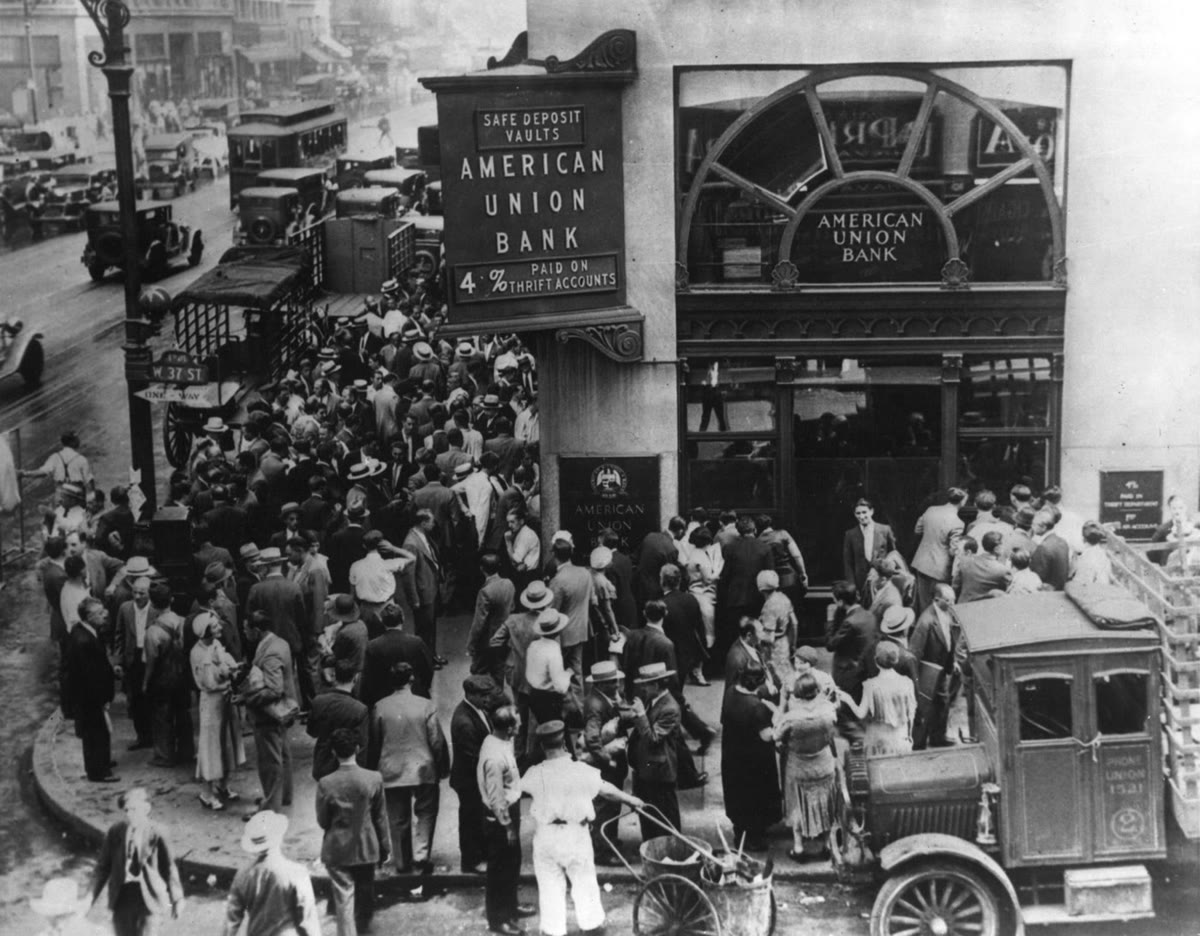
Tested. Consistent with the waves of bank suspensions in the United States from 1930 to 1933, in which hundreds of banks closed within a few weeks (see the record below); how many of the banks that failed were sound, and so how many failures the runs themselves caused, is still argued over.
Breaks. When deposits are insured, so that no insured depositor gains by running; when a central bank stands ready to lend to sound banks against their loans.
Definition 25.9 (Deposit insurance and lender of last resort)
Deposit insurance is a guarantee, usually by a public agency, that depositors will be repaid up to a limit if their bank fails. A lender of last resort
is a central bank that lends to banks short of cash, against good collateral, when no one else will.
On the record — Bank runs in the United States, 1930–33
When the crises began, nearly 16 000 American banks were outside the Federal Reserve System and over 8000 inside it. In November 1930, hundreds of banks suspended operations within a few weeks; about a third reopened, most were wound up. On 11 December 1930 the Bank of United States, the fourth-largest bank in New York City, closed; a new crisis broke out in Chicago in June 1931, and suspensions peaked in 1933. The Banking Act, signed on 16 June 1933, created the Federal Deposit Insurance Corporation; insurance began in January 1934, at first up to 2500 dollars per account holder. Since 1934, no depositor has lost insured funds.
Insurance stops runs, but it creates moral hazard: insured depositors no longer watch what their bank does with their money, and a bank’s owners, who lose only their capital if a gamble fails, gain from taking more risk. Rules on capital answer that. There are private answers too. A bank can hold more capital or more liquid assets than any rule requires; a bank funded far more by its owners’ shares than by deposits that can be withdrawn at any time has much less to fear from a run; and large depositors who are not insured have a reason to watch it. Before deposit insurance, some banks’ contracts let them delay withdrawals in a panic, and American banks in a city joined in clearing houses that lent to their members when runs began; these answers worked in some panics and failed in others. And a guarantee can breed the risk it insures: when depositors and lenders expect a large bank to be rescued in full, they stop watching it.
Definition 25.10 (Capital ratio)
A bank’s capital ratio is its capital divided by its assets, each asset weighted by its risk (a loan to a firm counts more than a government bond).
Facts as of 2026
American deposit insurance covers up to 250 000 dollars per depositor, per insured bank, for each kind of account ownership. The international banking rules require, above each bank’s minimum capital ratios, a further buffer of the highest-quality capital equal to 2.5 % of its risk-weighted assets.
25.6 Exercises
Exercise 25.1 ★
A household deposits 500 dalens of notes at its bank, which holds them as cash. Write the bank’s T-account.
Solution
Solution of Exercise 25.1.
Assets: reserves (cash) . Liabilities: deposits . Broad money is unchanged: the household holds 500 less in notes and 500 more in deposits.
Exercise 25.2 ★
A bank lends 1000 dalens to a firm and credits its account. Write the T-account. Has broad money changed?
Solution
Solution of Exercise 25.2.
Assets: loans . Liabilities: deposits . Broad money rises by 1000.
Exercise 25.3 ★
A bank buys a bond worth 200 from a household and pays by crediting the household’s deposit. Write the T-account. Has broad money changed?
Solution
Solution of Exercise 25.3.
Assets: bonds . Liabilities: deposits . Broad money rises by 200: buying an asset with a new deposit creates money just as a loan does.
Exercise 25.4 ★
From the opening chart and the figures in the text, by what factor did narrow money grow from 2007 to 2019, and broad money?
Exercise 25.5 ★
A bank has assets of 500 and capital of 40. Compute its capital ratio (unweighted) and its deposits, if it has no other liabilities.
Solution
Solution of Exercise 25.5.
; deposits .
Exercise 25.6 ★★
With and , compute the multiplier and broad money if central bank money is 100.
Exercise 25.7 ★★
Compute the multiplier for when , then when . Why does cash held by the public lower it?
Solution
Solution of Exercise 25.7.
: . : . Cash taken out of banks is not lent again, so each round of lending creates fewer new deposits.
Exercise 25.8 ★★
A firm repays a loan of 50 from its deposit. Write the T-account and say what happens to broad money.
Solution
Solution of Exercise 25.8.
Assets: loans . Liabilities: deposits . Broad money falls by 50: repaying a loan destroys money.
Exercise 25.9 ★★
With , the central bank buys bonds worth 100 from banks and pays them in reserves. Find the change in broad money if banks lend all excess reserves, and if they hold them.
Solution
Solution of Exercise 25.9.
If banks lend all excess reserves: the multiplier is , and broad money rises by 550. If they hold them: bonds are swapped for reserves inside the banks, no one’s deposit changes, and broad money does not change.
Exercise 25.10 ★★
A bank with assets of 1000 and capital of 60 loses 25 on its loans. Find its capital and its capital ratio before and after.
Solution
Solution of Exercise 25.10.
Before: . After: capital , assets , ratio .
Exercise 25.11 ★★
From the right-hand panel of the opening chart, give the ratio of broad to narrow money in 2000, 2007, 2008 and 2014. In which year did it fall most?
Solution
Solution of Exercise 25.11.
7.8 in 2000, 8.6 in 2007, 4.7 in 2008, 2.9 in 2014. It fell most in 2008, from 8.6 to 4.7.
Exercise 25.12 ★★★
What evidence contradicts the money-multiplier model? Use the opening chart, and say which assumption of the model failed.
Solution
Solution of Exercise 25.12.
The model predicts a stable ratio of broad to narrow money; the chart shows the ratio near 8 until 2007, then halving in one year and falling to 2.9 by 2014, while narrow money quadrupled. The assumption that failed is that banks lend every reserve beyond what they must keep: they held the new reserves, which earned interest at the central bank, while creditworthy borrowers were scarce.
Exercise 25.13 ★★★
In the run game of the chapter, show that both (stay, stay) and (run, run) are equilibria. What would deposit insurance paying 100 to anyone who stays change?
Solution
Solution of Exercise 25.13.
If the other stays, staying gives 110 and running 100: stay. If the other runs, staying gives 50 and running 75: run. So (stay, stay) and (run, run) are both equilibria. With insurance paying 100 to a depositor who stays, staying gives 100 against 75 when the other runs, and 110 against 100 when the other stays: staying is best whatever the other does, and the run equilibrium disappears.
Exercise 25.14 ★★★
A bank has capital of 10 and insured deposits of 90, paying 2 % interest. It can invest its 100 in a safe asset returning 5 %, or in a risky one returning 30 % or with equal chances. Its owners lose at most their capital. Compute the owners’ expected payoff for each choice, and the insurer’s expected cost. What does this show?
Solution
Solution of Exercise 25.14.
The bank owes . Safe asset: for the owners. Risky asset: or, with assets of 80, nothing (their loss stops at their capital), an expected ; the insurer pays half the time, an expected cost of . Both assets are worth 105 on average, but the owners gain from choosing risk, at the insurer’s expense: deposit insurance creates moral hazard, which capital rules try to contain.
Exercise 25.15 ★★★
A bank has assets of 500, capital of 40 and deposits of 460. What loss makes it insolvent? If its capital ratio must stay at or above 6 %, what loss puts it in breach?
Solution
Solution of Exercise 25.15.
A loss of 40 wipes out capital. A loss breaches 6 % when , that is , or .
25.7 Problem: The Banks of Brenland
Problem 25.1
Weekend problem — money creation, a reserve injection and a run
In Brenland, the public holds cash equal to 10 % of its deposits, and banks hold reserves equal to 10 % of their deposits. Central bank money is 200 million dalens. One bank, the Bren Savings Bank, has reserves of 20, bonds of 30, loans of 170 and deposits of 200 (millions of dalens). Bonds can be sold at once at their recorded value.
Part I — One bank.
- Compute the Bren Savings Bank’s capital and its capital ratio (unweighted).
- It lends 10 to a firm. Write the T-account and the new capital ratio.
- The firm pays the 10 to a supplier at another bank. Write both banks’ T-accounts.
- A borrower repays 5 from a deposit. What happens to broad money?
- After these changes, the bank loses 8 on its loans. Find its new capital and capital ratio.
Part II — All banks.
- Find Brenland’s total deposits, cash held by the public, reserves and broad money.
- Compute the multiplier.
- The central bank doubles its money to 400 by buying bonds from banks and paying in reserves. Find broad money if banks lend all excess reserves.
- Find broad money if banks hold all the new reserves.
- Compute the multiplier in each case.
Part III — The record.
- In the United States from 2007 to 2019, narrow money grew four times and broad money doubled. Which of the two regimes of Part II is closer?
- Give two reasons why banks may hold reserves rather than lend them.
- Explain why a bank’s lending is limited by its capital even when it has ample reserves.
Part IV — A run. Return to the Bren Savings Bank as at the start (before Part I’s changes). Its loans can be sold quickly only at half their recorded value.
- How much can it pay out without selling loans? What share of deposits is that?
- Beyond that, to raise 1 of cash it must sell loans recorded at 2. How much does it lose for each 1 paid out?
- Find the total withdrawals at which its capital is gone, and their share of deposits.
- Show that depositors who run first are paid in full while those who wait may not be.
- What would insurance of all deposits change?
- What would a central bank lending against the loans at their recorded value change?
- State the result of the problem: broad money after the reserve injection in each regime, and the share of deposits that can be withdrawn before the bank fails.
Solution
Solution of Problem 25.1.
1. Assets ; capital ; ratio .
2. Loans , deposits . Assets 230, capital 20, ratio .
3. Bren Savings Bank: reserves , deposits . The other bank: reserves , deposits . Broad money is unchanged by the payment.
4. Loans , deposits : broad money falls by 5.
5. The bank now has reserves 10, bonds 30, loans 175 and deposits 195. The loss leaves loans of 167, assets of 207 and capital of 12: a ratio of .
6. Central bank money is cash plus reserves: , so deposits are 1000, cash 100, reserves 100, and broad money .
7. , which is .
8. Deposits , cash 200, broad money 2200.
9. The banks swap bonds for reserves and lend nothing more: deposits stay at 1000 and cash at 100, so broad money stays at 1100; reserves are now 300.
10. if banks lend; if they hold.
11. Neither exactly: broad money would have quadrupled with narrow money in the first regime, and not grown at all in the second. It doubled, and the multiplier halved: much of the new reserves was held.
12. Reserves held at the central bank earn interest and carry no risk; creditworthy borrowers may be few in a recession; banks short of capital cannot add risky loans; rules may require them to hold liquid assets.
13. Every new loan adds to its risk-weighted assets but not to its capital, so its capital ratio falls. Once the ratio is at its minimum, the bank cannot lend more without raising capital, whatever its reserves.
14. Reserves plus bonds, : 25 % of deposits.
15. It loses 1 of capital for each 1 paid out.
16. Capital of 20 is gone after 20 more is paid out from loan sales, which uses loans recorded at 40. Total withdrawals: , or 35 % of deposits.
17. The first 70 are paid in full. After that the bank has loans recorded at 130 that fetch only 65 in a quick sale, against deposits of 130: if all the remaining depositors run, they get half their money. Waiting is costly if the others run, so each depositor has a reason to run first.
18. Insured depositors are paid in full whatever happens, so none gains by running; a run does not start.
19. The bank could raise cash against its loans without selling them at a loss: it pays every depositor who asks and keeps its capital, so running gains nothing.
20. After the central bank doubles its money to 400, broad money is 2200 if banks lend all excess reserves and stays at 1100 if they hold them; the Bren Savings Bank can pay out 35 % of its deposits before its capital is gone.