The Year 2 volume met groups as bookkeeping devices: Lagrange’s theorem, cyclic groups, the symmetric group and its signature. This chapter turns group theory into a method. The engine is the notion of a group acting on a set: counting orbits and fixed points yields the class equation, Cauchy’s theorem and the three Sylow theorems — the fundamental local-to-global principle of finite group theory. We then learn to assemble groups (direct and semidirect products) and to disassemble them (composition series, solvable groups), and we prove the theorem that, in Chapter 4, will close a three-century-old question about polynomial equations: the alternating groupAn is simple for n≥5.
1.1 Quotient groups and the isomorphism theorems
Throughout, G is a group written multiplicatively, e its identity. Recall from the Year 2 volume: subgroups, cosets gH, Lagrange’s theorem (∣G∣=[G:H]∣H∣ for finite G), the order of an element, cyclic groups, and the symmetric group Sn with its signature morphism ε:Sn→{±1}.
Definition 1.1
A subgroup N of G is normal (written N⊴G) when gNg−1=N for every g∈G — equivalently, when left and right cosets coincide: gN=Ng for all g.
Theorem 1.2(Quotient group)
Let N⊴G. The set G/N of cosets, with the multiplication (gN)(hN)=ghN, is a well-defined group, the quotient group, and the canonical projectionπ:G→G/N, g↦gN, is a surjective morphism with kernel N. Conversely, every kernel of a group morphism is normal: normal subgroups are exactly the kernels.
Proof. Well-definedness is the whole point. If gN=g′N and hN=h′N, write g′=gn, h′=hm with n,m∈N. Then g′h′=gnhm=gh(h−1nh)m∈ghN since h−1nh∈N by normality: the product of cosets does not depend on the representatives. Associativity, identity eN=N and inverses (gN)−1=g−1N are inherited from G. Clearly π is a surjective morphism and π(g)=N⟺g∈N.
If f:G→H is a morphism and k∈kerf, then f(gkg−1)=f(g)f(k)f(g)−1=e: kernels are normal. ∎
Theorem 1.3(Universal property; first isomorphism theorem)
Let f:G→H be a morphism and N⊴G with N⊆kerf. There is a unique morphism fˉ:G/N→H with f=fˉ∘π. In particular, taking N=kerf:
G/kerf∼imf,gN↦f(g).
Proof. Uniqueness: fˉ(gN) must be f(g). Existence: if gN=g′N then g−1g′∈N⊆kerf, so f(g)=f(g′) and fˉ(gN)=f(g) is well defined; it is a morphism because f is. For N=kerf: fˉ is injective, since fˉ(gN)=e means g∈kerf, i.e. gN=N; its image is that of f. ∎
Theorem 1.4(Second and third isomorphism theorems)
Let H≤G and N⊴G.
HN={hn:h∈H,n∈N} is a subgroup, N⊴HN, H∩N⊴H, and
H/(H∩N)≅HN/N.
If moreover N⊆K⊴G, then K/N⊴G/N and (G/N)/(K/N)≅G/K.
Proof. (1) HN is a subgroup: (hn)(h′n′)=hh′(h′−1nh′)n′∈HN and (hn)−1=h−1(hn−1h−1)∈HN, using normality of N. Compose H↪HNπHN/N: this morphism is surjective (hnN=hN) with kernel {h∈H:h∈N}=H∩N; apply Theorem 1.3.
(2) The projection G/N→G/K, gN↦gK, is well defined (N⊆K), surjective, with kernel K/N; apply Theorem 1.3 again. ∎
Theorem 1.5(Correspondence theorem)
Let N⊴G. The map H↦H/N is a bijection between subgroups of G containing N and subgroups of G/N, preserving inclusions, indices and normality (in both directions).
Proof. Its inverse is Hˉ↦π−1(Hˉ). Both maps send subgroups to subgroups, and are mutually inverse: π−1(H/N)=HN=H since N⊆H, and π(π−1(Hˉ))=Hˉ by surjectivity of π. Inclusions are clearly preserved; [G:H]=[G/N:H/N] because gH↦(gN)(H/N) is a well-defined bijection between coset spaces; and gHg−1=H for all g iff (gN)(H/N)(gN)−1=H/N for all gN, again by surjectivity of π. ∎
Example 1.6
ε:Sn→{±1} gives Sn/An≅{±1}; det:GLn(K)→K× gives GLn(K)/SLn(K)≅K×; t↦e2iπt gives R/Z≅U, the circle group. The first isomorphism theorem is how quotients are computed in practice: find a surjection with the right kernel.
Method 1.7
To prove N⊴G, in decreasing order of elegance: exhibit N as the kernel of a morphism defined on G; check gNg−1⊆N for all g (this suffices: applying it to g−1 and conjugating gives the reverse inclusion); verify that N is a union of conjugacy classes; or note that [G:N]=2 (then gN=Ng is forced — Exercise 1.1).
1.2 Group actions
Definition 1.8
An action of G on a set X is a morphism φ:G→S(X) into the group of bijections of X; one writes g⋅x for φ(g)(x). Equivalently: a map G×X→X with e⋅x=x and g⋅(h⋅x)=(gh)⋅x. The orbit of x is Ox={g⋅x:g∈G}, its stabilizer is the subgroup Gx={g:g⋅x=x}, and XG={x:∀g,g⋅x=x} is the set of fixed points. The action is transitive if there is exactly one orbit, faithful if φ is injective, free if all stabilizers are trivial.
G on itself by left translationg⋅x=gx: free and transitive.
G on itself by conjugationg⋅x=gxg−1: orbits are the conjugacy classes, stabilizers the centralizersZG(x)={g:gx=xg}, fixed points the centerZ(G).
G on the coset space G/H by g⋅xH=gxH: transitive, with stabilizer of the coset H equal to H. Every transitive action is of this form (Exercise 1.8).
G on its set of subgroups by conjugation: the stabilizer of H is the normalizerNG(H)={g:gHg−1=H}, the largest subgroup of G in which H is normal.
Sn on [[1,n]]: the mother of all examples.
Theorem 1.10(Orbit–stabilizer)
The map gGx↦g⋅x is a well-defined bijection G/Gx→Ox. In particular, for G finite,
∣Ox∣=[G:Gx]divides ∣G∣,
and, the orbits partitioning X (they are the classes of the equivalence x∼y⟺y∈Ox),
∣X∣=i∑[G:Gxi](xi:one point per orbit).
Proof. Well defined and injective: gGx=hGx⟺h−1g∈Gx⟺h−1g⋅x=x⟺g⋅x=h⋅x; read the chain in both directions. Surjectivity is the definition of the orbit. The counting statements follow from Lagrange’s theorem and the partition of X into orbits. ∎
Corollary 1.11(Class equation)
For a finite group G, picking one representative xi in each conjugacy class with more than one element:
Proof. Apply Theorem 1.10 to the conjugation action: singleton orbits are exactly the elements of Z(G). ∎
Theorem 1.12(Fixed points of p-groups)
Let p be prime. A p-group is a finite group whose order is a power of p. If a p-group G acts on a finite set X, then
XG≡∣X∣(modp).
Consequences: a nontrivial p-group has nontrivial center, and every group of order p2 is abelian.
Proof. Each orbit has cardinality [G:Gx], a power of p; this power is 1 exactly on fixed points and otherwise divisible by p. Summing over orbits gives the congruence. For the center: conjugation action of G on itself has XG=Z(G), so ∣Z(G)∣≡∣G∣≡0(modp), and Z(G)∋e forces ∣Z(G)∣≥p. Order p2: if Z(G)=G then ∣Z(G)∣=p and G/Z(G) is cyclic of order p, which forces G abelian (Exercise 1.2) — contradiction. ∎
Theorem 1.13(Cauchy)
If a prime p divides ∣G∣, then G contains an element of order p.
Proof (McKay). Let X={(g1,…,gp)∈Gp:g1g2⋯gp=e}. Choosing g1,…,gp−1 freely determines gp: ∣X∣=∣G∣p−1, divisible by p. The cyclic group Z/pZ acts on X by cyclic shift (g1,…,gp)↦(g2,…,gp,g1) — this preserves X, since g2⋯gpg1=g1−1(g1⋯gp)g1=e. By Theorem 1.12, XZ/pZ≡∣X∣≡0(modp). Fixed points are the constant tuples (g,…,g) with gp=e; the tuple (e,…,e) is one of them, so there are at least p of them, hence at least one g=e with gp=e: its order is exactly p. ∎
Theorem 1.14(Cayley)
Every group of order n embeds in Sn.
Proof. Left translation φ:G→S(G)≅Sn is a morphism; φ(g)=id forces g=ge=e: it is faithful. ∎
Method 1.15
Fixed-point counting is the universal opening move of finite group theory. To prove that something exists (a central element, an element of order p, a normal subgroup, a fixed point), make a well-chosen group act on a well-chosen finite set, then compare XG with ∣X∣ modulo p, or let orbit sizes divide the group order. The proofs of Theorems 1.12 and 1.13 and of all three Sylow theorems below are five variations on this single idea.
1.3 The Sylow theorems
Lagrange’s theorem says the order of a subgroup divides ∣G∣; the converse fails (A4, of order 12, has no subgroup of order 6 — Exercise 1.1). The Sylow theorems salvage the converse for prime powers, and their counting clause is the sharpest general tool we have for producing normal subgroups.
Definition 1.16
Write ∣G∣=pam with p∤m. A Sylow p-subgroup of G is a subgroup of order pa — a p-subgroup of the largest conceivable order. The number of Sylow p-subgroups of G is denoted np.
Lemma 1.17
If ∣G∣=pam with p∤m, then (papam)≡m(modp).
Proof. In Fp[X], the freshman’s dream (1+X)p=1+Xp (the coefficients (kp), 0<k<p, are divisible by p: p divides the numerator of k!(p−k)!p! but not the denominator) iterates to (1+X)pa=1+Xpa, whence
(1+X)pam=(1+Xpa)m=k=0∑m(km)Xkpain Fp[X].
Identify the coefficient of Xpa: on the left (papam)modp, on the right (1m)=m. ∎
Theorem 1.18(Sylow I: existence)
For every prime p, Sylow p-subgroups of G exist.
Proof (Wielandt). Let Ω be the set of subsets of G of cardinality pa; G acts on Ω by left translation g⋅S=gS. By Lemma 1.17, ∣Ω∣=(papam)≡m≡0(modp), so some orbitOS has size prime to p (if p divided every orbit size, it would divide ∣Ω∣). Let H=GS be the stabilizer of such an S. Since [G:H]=∣OS∣ is prime to p and pa∣∣G∣=[G:H]∣H∣, we get pa∣∣H∣. Conversely, fix s∈S: the map H→S, h↦hs, is injective and lands in S because hS=S; hence ∣H∣≤∣S∣=pa. So ∣H∣=pa. ∎
Theorem 1.19(Sylow II: domination and conjugacy)
Let P be a Sylow p-subgroup and Q any p-subgroup of G. Then Q⊆gPg−1 for some g∈G. In particular all Sylow p-subgroups are conjugate, and P⊴G⟺np=1.
Proof. Let Q act on the coset space X=G/P, of cardinality m≡0(modp). By Theorem 1.12 applied to the p-group Q, XQ≡m≡0(modp): there is a fixed coset gP, i.e. QgP=gP, i.e. g−1Qg⊆P. If Q is itself a Sylow subgroup, equality of orders turns Q⊆gPg−1 into an equality. Finally P⊴G iff its conjugates {gPg−1} — which by the above are all the Sylow p-subgroups — reduce to {P}. ∎
Theorem 1.20(Sylow III: counting)
np≡1(modp), and np=[G:NG(P)], which divides m.
Proof. Let Sylp be the set of Sylow p-subgroups; G acts on it transitively by conjugation (Theorem 1.19), with stabilizer of P the normalizerNG(P)⊇P: np=[G:NG(P)], and m=[G:P]=[G:NG(P)][NG(P):P] shows np∣m.
Now restrict the action to P and count fixed points. If Q∈Sylp is fixed by P, then P⊆NG(Q); both P and Q are Sylow p-subgroups of the group NG(Q), hence conjugate in it (Theorem 1.19 applied to NG(Q)); but Q⊴NG(Q), so Q is its only conjugate there: P=Q. Thus the only fixed point is P itself, and Theorem 1.12 gives np=Sylp≡SylpP=1(modp). ∎
Method 1.21
To analyse a group of given order n=pam: list the divisors of m congruent to 1 mod p — these are the candidates for np. If the only candidate is 1, the Sylow p-subgroup is normal. If np>1 is forced to be small, act by conjugation on Sylp to obtain a morphism G→Snp with small kernel. And count elements: distinct Sylow p-subgroups of prime order p intersect trivially, so they carry np(p−1) elements of order exactly p; overlapping counts for different primes often force a contradiction (Exercise 1.7).
Example 1.22
Let ∣G∣=pq with p<q primes and p∤q−1. Then nq∣p and nq≡1modq force nq=1 (as p<q); np∣q and np≡1modp force np=1 (as q≡1modp). Let P,Q be the two normal Sylows: P∩Q={e} (coprime orders), so ∣PQ∣=pq (Exercise 1.4) and G≅P×Q≅Z/pZ×Z/qZ≅Z/pqZ by Proposition 1.24 below. Every group of order 15, 33, 35, … is cyclic. The excluded case p∣q−1 produces exactly one more group, nonabelian — see the weekend problem (Problem 1.1).
Example 1.23(A complete Sylow census: S4)
Let us run the method on G=S4, ∣G∣=24=23⋅3. Sylow 3:n3∣8, n3≡1mod3, so n3∈{1,4}; since ⟨(123)⟩ and ⟨(124)⟩ are distinct, n3=4 — the four subgroups ⟨(abc)⟩, one for each 3-element subset {a,b,c}, accounting for the 8 three-cycles. By Sylow II they are conjugate, and the conjugation morphism S4→SSyl3≅S4 is an isomorphism here (its kernel is contained in N=NG(⟨(123)⟩) of order 24/4=6, and a normal subgroup of S4 inside S3-like N must be trivial: it would consist of even permutations fixing the four Sylows, and only e does). Sylow 2:n2∣3, n2≡1mod2: n2∈{1,3}. The subgroup D=⟨(1234),(13)⟩ has order 8 (a dihedral D4: the symmetries of the square with vertices 1,2,3,4), is not normal ((12)(1234)(12)=(2134) generates a different 4-cycle subgroup), so n2=3: the three copies of D4 correspond to the three ways of pairing 4 points into a “square”. Note the moral of the census: ∣S4∣=24 leaves room for either Sylow to fail normality, and both do — compare order 12, where the count forces one of them normal (Part IV of Problem 1.1).
1.4 Products, direct and semidirect
Proposition 1.24(Recognizing a direct product)
Let H,K⊴G with H∩K={e} and HK=G. Then (h,k)↦hk is an isomorphism H×K→G.
Proof. For h∈H, k∈K, the commutatorhkh−1k−1 lies in K (read it as (hkh−1)k−1, using normality of K) and in H (read it as h(kh−1k−1)): it is e, so H and K commute elementwise and the map is a morphism. It is surjective since HK=G, and injective since hk=e gives h=k−1∈H∩K={e}. ∎
Normality of both factors is what fails most often: in S3=⟨(123)⟩⟨(12)⟩ both factors intersect trivially and generate, yet S3≅Z/3Z×Z/2Z. The right notion when only one factor is normal:
Definition 1.25
Let H, K be groups and φ:K→Aut(H) a morphism. The semidirect productH⋊φK is the set H×K equipped with
(h,k)(h′,k′)=(hφ(k)(h′),kk′).
Proposition 1.26
H⋊φK is a group; H×{e} is a normal subgroup isomorphic to H, {e}×K a subgroup isomorphic to K; they intersect trivially and generate. Conversely, if G=NK with N⊴G, K≤G and N∩K={e}, then G≅N⋊φK for φ(k)=(n↦knk−1).
Proof. Direct verification: associativity reduces to φ(kk′)=φ(k)∘φ(k′) and each φ(k) being a morphism; the identity is (e,e) and (h,k)−1=(φ(k−1)(h−1),k−1). The projection (h,k)↦k is a morphism onto K with kernel H×{e}, which is therefore normal. For the converse: every g∈G writes uniquely as nk with n∈N, k∈K (existence: G=NK; uniqueness: nk=n′k′ gives n′−1n=k′k−1∈N∩K), and
(nk)(n′k′)=n(kn′k−1)kk′
shows that nk↦(n,k) transports the law of G to that of N⋊φK. ∎
Example 1.27
(a) The dihedral groupDn (n≥3) of the 2n symmetries of a regular n-gon: the rotations form a normal subgroup of index 2, any reflection generates a complement, and conjugating a rotation by a reflection inverts it: Dn≅Z/nZ⋊φZ/2Z with φ(1)=(x↦−x). (b) The affine group of a line, {x↦ax+b:a∈K×,b∈K}≅K⋊K×: translations normal, homotheties a complement. (c) Sn≅An⋊Z/2Z (complement: any transposition). (d) The quaternion groupQ8 is not a semidirect product of proper subgroups: every nontrivial subgroup contains −1 (Problem 1.1), so no two proper subgroups intersect trivially.
1.5 Solvable groups; simplicity of An
Definition 1.28
The commutator of x,y∈G is [x,y]=xyx−1y−1; the derived subgroupD(G) is the subgroup generated by all commutators. The derived series is D0(G)=G, Di+1(G)=D(Di(G)), and G is solvable if Dn(G)={e} for some n.
Proposition 1.29
D(G) is normal (indeed stable under every automorphism), G/D(G) is abelian, and for N⊴G: G/N abelian ⟺D(G)⊆N. Moreover G is solvable iff there is a chain G=G0⊵G1⊵⋯⊵Gn={e} with each Gi+1⊴Gi and each quotient Gi/Gi+1 abelian. Subgroups and quotients of solvable groups are solvable; conversely, if N and G/N are solvable, so is G.
Proof. An automorphism α maps [x,y] to [αx,αy]: it permutes the commutators, so preserves the subgroup they generate; conjugations are automorphisms, whence normality. In G/D(G), xˉyˉxˉ−1yˉ−1=[x,y]=eˉ: the quotient is abelian. If G/N is abelian then every [x,y]∈N, so D(G)⊆N; conversely if D(G)⊆N then G/N, a quotient of the abelian G/D(G) by the third isomorphism theorem, is abelian.
If G is solvable, the derived series is such a chain. Conversely, given a chain, Di(G)⊆Gi by induction: Gi/Gi+1 abelian gives D(Gi)⊆Gi+1, so Di+1(G)=D(DiG)⊆D(Gi)⊆Gi+1; hence Dn(G)={e}.
Heredity: Di(H)⊆Di(G) for H≤G (induction), and Di(G/N)=π(Di(G)) since π maps commutators onto commutators; this gives the statements for subgroups and quotients. Extension: if Dm(G/N)={e} then Dm(G)⊆N, and Dn(N)={e} gives Dm+n(G)=Dn(Dm(G))⊆Dn(N)={e}. ∎
Example 1.30
Abelian groups are solvable. p-groups are solvable, by induction on the order: Z(G)={e} and G/Z(G) is a smaller p-group. S3 and S4 are solvable: S4⊵A4⊵V⊵{e}, where V={e,(12)(34),(13)(24),(14)(23)} is the Klein group of double transpositions (normal in S4: a union of conjugacy classes), with abelian quotients Z/2Z, Z/3Z, V. In Chapter 4, “the general equation of degree n is solvable by radicals” will literally mean “Sn is a solvable group”. Whence the importance of the next definition.
Definition 1.31
A group G={e} is simple if its only normal subgroups are {e} and G. A nonabelian simple group is not solvable: D(G)⊴G is not {e} (else G abelian), so D(G)=G and the derived series is constant. The abelian simple groups are exactly the Z/pZ, p prime (an abelian group is simple iff it has no proper nontrivial subgroup, iff it is cyclic of prime order by Lagrange).
Lemma 1.32
For n≥3, An is generated by 3-cycles; for n≥5, all 3-cycles are conjugate in An.
Proof. An element of An is a product of an even number of transpositions; pair them up and use (composition right to left)
(ab)(cd)=(acb)(acd),(ab)(bc)=(abc),(ab)(ab)=e
for disjoint, overlapping and equal pairs respectively: each pair of transpositions is a product of 3-cycles.
Conjugacy: σ(abc)σ−1=(σaσbσc), so any two 3-cycles are conjugate by some σ∈Sn. If σ is odd, replace it by σ′=σ(de) where d,e are two points outside {a,b,c} — they exist since n≥5; then σ′ is even and σ′(abc)σ′−1=σ(abc)σ−1, since (de) commutes with (abc). ∎
Proof. Let N⊴An, N={e}. By Lemma 1.32 it suffices to show that N contains one3-cycle: normality and conjugacy of 3-cycles in An then put all 3-cycles in N, so N=An.
For ρ∈Sn let F(ρ)={x:ρ(x)=x} be its support and f(ρ)=∣F(ρ)∣. Choose σ∈N∖{e} with f(σ)minimal. Note that a nontrivial even permutation has f≥3, and that f(σ)=4 is impossible for σ∈An unless σ is a double transposition (a 4-cycle is odd). We show σ is a 3-cycle.
Case A: σ is a product of disjoint transpositions, say σ=(ab)(cd)⋯ with f(σ)≥4. Pick e′∈/{a,b,c,d} (possible: n≥5), set τ=(cde′) and
σ′=τστ−1σ−1∈N(τστ−1∈N by normality).
Since στ−1σ−1=(σcσe′σd)=(dσe′c) (using σc=d, σd=c), we get σ′=(cde′)(dσe′c).
If σe′=e′ (which holds in particular when f(σ)=4, i.e. σ=(ab)(cd)): then (de′c)=(cde′) and σ′=(cde′)2=(ce′d), a 3-cycle lying in N, with f(σ′)=3<4≤f(σ) — contradicting minimality.
If σe′=e′: then σe′∈/{a,b,c,d,e′} (σ swaps a,b and c,d, and e′∈/{a,b,c,d} with σ injective), so σ moves the six points a,b,c,d,e′,σe′: f(σ)≥6. On the other hand σ′, a product of two 3-cycles with supports in {c,d,e′,σe′}, satisfies f(σ′)≤4; and σ′=e, since σ′(d)=τστ−1(c)=τσ(e′)=σe′=d (τ fixes σe′∈/{c,d,e′}). So σ′∈N∖{e} with f(σ′)≤4<f(σ): minimality is contradicted.
Case B: some cycle of σ has length ≥3, say σ(a)=b, σ(b)=c with a,b,c distinct. If σ is exactly this 3-cycle, we are done. Otherwise f(σ)≥5 (the case f(σ)=4 with a ≥3-cycle is the odd 4-cycle, excluded), so we may pick d,e′∈F(σ)∖{a,b,c}. Set τ=(cde′) and σ′=τστ−1σ−1∈N. As before σ′=(cde′)(σcσe′σd) moves only points of
M={c,d,e′}∪{σc,σd,σe′}⊆F(σ)
(images of moved points are moved: σ(x)=x implies σ(σx)=σx, σ being injective). Also b∈/M: the five points a,b,c,d,e′ are distinct, so b∈/{c,d,e′}; and b∈{σc,σd,σe′} would force a∈{c,d,e′} (apply σ−1, using σa=b), which is false. Hence σ′ fixes b, while σ moves b; and F(σ′)⊆F(σ). Finally σ′=e: σ−1(c)=b, τ−1(b)=b, σ(b)=c, τ(c)=d, so σ′(c)=d=c. Thus σ′∈N∖{e} with f(σ′)≤f(σ)−1, contradicting minimality.
Both cases being impossible, σ is a 3-cycle. ∎
Corollary 1.34
For n≥5: An and Sn are not solvable, and the only normal subgroups of Sn are {e}, An and Sn.
Proof.An is nonabelian simple, hence not solvable (Definition 1.31); a group containing a non-solvable subgroup is not solvable (Proposition 1.29). Let N⊴Sn: then N∩An⊴An equals {e} or An. If N∩An=An, then An⊆N and N∈{An,Sn} by the index. If N∩An={e}, the restriction to N of the projection Sn→Sn/An≅Z/2Z is injective, so ∣N∣≤2; if N={e,σ}, normality makes the conjugacy class of σ equal to {σ}, i.e. σ∈Z(Sn). But Z(Sn)={e} for n≥3: if σ=e moves a to b=a, pick c∈/{a,b}; then (bc)σ(bc)−1 sends a to c=b, so it differs from σ. Hence N={e}. ∎
Theorem 1.35(Jordan–Hölder)
Every finite group G={e} admits a composition series
{e}=G0⊴G1⊴⋯⊴Gr=G,Gi/Gi−1 simple,
and the multiset of composition factorsGi/Gi−1, up to isomorphism, does not depend on the chosen series. A finite group is solvable iff all its composition factors are cyclic of prime order.
Proof.Existence: induction on ∣G∣. If G is simple, take {e}⊴G. Otherwise pick a maximal proper normal subgroupN (there are finitely many subgroups); G/N is simple by the correspondence theorem (a proper nontrivial normal subgroup of G/N would lift to a normal subgroup of G strictly between N and G). Append N⊴G to a composition series of N.
Uniqueness: induction on ∣G∣, the case Gsimple being clear. Take two composition series, with penultimate terms M⊴G and N⊴G (so G/M, G/N are simple). If M=N, conclude by induction applied to M. Otherwise MN, normal in G and strictly containing M, equals G (M is maximal normal: any normalM⊊L⊊G would map to a proper nontrivial normal subgroup of the simpleG/M). The second isomorphism theorem gives
G/M=MN/M≅N/(M∩N),G/N=MN/N≅M/(M∩N).
Set K=M∩N (⊴G) and fix a composition series of K. Then M carries two composition series: its original one, and the series of K followed by K⊴M (the quotient M/K≅G/N is simple). By induction (applied to M), the factors of the original series of M are {factors of K}∪{G/N}; likewise for N. Hence both series of G have factors
Jordan–Hölder says every finite group is built from simple groups, with a well-defined parts list — an arithmetic of groups in which the simple groups are the primes, and where how the parts are glued (extension data, as in the semidirect product) replaces mere multiplication. The classification of the finite simple groups — the cyclic Z/pZ, the alternating An≥5, sixteen families of Lie type, and 26 sporadic groups — is one of the monuments of twentieth-century mathematics; its proof, spread over some ten thousand journal pages, is very far beyond this course.
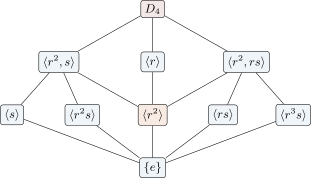
The ten subgroups of the dihedral groupD4=⟨r,s∣r4=s2=e,srs−1=r−1⟩. The three subgroups of index 2 (middle row) are normal, as is the center⟨r2⟩ (highlighted); the four reflection subgroups fall into two conjugacy classes of two. Chains from bottom to top give composition series, e.g. {e}⊴⟨r2⟩⊴⟨r⟩⊴D4: factors Z/2Z,Z/2Z,Z/2Z — always the same multiset, as Jordan–Hölder demands.
1.6 Exercises
Exercise 1.1★
(a) Show that every subgroup of index 2 is normal. (b) Show that if [G:H]=2, then x2∈H for every x∈G. (c) Deduce that A4 has no subgroup of order 6: Lagrange’s converse fails. (Count the squares of 3-cycles.)
Solution
Solution of Exercise 1.1.
(a) Let [G:H]=2. For g∈H, gH=H=Hg. For g∈/H: the two left cosets are H and gH, so gH=G∖H; likewise Hg=G∖H. Hence gH=Hg for all g: H⊴G.
(b) By (a), G/H is a group of order 2; the class xˉ satisfies xˉ2=eˉ, i.e. x2∈H.
(c) Suppose H≤A4 with ∣H∣=6, hence of index 2. By (b), σ2∈H for every σ∈A4. Every 3-cycle is such a square: if σ3=e then σ=σ4=(σ2)2. So H contains all eight 3-cycles of A4: ∣H∣≥8>6, a contradiction. (Lagrange’s converse fails at the very first opportunity: 6∣12.)
Exercise 1.2★
Show that if G/Z(G) is cyclic then G is abelian. Deduce again that every group of order p2 is abelian, and exhibit, for each prime p, a nonabelian group of order p3. (Think of upper triangular matrices with unit diagonal over Fp.)
Solution
Solution of Exercise 1.2.
Say G/Z(G)=⟨gZ(G)⟩. Every x∈G then writes x=gkz with k∈Z, z∈Z(G). For x=gkz, y=glz′:
xy=gkzglz′=gk+lzz′=glz′gkz=yx,
central elements commuting with everything: G is abelian.
Order p2: Z(G)={e} (Theorem 1.12), so ∣Z(G)∣∈{p,p2}. If it were p, then G/Z(G) would have order p, hence be cyclic, forcing G abelian and Z(G)=G of order p2 — contradiction. So Z(G)=G.
Nonabelian of order p3: the Heisenberg group
Hp=⎩⎨⎧100a10cb1:a,b,c∈Fp⎭⎬⎫≤GL3(Fp),
of order p3 (free choice of a,b,c; closure and inverses by direct computation). It is nonabelian: the two elementary matrices I+E12 and I+E23 have commutatorI+E13=I.
Exercise 1.3★
(a) Show that Aut(Z/nZ)≅(Z/nZ)×. (b) Show that the inner automorphisms ιg:x↦gxg−1 form a normal subgroupInn(G)⊴Aut(G), with Inn(G)≅G/Z(G).
Solution
Solution of Exercise 1.3.
(a) A morphism f:Z/nZ→Z/nZ is determined by k=f(1ˉ) (then f(mˉ)=mkˉ), and every kˉ defines one. It is bijective iff kˉ generates Z/nZ, iff gcd(k,n)=1, iff kˉ∈(Z/nZ)×. Composition corresponds to multiplication: fk∘fl=fkl. Hence Aut(Z/nZ)≅(Z/nZ)×.
(b) The map ι:G→Aut(G), g↦ιg, is a morphism: ιg∘ιh=ιgh. Its image is Inn(G); its kernel is {g:gxg−1=x∀x}=Z(G). The first isomorphism theorem gives Inn(G)≅G/Z(G). Normality in Aut(G): for α∈Aut(G),
Let H,K be subgroups of a finite group G. (a) Prove the product formula∣HK∣∣H∩K∣=∣H∣∣K∣, by counting the fibers of the map H×K→HK, (h,k)↦hk. (b) Show that HK is a subgroup iff HK=KH (automatic when one of the two is normal). (c) If H,K⊴G and H∩K={e}, show that hk=kh for all h∈H, k∈K.
Solution
Solution of Exercise 1.4.
(a) Consider μ:H×K→HK, (h,k)↦hk, surjective by definition. Fix h0k0∈HK: then hk=h0k0⟺h0−1h=k0k−1∈H∩K. Writing u=h0−1h, the fiber of h0k0 is {(h0u,u−1k0):u∈H∩K}, of cardinality ∣H∩K∣. Hence ∣H∣∣K∣=∣H×K∣=∣HK∣∣H∩K∣.
(b) If HK is a subgroup: KH⊆HK because kh=(h−1k−1)−1∈(HK)−1=HK; and HK⊆KH by taking inverses in HK=(HK)−1⊆(KH)−1… more directly, for hk∈HK, (hk)−1=k−1h−1∈KH, so HK=(HK)−1⊆KH; both inclusions give HK=KH. Conversely if HK=KH: closure, (hk)(h′k′)=h(kh′)k′∈h(HK)k′=(hH)(Kk′)⊆HK; inverses, (hk)−1=k−1h−1∈KH=HK; and e∈HK: subgroup. If, say, K⊴G, then hK=Kh for all h, so HK=KH automatically.
(c) For h∈H, k∈K, the commutator[h,k]=hkh−1k−1 equals (hkh−1)k−1∈K (Knormal) and h(kh−1k−1)∈H (Hnormal), hence lies in H∩K={e}: hk=kh.
Exercise 1.5★★
(Burnside’s counting lemma) A finite group G acts on a finite set X. Show that the number of orbits is the average number of fixed points:
#{orbits}=∣G∣1g∈G∑∣Fix(g)∣,Fix(g)={x∈X:g⋅x=x},
by counting the set {(g,x):g⋅x=x} in two ways. Application: Z/pZ (p prime) acts by rotation on necklaces of p beads with a available colors; deduce Fermat’s little theorem ap≡a(modp).
using orbit–stabilizer (∣Gx∣=∣G∣/∣Ox∣) and the partition into orbits.
Necklaces: let X be the set of maps Z/pZ→{1,…,a} (colorings of p positions), ∣X∣=ap, with Z/pZ acting by rotation. The identity fixes all ap colorings. A rotation kˉ=0ˉ generates Z/pZ (p prime), so a coloring it fixes is invariant under all rotations, hence constant: a fixed colorings. Burnside:
#{orbits}=pap+(p−1)a∈N,
so p∣ap+(p−1)a, i.e. p∣ap−a: Fermat’s little theorem, by pure counting.
Exercise 1.6★
Using the Sylow theorems, show that every group of order 15 is cyclic and that every group of order 45 is abelian.
Solution
Solution of Exercise 1.6.
Order 15=3⋅5: n3∣5 and n3≡1(mod3) force n3=1; n5∣3 and n5≡1(mod5) force n5=1. The Sylows P3,P5 are normal, intersect trivially (coprime orders), and ∣P3P5∣=15 (Exercise 1.4(a)): by Proposition 1.24, G≅Z/3Z×Z/5Z≅Z/15Z (Chinese remainder).
Order 45=32⋅5: n3∣5, n3≡1(mod3) give n3=1; n5∣9, n5≡1(mod5) give n5=1. So G≅P3×P5 with ∣P3∣=9=32 and ∣P5∣=5: both abelian (Theorem 1.12 for p2; prime order is cyclic), hence so is G.
Exercise 1.7★★
Show that no group of order 30, and none of order 56, is simple. (For 30: if n3=1 and n5=1, count the elements of orders 3 and 5. For 56: count the elements of order 7.)
Solution
Solution of Exercise 1.7.
Order 30=2⋅3⋅5. n5∣6, n5≡1(mod5): n5∈{1,6}; n3∣10, n3≡1(mod3): n3∈{1,10}. Suppose Gsimple, so n5=6 and n3=10. Two distinct subgroups of prime order p intersect trivially (the intersection is a proper subgroup of Z/pZ), so the six Sylow 5-subgroups carry 6×4=24 elements of order 5, and the ten Sylow 3-subgroups carry 10×2=20 elements of order 3: 24+20=44>30−1 non-identity elements — absurd. So n5=1 or n3=1: a normal Sylow exists.
Order 56=23⋅7. n7∣8, n7≡1(mod7): n7∈{1,8}. If n7=8, the Sylow 7-subgroups carry 8×6=48 elements of order 7, leaving exactly 56−48=8 other elements. A Sylow 2-subgroup has order 8 and consists of such elements, so it is the set of them: n2=1. Either n7=1 or n2=1: never simple.
Exercise 1.8★★
(a) Let H≤G of index n. Show that the action of G on G/H yields a morphism G→Sn whose kernel ⋂g∈GgHg−1 is the largest normal subgroup of G contained in H. (b) Deduce: if G is finite and p is the smallest prime divisor of ∣G∣, every subgroup of index p is normal. (c) Show that every transitive action of G on a set X is isomorphic to the action on a coset space: there is a bijection X→G/Gx commuting with the actions.
Solution
Solution of Exercise 1.8.
(a) The actiong⋅xH=gxH gives a morphism ρ:G→S(G/H)≅Sn. Its kernel is
kerρ={g:∀x∈G,gxH=xH}={g:∀x,x−1gx∈H}=x∈G⋂xHx−1,
a normal subgroup (a kernel) contained in H (take x=e). If N⊴G and N⊆H, then for every x: N=xNx−1⊆xHx−1, so N⊆kerρ: the kernel is the largest such.
(b) Let [G:H]=p, smallest prime dividing ∣G∣, and K=kerρ⊆H. Then G/K embeds in Sp, so [G:K] divides p!. Also [G:K]=[G:H][H:K]=p[H:K], so [H:K] divides (p−1)!. But [H:K] divides ∣G∣, whose prime divisors are all ≥p, while the prime divisors of (p−1)! are all <p: hence [H:K]=1, i.e. H=K=kerρ is normal.
(c) Let the action be transitive and x∈X. The map Φ:G/Gx→X, gGx↦g⋅x, is well defined and bijective (orbit–stabilizer; the orbit is all of X), and it intertwines the actions: Φ(h⋅gGx)=Φ(hgGx)=(hg)⋅x=h⋅Φ(gGx).
Exercise 1.9★★
(a) Show that D(G) is the smallest normal subgroup of G with abelian quotient, and that every morphism from G to an abelian group factors uniquely through the abelianizationGab=G/D(G). (b) Compute D(Sn) and Snab for n≥2, and D(Q8) and Q8ab.
Solution
Solution of Exercise 1.9.
(a) D(G) is normal with abelian quotient (Proposition 1.29); and if N⊴G has G/N abelian, the same proposition gives D(G)⊆N: D(G) is the smallest. Universal property: let f:G→A with A abelian. Then f([x,y])=[f(x),f(y)]=e, so D(G)⊆kerf, and Theorem 1.3 factors f=fˉ∘π through Gab, uniquely since π is surjective.
(b) Commutators are even permutations, so D(Sn)⊆An. Conversely every 3-cycle is a commutator:
[(ab),(ac)]=(ab)(ac)(ab)(ac)=(abc),
(direct check on a,b,c), and 3-cycles generate An (Lemma 1.32): D(Sn)=An for n≥3, and Snab≅Sn/An≅Z/2Z. (For n=2: S2 is abelian, D(S2)={e}, S2ab=S2≅Z/2Z — the formula Snab≅Z/2Z holds for all n≥2.)
Q8: the quotient Q8/{±1} has order 4, hence is abelian, so D(Q8)⊆{±1}; and [i,j]=iji−1j−1=ij(−i)(−j)=(ij)2=k2=−1, so D(Q8)={±1} and Q8ab≅(Z/2Z)2 (order 4, exponent 2: the classes of i,j square to 1ˉ).
Exercise 1.10★★
Let G be a p-group and H⊊G a proper subgroup. Show that H⊊NG(H) (“normalizers grow”), and deduce that every maximal subgroup of a p-group is normal of index p. (Induction on ∣G∣, using Z(G)={e}: treat separately Z(G)⊆H and Z(G)⊆H.)
Solution
Solution of Exercise 1.10.
Induction on ∣G∣; for ∣G∣=p the only proper subgroup is H={e}, and NG({e})=G⊋{e}. Let Z=Z(G)={e} (Theorem 1.12).
If Z⊆H: pick z∈Z∖H; z commutes with H, so zHz−1=H and z∈NG(H)∖H.
If Z⊆H: pass to Gˉ=G/Z, a p-group of smaller order, and Hˉ=H/Z⊊Gˉ (correspondence theorem). By induction, NGˉ(Hˉ)⊋Hˉ; pick gˉ∈NGˉ(Hˉ)∖Hˉ and a lift g. Then g∈/H, and gHg−1⊆HZ=H: indeed ghg−1=gˉhˉgˉ−1∈Hˉ means ghg−1∈HZ=H (as Z⊆H). So g∈NG(H)∖H.
Maximal subgroups: if M is maximal, NG(M)⊋M forces NG(M)=G: M⊴G. Then G/M is a p-group with no proper nontrivial subgroup (correspondence + maximality). Take xˉ=eˉ in G/M, of order pk; then xˉpk−1 generates a subgroup of order p, which must be everything: ∣G/M∣=p.
Exercise 1.11★★★
(Simplicity of A5, hands on) (a) Show that the conjugacy classes of A5 have cardinalities 1, 15, 20, 12, 12. Pay attention to the splitting of the S5-class of 5-cycles: for a 5-cycle σ, compare the centralizers of σ in S5 and in A5. (b) Deduce that A5 is simple: a normal subgroup is a union of conjugacy classes, contains e, and has cardinality dividing 60. (c) Show that a simple group of order 60 necessarily has n5=6.
Solution
Solution of Exercise 1.11.
(a) ∣A5∣=60. Cycle types in A5: e; double transpositions, 21(15)(24)⋅1=15 of them (5⋅3 ways: choose the fixed point, then pair up); 3-cycles, 35⋅4⋅3=20; 5-cycles, 4!=24.
A class of S5 contained in A5 either stays one A5-class or splits in two, according to whether the S5-centralizer of an element contains an odd permutation (∣class in A5∣=60/∣ZA5(σ)∣ and ZA5=ZS5∩A5). For σ=(12)(34): ∣ZS5(σ)∣=120/15=8, and (12)∈ZS5(σ) is odd, so ∣ZA5∣=4 and the class has 60/4=15 elements: no split. For σ=(123): ZS5(σ)⊇⟨σ⟩×⟨(45)⟩, of order 6=120/20, hence equal; it contains the odd (45): class of 60/3=20: no split. For σ a 5-cycle: ZS5(σ)=⟨σ⟩ (order 120/24=5), all even: ZA5(σ)=⟨σ⟩ and the A5-class has 60/5=12 elements — the 24 five-cycles split into two classes of 12. Class sizes: 1,15,20,12,12.
(b) A normal subgroupN is a union of conjugacy classes including {e}, with ∣N∣∣60. The possible sums 1+(subset of {15,20,12,12}) are
1,13,13,16,21,25,28,28,33,36,40,40,45,48,48,60;
the only divisors of 60 in the list are 1 and 60: N={e} or A5.
(c) Let G be simple with ∣G∣=60. n5∣12, n5≡1(mod5): n5∈{1,6}. n5=1 would make the Sylow 5-subgroup normal, contradicting simplicity (1<5<60). Hence n5=6.
Exercise 1.12★★
(Normalizers of Sylow subgroups are self-normalizing) Let P be a Sylow p-subgroup of a finite group G and H=NG(P). (a) Show that P is the unique Sylow p-subgroup of H. (b) Deduce NG(H)=H. (For g∈NG(H): gPg−1 is a Sylow p-subgroup of H, so gPg−1=P.) (c) Conclude that no Sylow normalizer is contained in a proper normal subgroup of G, and that a maximal subgroup containing NG(P) is self-normalizing.
Solution
Solution of Exercise 1.12.
(a) P is normal in H=NG(P) by definition of the normalizer, and it is a Sylow p-subgroup of H (its order is already the full p-part of ∣G∣, a fortiori of ∣H∣). A normalSylow subgroup is unique: any other would be conjugate to it (Sylow II in H), hence equal to it.
(b) Let g∈NG(H). Then gPg−1⊆gHg−1=H is a subgroup of H of the same order as P: a Sylow p-subgroup of H, so gPg−1=P by (a). Thus g∈NG(P)=H: NG(H)⊆H, and the reverse inclusion is trivial.
(c) Suppose H⊆N⊴G with N proper. P is a Sylow p-subgroup of N; for any g∈G, gPg−1⊆N is another, so gPg−1=nPn−1 for some n∈N (Sylow II in N), giving n−1g∈NG(P)⊆N and g∈N: N=G, contradiction (this is the Frattini argument). For a maximal subgroup M⊇NG(P): NG(M)⊇M is either M or G; if G, then M⊴G is a proper normal subgroup containing NG(P) — excluded by the previous point. So NG(M)=M.
1.7 Problem: the groups of order at most 15
Problem 1.1
Weekend problem — classification of small groups
The aim is a complete classification, with full proofs, of the groups of order ≤15 up to isomorphism. Orders 1,2,3,5,7,11,13 are settled by Lagrange (cyclic), and orders 4 and 9 by Theorem 1.12 plus the analysis below of p2: there remain 6,8,10,12,14,15.
Part I — Tools.
Show that a group in which every element satisfies x2=e is abelian; deduce that such a finite group has order 2k and is isomorphic to (Z/2Z)k. (View it as a vector space over F2.)
Show that a group of order p2 is isomorphic to Z/p2Z or (Z/pZ)2. List the abelian groups of order 8 up to isomorphism: Z/8Z, Z/4Z×Z/2Z, (Z/2Z)3 — prove the list is complete and irredundant without the structure theorem of Chapter 3 (discuss by the maximal order of an element).
Let φ,φ′:K→Aut(H) be two actions. Show that if φ′=φ∘α with α∈Aut(K), then H⋊φK≅H⋊φ′K.
Determine Aut(Z/nZ) for n=3,4,5,7 explicitly, and show Aut((Z/2Z)2)≅S3.
Part II — Orders 2p (6, 10, 14) and pq.
Let ∣G∣=2p with p an odd prime. Show that G has a normal subgroupN=⟨r⟩ of order p and an element s of order 2 outside N.
Deduce G≅Z/pZ⋊φZ/2Z, where φ(1)∈Aut(Z/pZ) is an involution, and conclude: G≅Z/2pZ or G≅Dp; check these two are not isomorphic. This settles orders 6, 10, 14.
More generally, let ∣G∣=pq with p<q primes. Show that if p∤q−1 then G is cyclic (Example 1.22), and that if p∣q−1 there is, besides Z/pqZ, exactly one nonabelian group Z/qZ⋊Z/pZ up to isomorphism — use question 3 and the fact that Aut(Z/qZ)≅(Z/qZ)× is cyclic of order q−1, admitted here and proved in Chapter 4 (cyclicity of Fq×). Conclude for order 15.
Part III — Order 8. Let G be nonabelian of order 8.
Show that G has an element r of order 4 (use question 1) and that N=⟨r⟩ is normal.
Let s∈/N. Show that s2∈N (Exercise 1.1(b)), that srs−1=r−1 (examine the possible images of r under conjugation, which must have order 4, and exclude srs−1=r), and that s2∈{e,r2}(what happens if s2=r or r3? and why must s2 commute with s?).
In the case s2=e, show G≅D4.
In the case s2=r2, show that the multiplication table is entirely determined; the resulting group is the quaternion groupQ8={±1,±i,±j,±k}, i2=j2=k2=ijk=−1 (set r=i, s=j). Verify that Q8 exists, e.g. inside GL2(C) via
i↦(i00−i),j↦(0−110).
Show that every nontrivial subgroup of Q8 contains −1; deduce that every subgroup of Q8 is normal, that D4≅Q8 (count elements of order 2), and that Q8 is not a semidirect product of two proper subgroups.
Part IV — Order 12. Let ∣G∣=12, P3∈Syl3(G), P2∈Syl2(G).
Show n3∈{1,4}, n2∈{1,3}, and that n3=4 forces n2=1(count elements of order 3).
Suppose n3=4. The conjugation action on Syl3 gives ρ:G→S4. Show that kerρ, contained in every NG(P3) and hence of order dividing 3, is trivial (why can it not have order 3?); that the image, a subgroup of order 12 of S4, is necessarily A4(index 2 subgroups are normal and contain all squares — Exercise 1.1; count the squares in S4); and conclude G≅A4.
Suppose n3=1, so G≅Z/3Z⋊φP2 with φ:P2→Aut(Z/3Z)≅Z/2Z. Enumerate the cases: φ trivial yields Z/12Z and Z/6Z×Z/2Z; P2=Z/4Z with φ surjective yields the dicyclic groupDic3=Z/3Z⋊Z/4Z; P2=(Z/2Z)2 with φ surjective yields, up to the equivalence of question 3, a single group — show it is D6, e.g. by exhibiting an element of order 6 and a reflection-like involution.
Show that Z/12Z, Z/6Z×Z/2Z, D6, A4, Dic3 are pairwise non-isomorphic (count elements of order 2, or use n3). This settles order 12.
Part V — Synthesis.
Assemble the classification table: for each order n≤15, the complete list of groups up to isomorphism, with the counts 1,1,1,2,1,2,1,5,2,2,1,5,1,2,1.
Part VI — Beyond: the groups of order p3, p odd. The order-8 analysis of Part III has a beautiful odd-prime analogue, with one genuinely new phenomenon. Let p be an odd prime and G nonabelian of order p3.
Show that ∣Z(G)∣=p, that G/Z(G)≅(Z/pZ)2(a cyclic quotient by the center forces abelianity: Exercise 1.2), and that D(G)=Z(G)(for D(G)⊆Z(G), use that G/Z(G) is abelian; for equality, G is nonabelian and D(G)={e}). Deduce that every commutator[x,y]=xyx−1y−1 is central and of order dividing p.
(The key identity) Let x,y∈G and z=[y,x], central. Prove by induction on k:
(xy)k=xkykzk(k−1)/2.
(Move each y past each x; every crossing costs one central factor z.)
Deduce that for p odd the map θ:x↦xp is a group morphism from G to Z(G)(why is xp central? why does zp(p−1)/2=e need p odd?), and conclude that G has exponent p or p2, the two cases being distinguished by whether θ is trivial.
(Exponent p) Suppose every element satisfies xp=e. Pick x,y whose classes generate G/Z(G) and set z=[y,x]. Show that z=e, that every element of G is uniquely xaybzc (0≤a,b,c<p), and that the multiplication is entirely determined by the relations xp=yp=zp=e, z central, [y,x]=z. Verify that the Heisenberg group
Hp=⎩⎨⎧100a10cb1:a,b,c∈Fp⎭⎬⎫⊆GL3(Fp)
realizes these relations and has exponent p (compute (I+N)p with N strictly upper triangular, using N3=0 and p≥3): every exponent-p nonabelian group of order p3 is isomorphic to Hp.
(Exponent p2) Suppose some r∈G has order p2, and set N=⟨r⟩, normal (index p: Exercise 1.10). Show there is s∈/N with sp=e(take any t∈/N; using question 20, correct it: θ(t)=tp∈Z(G)⊆N — justify Z(G)=⟨rp⟩ — and choose a with s=tra satisfying sp=e; where is p odd used?). Show srs−1=r1+p up to replacing s by a power, and conclude: there is exactly one nonabelian group of order p3 and exponent p2, namely Z/p2Z⋊φZ/pZ with φ(1):r↦r1+p(use question 3; Aut(Z/p2Z) is cyclic of order p(p−1), admitted here, so it has a unique subgroup of order p).
Conclude the count: for odd p there are exactly 5 groups of order p3 (three abelian, two nonabelian), just as for p=2 — but the two nonabelian ones are no longer D4 and Q8. Pinpoint exactly where the odd-p argument breaks for p=2: in the identity of question 19, zk(k−1)/2 for k=p=2 is z1=e, so squaring is not a morphism — and indeed Q8 has a unique element of order 2 while exponent-4D4 has five.
Part VII — Complements.
For p odd, count the elements of order p in each of the two nonabelian groups of order p3: show that Hp has exactly p3−1 of them, while Mp=Z/p2Z⋊Z/pZ has exactly p2−1(use the morphism θ of question 20: identify its image, then the order of its kernel). Verify numerically for p=3: 26 against 8. Explain why no squaring-morphism argument of this kind can separate D4 from Q8, and which count does separate them.
Call an integer n≥1cyclic if every group of order n is cyclic. Show that if p2∣n for some prime p, or if n has prime divisors p<q with p∣q−1, then n is not cyclic (in each case exhibit a noncyclic group of order n, using Part II for the second). Deduce that n cyclic forces gcd(n,φ(n))=1, where φ is Euler’s totient, and check against the table of question 17: among n≤15, the orders carrying a single group are exactly n∈{1,2,3,5,7,11,13,15}, precisely those with gcd(n,φ(n))=1.
Solution
Solution of Problem 1.1.
1. For x,y∈G: (xy)2=e gives xy=(xy)−1=y−1x−1=yx (each element is its own inverse): abelian. Such a G, written additively, is a vector space over F2 (2x=0, and the axioms are the abelian group axioms); if finite, it has a finite basis: G≅(Z/2Z)k, of order 2k.
2. Order p2: G is abelian (Theorem 1.12). If some element has order p2, G is cyclic. Otherwise all x=e have order p; additively G is then a vector space over Fp (px=0), of dimension 2 (p2 elements): G≅(Z/pZ)2.
Abelian of order 8, by the maximal order m of an element: m=8: cyclic Z/8Z. m=2: (Z/2Z)3 by question 1. m=4: let x have order 4 and y∈/⟨x⟩; y2∈⟨x⟩ (index 2). y2∈{x,x3} would give y order 8; so y2∈{e,x2}. If y2=x2, replace y by xy: (xy)2=x2y2=x4=e (G abelian) and xy∈/⟨x⟩. So we may assume y2=e: then ⟨x⟩∩⟨y⟩={e}, both normal (abelian), ∣⟨x⟩⟨y⟩∣=8: Proposition 1.24 gives G≅Z/4Z×Z/2Z. Irredundant: the numbers of solutions of x2=e are 2,4,8 in the three groups.
3. Define ψ:H⋊φ′K→H⋊φK by ψ(h,k)=(h,α(k)), a bijection. Morphism:
4.Aut(Z/nZ)≅(Z/nZ)× (Exercise 1.3): for n=3: {±1}≅Z/2Z; n=4: {1ˉ,3ˉ}≅Z/2Z; n=5: {1ˉ,2ˉ,3ˉ,4ˉ}, cyclic of order 4 generated by 2ˉ (2,4,3,1); n=7: cyclic of order 6 generated by 3ˉ (3,2,6,4,5,1). For V=(Z/2Z)2: an automorphism is F2-linear (it preserves addition, and scalars are 0,1), so Aut(V)=GL2(F2), of order (4−1)(4−2)=6; it acts faithfully on the 3 nonzero vectors, giving an injective morphism to S3 between groups of order 6: Aut(V)≅S3.
5. Cauchy provides r of order p; N=⟨r⟩ has index 2, hence is normal (Exercise 1.1). Cauchy also provides s of order 2, and s∈/N (all non-identity elements of N have odd order p).
6.N∩⟨s⟩={e} and ∣N⟨s⟩∣=2p (Exercise 1.4(a)): by Proposition 1.26, G≅Z/pZ⋊φZ/2Z with φ(1)=(x↦sxs−1) an automorphism of order dividing 2. In (Z/pZ)×, k2=1 has only the solutions k=±1 (X2−1 has at most two roots in the field Fp). If φ(1)=id: the product is direct, G≅Z/pZ×Z/2Z≅Z/2pZ. If φ(1)=−id: G=⟨r,s∣rp=s2=e,srs−1=r−1⟩≅Dp (Example 1.27). They are not isomorphic: Dp is nonabelian for p≥3 (srs−1=r−1=r).
7.nq≡1(modq) divides p<q: nq=1, so N≅Z/qZ is normal. Let P≅Z/pZ be a Sylow p-subgroup: N∩P={e}, NP=G (order pq), so G≅Z/qZ⋊φZ/pZ with φ:Z/pZ→Aut(Z/qZ)≅Z/(q−1)Z (cyclic, admitted). If p∤q−1: the image of φ has order dividing both p and q−1, hence is trivial, and G≅Z/pqZ (Example 1.22). If p∣q−1: besides the trivial φ, any nontrivial φ is injective (its kernel, a subgroup of Z/pZ, is trivial) with image the unique subgroup C of order p of the cyclic group Z/(q−1)Z. Two nontrivial actionsφ,φ′ are then two isomorphisms Z/pZ→C, so α=φ−1∘φ′∈Aut(Z/pZ) satisfies φ′=φ∘α: by question 3 the two semidirect products are isomorphic. Hence exactly one nonabelian group of order pq (nonabelian since φ=id makes some conjugation nontrivial). Order 15: p=3, q=5, 3∤4: cyclic only.
8. Not every element has order ≤2 (else abelian by question 1), and no element has order 8 (else cyclic, abelian): some r has order 4, and N=⟨r⟩, of index 2, is normal.
9.s2∈N by Exercise 1.1(b). The conjugate srs−1∈N has order 4, so srs−1∈{r,r3}; if srs−1=r then r and s commute and G=⟨r,s⟩ is abelian — excluded. So srs−1=r−1. If s2=r or r3, then s has order 8: excluded. (Alternatively: s2 commutes with s, but srs−1=r−1 and sr3s−1=r−3=r: neither r nor r3 is fixed by conjugation by s.) So s2∈{e,r2}.
10. If s2=e: G=⟨r,s∣r4=s2=e,srs−1=r−1⟩. The eight elements risj (0≤i<4, 0≤j<2) are distinct (s∈/⟨r⟩) and the relations determine all products: the assignment r↦ (rotation by π/2), s↦ (a reflection) defines a surjective morphism onto D4, between groups of order 8: an isomorphism.
11. If s2=r2: again G={risj} and the relations r4=e, s2=r2, srs−1=r−1 force the whole table. With i=r, j=s, k=rs, −1=r2: i2=j2=−1, k2=rsrs=rr−1ss=s2=−1 (using sr=r−1s), and ijk=rsrs=rr−1ss=s2=−1. Existence: the matrices
A=(i00−i),B=(0−110)
satisfy A4=I, B2=−I=A2 and BAB−1=A−1 — for the last one, check
BA=(0−i−i0)=A−1B.
So {±I,±A,±B,±AB} is a group of order 8 realizing the table: Q8 exists.
12. Let H={e} be a subgroup and x∈H∖{e}. If x=−1 then x∈{±i,±j,±k} and x2=−1∈H. So −1∈H always. The subgroups are {e}, {±1} (the center), ⟨i⟩,⟨j⟩,⟨k⟩ (index 2) and Q8: all normal ({e} and the center trivially, index 2 by Exercise 1.1, Q8 itself). D4 has five elements of order 2 (r2 and the four reflections), Q8 only one (−1): not isomorphic. A semidirect productH⋊K with H,K={e} requires H∩K={e}, impossible since both contain −1.
13.n3∣4, n3≡1(mod3): n3∈{1,4}; n2∣3, odd: n2∈{1,3}. If n3=4: the four Sylow 3-subgroups pairwise intersect trivially (prime order), giving 4×2=8 elements of order 3; the remaining 4 elements must constitute the unique Sylow 2-subgroup: n2=1.
14.kerρ normalizes every Sylow 3-subgroup, so kerρ⊆NG(P3), which has index n3=4, i.e. order 3: ∣kerρ∣∈{1,3}. Order 3 would make kerρ a normal Sylow 3-subgroup, contradicting n3=4. So ρ is injective and its image H≤S4 has order 12, index 2: H⊴S4 and H contains all squares (Exercise 1.1(b)). The squares of S4 include e and all eight 3-cycles (σ=(σ2)2 for a 3-cycle), which generate A4 (they lie in A4, and together with their products give all twelve elements; or: Lemma 1.32 for n=4’s generation part, which only needs n≥3). So A4⊆H and ∣A4∣=∣H∣: G≅H=A4.
φ trivial: direct productsZ/3Z×Z/4Z≅Z/12Z and Z/3Z×(Z/2Z)2≅Z/6Z×Z/2Z.
P2=Z/4Z, φ surjective: necessarily φ(1)=−id (the only nontrivial choice): one group, Dic3=Z/3Z⋊Z/4Z.
P2=(Z/2Z)2, φ surjective: kerφ is one of the three subgroups of order 2; the three resulting φ differ by automorphisms of (Z/2Z)2 permuting these subgroups (question 4: Aut≅S3 acts transitively on the three involutions), so by question 3 they give one isomorphism class. It is D6: pick t generating kerφ and x generating Z/3Z; the element ρ=(x,t) satisfies ρ2=(2x,0), ρ3=(0,t), ρ6=e and no smaller power is e: order 6; for s=(0,u) with u∈/kerφ: s2=e and sρs−1=(−x,t)=ρ−1. As ⟨ρ,s⟩ has order 12, G≅D6.
16. Counting elements of order 2: Z/12Z has 1; Z/6Z×Z/2Z has 3; D6 has 7 (six reflections and the half-turn ρ3); A4 has 3; Dic3 has 1 (only (0,2): an element (h,k) with k of order 4 in Z/4Z has order 4). This separates all but the pairs {Z/12Z,Dic3} and {Z/6Z×Z/2Z,A4}: the first members are abelian, the second not (Dic3: the action is nontrivial; A4: (123) and (12)(34) do not commute). Five distinct groups; parts II–IV show the list is complete.
17. The classification table:
n
groups of order n
#
1
{e}
1
2
Z/2Z
1
3
Z/3Z
1
4
Z/4Z, (Z/2Z)2
2
5
Z/5Z
1
6
Z/6Z, S3=D3
2
7
Z/7Z
1
8
Z/8Z, Z/4Z×Z/2Z, (Z/2Z)3, D4, Q8
5
9
Z/9Z, (Z/3Z)2
2
10
Z/10Z, D5
2
11
Z/11Z
1
12
Z/12Z, Z/6Z×Z/2Z, D6, A4, Dic3
5
13
Z/13Z
1
14
Z/14Z, D7
2
15
Z/15Z
1
Orders 6,10,14 are Part II with p=3,5,7; order 15 is question 7; order 8 is Part III together with question 2; order 12 is Part IV; prime orders are Lagrange; orders 4 and 9 are question 2.
18.Z=Z(G) is nontrivial (Theorem 1.12) and Z=G (nonabelian), so ∣Z∣∈{p,p2}. If ∣Z∣=p2, then G/Z is cyclic of order p and Exercise 1.2 makes G abelian: excluded, so ∣Z∣=p and ∣G/Z∣=p2. By question 2, G/Z is Z/p2Z or (Z/pZ)2; cyclic is again excluded by Exercise 1.2: G/Z≅(Z/pZ)2. Since G/Z is abelian, every commutator lies in Z: D(G)⊆Z; and D(G)={e} (G nonabelian), so D(G)=Z (∣Z∣=p leaves no room). Commutators are central of order dividing ∣Z∣=p.
19. Induction on k, the case k=1 being trivial. Using yx=xyz−1⋅ — precisely, z=[y,x]=yxy−1x−1 gives yx=zxy, i.e. moving one y leftward past one x produces one factor z, which is central and can be parked anywhere. Then
since carrying x past yk costs k factors of z (ykx=zkxyk, by k applications of yx=zxy); and k(k−1)/2+k=k(k+1)/2.
20. With k=p: (xy)p=xpypzp(p−1)/2. For p odd, (p−1)/2 is an integer, so zp(p−1)/2=(zp)(p−1)/2=e (question 18: z has order dividing p): θ(xy)=θ(x)θ(y), a morphism. Its values are central: the class of x in G/Z≅(Z/pZ)2 has order dividing p, so xp∈Z. If θ is trivial, every element has order dividing p: exponent p (not 1: G={e}). Otherwise some xp=e, and x has order p2 (order divides p3, and x cannot have order p3: G would be cyclic, hence abelian): exponent p2.
21. Classes xˉ,yˉ generating G/Z: their commutatorz=[y,x] is =e, else x,y,Z would generate an abelian G (their classes generate the quotient and Z is central) — and z generates Z (∣Z∣=p). Every g∈G has class xˉayˉb for unique 0≤a,b<p, so g=xaybzc with a unique 0≤c<p: p3 elements, all accounted for. Products of such normal forms are computed using only yx=zxy, z central, and xp=yp=zp=e: the table is forced, so any two exponent-p nonabelian groups of order p3 are isomorphic (match the generators). The Heisenberg group realizes the relations: with X=I+E12, Y=I+E23, one computes [Y,X]=I−E13 (central in Hp), and for any strictly upper triangular N, N3=0 gives
(I+N)p=I+pN+(2p)N2=Iin characteristic p,p≥3,
since p∣p and p∣(2p) for odd p: exponent p. So the exponent-p group is Hp.
22.Z(G)=⟨rp⟩: indeed rp is central (question 20 argument: the class of r in the exponent-p quotient G/Z gives rp∈Z) and is =e, so it generates the order-pcenter. Take any t∈/N. If tp=e, set s=t. Otherwise θ(t)=tp∈Z=⟨rp⟩, say tp=rpb; set s=tr−b: by question 20 (θ a morphism, p odd), sp=tpr−pb=e, and s∈/N. Conjugation: srs−1∈N (Nnormal) has order p2, so srs−1=rm with p∤m; also sp=e forces mp≡m(modp2) — conjugating p times returns r, so mp≡1(modp2), and m≡mp≡1(modp) (Fermat): m=1+ap. Nontriviality (G nonabelian) gives a≡0; replacing s by the power sa′ with aa′≡1(modp) turns the action into r↦r1+p. This presents G as Z/p2Z⋊φZ/pZ with φ(1):r↦r1+p; by question 3, any two nontrivial morphisms Z/pZ→Aut(Z/p2Z) with the same image — and the image is the unique subgroup of order p of the cyclic Aut(Z/p2Z) — give isomorphic semidirect products: uniqueness.
23. Abelian: Z/p3Z, Z/p2Z×Z/pZ, (Z/pZ)3 (question 2’s argument, one degree up: classify by maximal order). Nonabelian: exactly Hp (exponent p, question 21) and Z/p2Z⋊Z/pZ (exponent p2, question 22), distinguished by their exponents. Total: five. For p=2 the morphism argument of question 20 collapses: zp(p−1)/2=z1=z=e, squaring is not a morphism, and indeed both nonabelian groups of order 8 have exponent 4 — the invariant that separates D4 from Q8 is the number of elements of order 2 (five against one), not the exponent. The odd-p world is, for once, tidier than characteristic 2.
24. In Hp every element =e has order p (exponent p, question 21): p3−1 elements of order p. In Mp, the map θ:x↦xp is a morphism Mp→Z(Mp)=⟨rp⟩ (question 20, p odd); θ(r)=rp=e, so the image is the whole order-pcenter and kerθ={x:xp=e} has order p3/p=p2. The elements of order p are the nonidentity elements of this kernel: p2−1 of them. For p=3: H3 has 27−1=26 elements of order 3, and M3=Z/9Z⋊Z/3Z has 9−1=8. For p=2 the argument dies at the start: squaring is not a morphism on a nonabelian group of order 8 (question 23), and indeed the set {x:x2=e} has 6 elements in D4 — not the order of a subgroup of D4. The count that does separate the pair is the number of elements of order 2: five in D4, one in Q8 (question 11).
25. If p2∣n, the group Z/pZ×Z/(n/p)Z has order n and is not cyclic: every element’s order divides lcm(p,n/p)=n/p<n, since p∣n/p. If p<q are primes dividing n with p∣q−1, question 7 provides a nonabelian group Z/qZ⋊Z/pZ of order pq; then (Z/qZ⋊Z/pZ)×Z/(n/pq)Z has order n and is nonabelian, hence not cyclic. Now suppose gcd(n,φ(n))>1 and pick a prime p dividing both. Writing φ(n)=∏qa∥nqa−1(q−1), the divisibility p∣φ(n) means either p2∣n (the factor qa−1 with q=p, a≥2) or p∣q−1 for some prime q∣n, q=p: in both cases n is not cyclic by the above. By contraposition, n cyclic forces gcd(n,φ(n))=1. Check for n≤15: the values φ(n) for n=1,…,15 are 1,1,2,2,4,2,6,4,6,4,10,4,12,6,8, and gcd(n,φ(n))=1 exactly for n=1,2,3,5,7,11,13,15 — exactly the entries of the table of question 17 with a single group. The other orders are witnessed noncyclic as above: 4,8,9,12 by a square factor, 6,10,12,14 by 2∣q−1. (The converse — gcd(n,φ(n))=1 implies n cyclic — is also true; question 7 proves its first nontrivial case, n=pq with p∤q−1.)