University Mathematics — Year 3 · Bachelor Year 3
3Modules over a Principal Ideal Domain
Linear algebra over a ring instead of a field: this small change of hypothesis produces one of algebra’s great unification theorems. A module over is an abelian group; a module over is a vector space equipped with an endomorphism. The structure theorem for finitely generated modules over a PID therefore classifies, in one stroke, all finitely generated abelian groups and all endomorphisms up to similarity — Jordan’s reduction, which Year 2 obtained by delicate inductions, falls out as a corollary, together with its subtler sibling, the rational canonical form, valid over every field. The computational engine is the Smith normal form, an arithmetic of matrices worthy of Euclid.
Throughout, is a commutative ring, soon a PID; “module” means -module.
3.1 Modules, free modules
Definition 3.1
An -module is an abelian group with a scalar multiplication satisfying the vector-space axioms: , , , . Submodules, quotients , morphisms (-linear maps), direct sums , and the isomorphism theorems are defined and proved word for word as for vector spaces and abelian groups; in particular for a morphism .
Example 3.2
The three motivating cases.
- a field: modules are vector spaces.
- : modules are exactly abelian groups ( is forced to be ), submodules are subgroups.
- : a module is a -vector space together with the -linear map — conversely, every pair with becomes a -module by . The submodules are precisely the -stable subspaces.
An ideal of is exactly a submodule of ; a quotient ring is an -module. Unlike vector spaces, modules can have torsion: in , the element is killed by .
Definition 3.3
is finitely generated if for some . is free of rank if , i.e. if it has a basis (a generating family that is -linearly independent). Every finitely generated is a quotient of a free module: maps onto .
Proposition 3.4 (Invariance of rank)
If and , then .
Proof. Pick a maximal ideal of (Theorem 2.8) and set , a field. An isomorphism maps into (linearity), hence induces an isomorphism of quotients
as -vector spaces (the quotient is killed by , so the -action factors through ; the images of the standard basis form a -basis). Dimension theory over the field gives . ∎
Theorem 3.5 (Submodules of free modules)
Proof. Induction on . For : is an ideal, so (free of rank ) or ( is injective: domain). For : let be the last coordinate. Then is an ideal, or . If : and induction applies. Otherwise choose with . Every writes uniquely
(, so the coefficient is in ). Thus : the sum is direct since forces . By induction is free of rank ; adjoining (independent from as just seen) gives a basis of of cardinality . ∎
Remark 3.6
Consequently, over a PID every finitely generated module has a finite presentation: a surjection has free kernel with basis (), and where is the matrix whose columns are the . Understanding means understanding a matrix over up to change of bases in source and target — the subject of the next section.
3.2 Smith normal form
Definition 3.7
Two matrices are equivalent if with , (invertible over : determinant in ). Equivalent presentation matrices define isomorphic modules (change bases in and ).
Theorem 3.8 (Smith normal form)
Let be a PID and . Then is equivalent to a diagonal matrix
and the are unique up to associates: is a gcd of the minors of (in particular that gcd is an invariant of equivalence). The are the invariant factors of .
Proof. Existence. If , done. Otherwise, consider the set of ideals generated by entries of matrices equivalent to ; since is Noetherian, choose a matrix equivalent to and an entry of with maximal in this set. Move to position by row and column swaps.
Claim: divides every entry of . First, column 1: if is not a multiple of , let (Bézout), so . The matrix trick: acting on rows and by
produces an equivalent matrix with entry in position : this contradicts maximality of . So divides column , and symmetrically row . Subtracting multiples of row 1 and column 1 clears them: is equivalent to . Next, divides every entry of : add the row of to row 1 (an elementary operation; the new first row contains and -entries), and repeat the column-clearing argument: a non-multiple would again improve . Now induct on the size: , all of whose entries are divisible by , has a Smith form whose entries remain divisible by (every entry of any is an -combination of entries of ); set .
Uniqueness. Let denote a gcd of all minors. Row and column operations, and more generally multiplication by any matrix, cannot shrink the gcd: the minors of are -combinations of those of (Cauchy–Binet expansion; or directly: each row of is a combination of rows of , and minors are multilinear in rows). So and divide each other: is an equivalence invariant. On the diagonal form, the nonzero minors are the products of of the ’s, and divisibility makes the gcd. Hence up to units, and is determined. ∎
Method 3.9
Over a Euclidean domain (, ), Smith reduction is an algorithm — no maximality argument needed: bring the entry of smallest Euclidean size to position ; if it fails to divide some entry of its row or column, a Euclidean division leaves a strictly smaller remainder there — swap it in and restart (termination: sizes decrease); when it divides its whole row and column, clear them; if it fails to divide an inner entry, add that row to row and restart; recurse on the inner block. In practice on integer matrices: compute of entries, , … via minors for small sizes, or run the algorithm.
Example 3.10 (A Smith reduction, in full)
Reduce over . The corner divides everything: clear its row and column (, , then , ):
In the inner block, the corner divides all entries: and clear it to . Adjusting signs (multiply a row by , a legal operation):
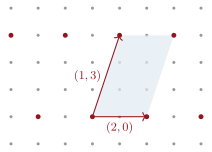
Cross-check by determinantal divisors: ; every minor of is a multiple of (e.g. ) and one equals : ; . Hence , , : same answer. Two lessons: a zero invariant factor records the rank drop (the cokernel picks up a free summand), and the divisibility chain is the Smith certificate — a diagonal reduction that violates the chain (say , which the careless can produce from by stopping too early: correct Smith form , as here!) is not finished.
3.3 The structure theorem
Definition 3.11
Let be a domain and an -module. The torsion submodule is
(a submodule: if then , ). is torsion-free if , a torsion module if .
Theorem 3.12 (Structure of finitely generated modules over a PID)
Let be a PID and a finitely generated -module. There exist a unique and nonzero nonunits , unique up to associates, with
Moreover and : a finitely generated torsion-free module over a PID is free.
Proof. Existence. Present (Remark 3.6) and put in Smith form: after the two base changes, . Discard the factors where is a unit (); the divisibility chain survives.
The torsion identification. In the decomposition, is torsion-free (a domain has no zero divisors) and each is torsion (killed by ); a direct sum splits torsion accordingly: and .
Uniqueness of : depends only on , and Proposition 3.4 pins down.
Uniqueness of the : it suffices to treat the torsion module . Decompose each into primes and split by the Chinese remainder theorem (Theorem 2.9; distinct primes generate comaximal ideals):
the elementary divisors . Conversely the are reconstructed from the multiset of elementary divisors ( = product of the highest power of each prime, etc.), so it suffices to prove the multiset is determined by , for each prime . Fix ; for consider the -vector spaces . On a cyclic factor :
and on a factor , : multiplication by is bijective there ( invertible mod : Bézout), so the quotient is . Direct sums pass through: . These intrinsic dimensions determine the multiset of exponents. ∎
Corollary 3.13 (Finitely generated abelian groups)
Every finitely generated abelian group is with , uniquely. Every finite abelian group is a product of cyclic groups of prime-power order, unique as a multiset.
Example 3.14
The abelian groups of order correspond to partitions of : for : , , , , — five groups, as has five partitions. Mixed orders multiply the counts prime by prime (CRT): there are abelian groups of order .
3.4 Application: canonical forms of endomorphisms
Let be a field, a -vector space of finite dimension , and ; make a -module via (Example 3.2). This module is finitely generated (a -basis generates) and torsion: for each , the vectors are -dependent, providing a nonzero annihilating polynomial.
Definition 3.15
For monic, the companion matrix is
the matrix of “multiplication by ” on in the basis .
Theorem 3.16 (Frobenius: rational canonical form)
There is a unique sequence of monic nonconstant polynomials (the similarity invariants of ) such that, as -modules,
in a suitable basis, has block-diagonal matrix . Moreover:
- (minimal polynomial) and (characteristic polynomial); in particular (Cayley–Hamilton re-proved) and , so and have the same irreducible factors.
- Two endomorphisms (or square matrices) are similar iff they have the same similarity invariants.
Proof. The structure theorem (Theorem 3.12) applied to the PID : the torsion module decomposes with invariant factors , normalized monic (units of are ); no free part occurs ( is torsion). On each cyclic factor , multiplication by has matrix in the basis of powers of : concatenating bases gives the block form.
(1) The annihilator of is (divisibility chain: is a common multiple, and the class of in the last factor is killed exactly by ): . For : on a cyclic factor, , by induction on . Expanding along the first row (whose entries are , then zeros, then in the last column):
where (same shape, one size down) and is triangular with diagonal , so . By induction the first term is , and the second is : the total is (base case : ). Determinants multiply over blocks: . Cayley–Hamilton: since each… conversely each , so divides ; and divides as one of its factors.
(2) Similar endomorphisms are conjugate module structures, hence have equal invariants (uniqueness in Theorem 3.12); conversely equal invariants give isomorphic -modules, and a module isomorphism is exactly a linear bijection intertwining the two endomorphisms: a similarity. ∎
Corollary 3.17 (Similarity is insensitive to field extension)
Let be fields and . If and are similar over , they are similar over .
Proof. The similarity invariants of are computed by Smith’s minor formula (Theorem 3.8) applied to the presentation matrix over — indeed the -module has presentation : the map , , is onto with kernel generated by the columns of (a direct verification: modulo those columns, every element of reduces to a constant vector, and constant vectors map bijectively; the weekend problem spells this out). Gcds of polynomials do not change under field extension: if is the monic gcd in of a family , Bézout gives with , so every common divisor of the in divides ; as is itself a common divisor, it is the gcd in too. Hence the invariant factors of , quotients of successive minor gcds, are the same over and over : have the same similarity invariants over iff over ; conclude by Theorem 3.16(2). ∎
Theorem 3.18 (Jordan form, re-derived)
Suppose splits over (e.g. ). Applying to the elementary-divisor decomposition (proof of Theorem 3.12) instead of invariant factors:
and in the basis of each factor, acts as the Jordan block : every endomorphism with split characteristic polynomial has a Jordan basis, and the multiset of blocks is unique.
Proof. The elementary divisors of the torsion module are the with ranging over the irreducible factors of (which splits, since does and both have the same irreducible factors, Theorem 3.16). In , put for : then (with ), i.e. : the matrix of on is exactly (ones above the diagonal). Uniqueness of the multiset of elementary divisors is Theorem 3.12. ∎
Remark 3.19
The hierarchy of canonical forms is now transparent: the rational form exists over every field and detects similarity absolutely (Corollary 3.17); the Jordan form is its refinement when splits. Year 2’s dimension-counting proofs of Jordan’s theorem are subsumed: all the combinatorics was the arithmetic of the PID .
3.5 Exercises
Exercise 3.1 ★
(a) Show that is not finitely generated as a -module. (b) Show that is torsion-free but not free. (c) Why does neither statement contradict Theorem 3.12?
Solution
Solution of Exercise 3.1.
(a) If , let be a common denominator of the : every combination lies in , but . Contradiction.
(b) Torsion-free: with forces in . Not free: any two nonzero rationals satisfy the nontrivial relation , so a basis has at most one element; would make cyclic, but . (And .)
(c) Theorem 3.12 assumes finite generation, which (a) denies: no contradiction — rather, shows the hypothesis is necessary in the statement “torsion-free free”.
Exercise 3.2 ★
List the abelian groups of order up to isomorphism, in both elementary-divisor and invariant-factor forms. How many abelian groups of order are there?
Solution
Solution of Exercise 3.2.
. Partitions: of : ; of : ; of : . Hence groups. Elementary divisors invariant factors:
(To pass to invariant factors: the largest collects the highest prime power of each prime, and so on down.) Of order : as many as partitions of , namely .
Exercise 3.3 ★
Compute the Smith normal form over of
and identify the abelian groups and .
Solution
Solution of Exercise 3.3.
: ; . Invariant factors , : Smith form , and .
: diagonal but not Smith (). ; ; . So and — consistently with the CRT: .
Exercise 3.4 ★★
Let be a subgroup of rank with basis the columns of , . Show that is finite of cardinality , and that for the invariant factors of . Illustrate with .
Solution
Solution of Exercise 3.4.
Write with (Theorem 3.8; no zero since ). Then (the composed isomorphism of maps onto ). Its cardinality is , as . For : , , : , of cardinality .
Exercise 3.5 ★★
Let be a domain. (a) Verify that is a submodule and that is torsion-free. (b) Show that the ideal of , as a -module, is torsion-free but not free: the structure theorem genuinely needs the PID hypothesis.
Solution
Solution of Exercise 3.5.
(a) Submodule: done in Definition 3.11. If in with , then : for some , and (domain), so : the class is zero. is torsion-free.
(b) is torsion-free (a submodule of the domain acting on itself). Suppose it were free; any two elements satisfy , a nontrivial relation when are nonzero, so a basis has one element: principal — contradicting Exercise 2.6(a). Torsion-free and finitely generated ( generate), yet not free: over the non-PID , the structure theorem fails.
Exercise 3.6 ★★
(a) Show that has no direct complement in the -module : submodules of free modules are free (Theorem 3.5), but direct summands they need not be. (b) Show that if ( a PID) satisfies: is torsion-free, then is a direct summand.
Solution
Solution of Exercise 3.6.
(a) If , the projection restricts to an isomorphism : would be a subgroup of whose nonzero element satisfies . But is torsion-free: , forcing — false.
(b) is finitely generated and torsion-free, hence free (Theorem 3.12): with basis . Choose preimages of the and set . Every has , so : . If , applying gives , hence all (basis): . So .
Exercise 3.7 ★★
Solve in the system
for which pairs solutions exist, using the Smith form of Exercise 3.3 (invertible changes of variables on both sides).
Solution
Solution of Exercise 3.7.
The reduction of Exercise 3.3 was effective: with
(row operation , column operations then ). Setting (a bijection of , being invertible over ), the system is equivalent to
The congruence is solvable iff : solutions exist iff and , i.e. even and . When solvable there are solutions modulo .
Exercise 3.8 ★★
(a) Determine all similarity invariants and possible Jordan forms of a nilpotent matrix, sorted by the partition of they realize. (b) Exhibit two complex matrices with the same characteristic and minimal polynomials that are not similar, and prove that for this cannot happen.
Solution
Solution of Exercise 3.8.
(a) A nilpotent has ; the elementary divisors are , one Jordan block per part of a partition of :
| partition | Jordan form | invariant factors |
(b) Take and : both have , , but different invariant factors — not similar (Theorem 3.16); one can also compare ranks: . For : and determine, for each eigenvalue (over a splitting field), the total size of the -blocks and the largest block ; a partition of is determined by its largest part ( forces , etc.). So the elementary divisors coincide, and Corollary 3.17 descends the similarity to the base field.
Exercise 3.9 ★★★
Let , . Show that the following are equivalent: (i) is a cyclic -module (there is with , a cyclic vector); (ii) ; (iii) in Theorem 3.16. Deduce that a companion matrix has a cyclic vector, and determine when a diagonal matrix has one.
Solution
Solution of Exercise 3.9.
(i)(ii): if , then , and (a polynomial kills iff it kills all of , since ). So ; as and , monicity gives .
(ii)(iii): and (Theorem 3.16); equality of degrees forces .
(iii)(i): is cyclic, generated by the preimage of .
A companion matrix is the case itself: , i.e. , is cyclic. For a diagonal matrix : , ; they agree iff the are pairwise distinct: a diagonal matrix has a cyclic vector iff its diagonal entries are pairwise distinct (then works: Vandermonde).
Exercise 3.10 ★★★
For viewed as an endomorphism of , prove the index formula: if , then , and deduce that iff . Application: the group has exactly subgroups of index . (Count matrices in Hermite form , , .)
Solution
Solution of Exercise 3.10.
Smith: ; Exercise 3.4 gives . If : the adjugate formula has integer entries, so ; conversely gives in , so .
Subgroups of index in : such a subgroup has rank (finite index) and a unique basis in Hermite normal form : is characterized by , by (first coordinates), and is then unique modulo ; normalize and . The index is . Counting: for each divisor (), there are choices of : total .
Exercise 3.11 ★★
(Equations in abelian groups) Let be a finite abelian group with invariant factors . (a) Show that for every ,
(b) Deduce: a finite abelian group is cyclic if and only if for every , the equation has at most solutions. (c) Recover the cyclicity of finite subgroups of ( a field, Chapter 4): why does the polynomial guarantee the criterion of (b)?
Solution
Solution of Exercise 3.11.
(a) By the structure theorem, , and decouples coordinatewise. In : has exactly solutions ( must be a multiple of , and there are of those). Multiply over the factors.
(b) If is cyclic (), the count is . If : take ; the count is (each equals by the divisibility chain): the equation has more than solutions.
(c) In a field, has at most roots (Chapter 2: a nonzero polynomial of degree over a domain), so every finite subgroup satisfies the criterion of (b): is cyclic — the one-line structural proof of the cyclicity of , complementing the counting proof of Chapter 4.
Exercise 3.12 ★★★
(Elementary matrices generate) (a) Show that is invertible in iff . (b) Show that is generated by the two elementary matrices and . (Run the Euclidean algorithm on the first column of by left multiplications by powers of , reaching ; finish by hand — note .) (c) Explain the connection with Smith reduction: over , row and column operations of determinant suffice to diagonalize, up to signs.
Solution
Solution of Exercise 3.12.
(a) If with integer : with both integers, so . Conversely if , the cofactor formula has integer entries.
(b) Left multiplication by subtracts times row from row ; by , times row from row . Given , the first column is a unimodular vector (: it divides ). Run Euclid on by these row operations: after finitely many steps the column becomes . The matrix is now (the determinant stayed ). It remains to write in the generators: (check the square of the rotation matrix). Unwinding, is a word in .
(c) The Smith algorithm (Method 3.9) uses exactly such row and column operations (plus swaps and sign changes, themselves products of elementary operations up to determinant sign): over , every matrix is with products of elementary matrices and the Smith form — (b) is the , determinant- instance of the general fact that -type matrices generate .
3.6 Problem: the commutant and the double commutant
Problem 3.1
Weekend problem — rational form, commutant, bicommutant
Let be a field, a -vector space of dimension , and . We study the commutant
a subalgebra of containing , and we prove Frobenius’ dimension formula and the double commutant theorem: . Throughout, is the -module defined by , with invariant factors and cyclic decomposition , , (Theorem 3.16).
Part I — The presentation matrix , and warm-ups.
- Let and let send to . Show that is a surjective morphism of -modules and that every column of lies in .
- Show that, modulo the columns of , every element of is congruent to a constant vector (reduce degrees using ), and deduce : the module has presentation matrix . Recover Corollary 3.17’s starting point: the similarity invariants of are the nonunit invariant factors of .
- Compute the similarity invariants of: a scalar matrix ; a diagonal matrix with distinct diagonal entries; the Jordan block ; for .
- Show that .
Part II — Morphisms between cyclic modules.
- Let be monic nonconstant. Show that a -morphism is determined by , and that can serve as iff in .
Deduce
of dimension over . (Show that the solutions of in form the cyclic submodule generated by .)
Prove Frobenius’ formula:
(A commuting is exactly a -endomorphism of ; decompose as matrices of morphisms and use the divisibility chain.)
- Deduce , with equality iff is cyclic (), and compute for : both extremes of the formula.
- Verify Frobenius’ formula directly for by computing the commutant explicitly as matrices.
Part III — The double commutant theorem. Let ; we prove .
- Show , and that every commutes with — so the inclusion to be proved, , is a genuine sharpening of .
- Suppose first that is cyclic, . Show directly that (evaluate a commuting on : for some , and compare with on the basis ), and conclude the theorem in this case.
- Back to the general case. For each , let be the projection along the other summands. Show , and deduce that preserves each and commutes with ; conclude via question 11 applied to the cyclic : there are polynomials with .
- It remains to glue the into one polynomial. For (so ), show that , , is a well-defined -morphism (what must be checked is that implies ), and that , extended by on the other summands, lies in .
Using , show for . Deduce that satisfies for all , hence on every , hence on :
- (Coda) Deduce from the theorem: if commutes with every matrix commuting with , and is cyclic, then is a polynomial in ; and give an example showing fails for , — where exactly does cyclicity enter?
Part IV — Dividends of the similarity invariants. The rational canonical form is a machine; here are five of its classical outputs.
- (Transpose) Show that every is similar to its transpose . (The operations that bring to Smith form, transposed, bring to the same Smith form: equal similarity invariants.)
- (Descent of similarity) Let be a field extension and . Show that if and are similar over , they are similar over . (The Smith form of computed in is still a Smith form in — why do the invariant factors not change?) Consequence worth memorizing: two real matrices conjugate in are conjugate in .
- (Nilpotent classification) Let be nilpotent. Show that the number of blocks of size in its decomposition into nilpotent Jordan blocks equals , and deduce: nilpotent classes of , for any field , are in bijection with the partitions of . How many nilpotent classes in ?
- (A concrete pair) Determine the similarity invariants of the derivation acting on the space of polynomials of degree : (a) for ; (b) for with (in characteristic , : compute and use question 18).
- (Conjugacy classes of ) Using invariant factors, show that every class of is of exactly one of four types: central ; diagonalizable with two distinct eigenvalues in ; non-semisimple with minimal polynomial ; cyclic with irreducible characteristic polynomial.
- Count the classes of each type and conclude: has exactly conjugacy classes. (Count monic irreducible quadratics over ; unordered pairs ; remember invertibility constrains constant terms.)
- (Cyclic is generic) Show that fails to be cyclic iff is scalar, and deduce that a uniformly random matrix over is cyclic with probability . State the analogous heuristic for and large (no proof required): non-cyclic matrices are rare — which is why Problem 3.1’s Part III needed real work only past the generic case.
Part V — Complements.
- (Center of the commutant) Show that the center of the algebra is exactly (combine the two inclusions of Part III). Deduce that is commutative iff is cyclic — recovering the equality case of question 8 by a purely structural route.
- (Which dimensions occur?) Deduce from Frobenius’ formula that for every . Then determine the exact set of values taken by as ranges over with : show it is (enumerate the degree sequences summing to and realize each by a nilpotent). In particular and , though of the right parity, are not attained: the parity constraint is necessary but not sufficient.
(Class equation of ) For , compute the size of each conjugacy class of question 20 via orbit–stabilizer: the centralizer of a cyclic in is the unit group of (question 11). Identify in the three noncentral types, list the three monic irreducible quadratics over , and verify the class equation
with classes, as predicted by question 21.
Solution
Solution of Problem 3.1.
1. is additive, and -linear: , the module structure of being . It is surjective: constant vectors give all of . Column of is , whose image is .
2. Modulo the columns, : any vector of polynomials reduces, by induction on the top degree, to a constant vector . If the original vector is in , then (on constants, is the identification ), so the vector lies in the column span: . Hence , and Smith over (all invariant factors nonzero, their product being ) gives : the nonconstant are the similarity invariants, computable as quotients of minor gcds (Theorem 3.8).
3. : is already Smith: invariants , of them. Distinct diagonal entries: with pairwise comaximal moduli, so CRT compresses to the single cyclic : one invariant, . : forces a single invariant . : elementary divisors : invariants .
4. maps onto , with kernel by definition of the minimal polynomial: , of dimension .
5. -linearity forces . The class satisfies , so is necessary. Conversely if , then is well defined ( multiples of ) and -linear.
6. Let , , with . In : (Euclid, ). So the admissible form the submodule generated by , whose annihilator is : that submodule is . With question 5, , of dimension .
7. commutes with iff commutes with every , iff is -linear: . Writing morphisms of as matrices , (compose with injections and projections), question 6 gives
using the divisibility chain () and, for the last step, that happens for exactly pairs .
8. Since , , with equality iff , i.e. iff is cyclic (Exercise 3.9). For : , all : — correct, since .
9. Formula: invariants , so , , : . Directly: in the basis with , , writing for yields the conditions and : five free parameters .
10. A polynomial commutes with anything that commutes with (it is a sum of powers of ): . And , so any commutes with .
11. Let and . Write (cyclicity). For arbitrary: . So : . Then (commuting with all of is the same as commuting with ). The theorem holds in the cyclic case.
12. is -linear (the decomposition is a direct sum of submodules), so , and commutes with it: . The restriction commutes with the cyclic (question 10), and (question 11): for some .
13. Well-definedness of : if then , and gives , so (). is then -linear by construction, and is a composition of -morphisms : .
14. Evaluate at : the left side is ; the right side is . Hence : for all . In particular, with : , so and agree on (which kills). Therefore on each , hence on : , and with question 10, .
15. The first assertion is questions 10–14 (or, for cyclic , question 11 alone). For , : has dimension , while . So fails badly; yet the bicommutant theorem holds (: the center of the matrix algebra is the scalars). Cyclicity is what makes the single commutant already polynomial; the double commutant is polynomial always.
16. If is a Smith reduction ( invertible over ), transposing gives : same Smith form, so and have the same invariant factors, i.e. and have the same similarity invariants (Corollary 3.17): they are similar.
17. The similarity invariants of over are the invariant factors of in . A Smith reduction of over — invertible over , diagonal with the divisibility chain — is also a valid Smith reduction over ( stay invertible: their determinants are nonzero constants), and monic invariant factors are unique: the invariant factors computed over and over coincide. So iff they have the same invariant factors iff . In particular -conjugate real matrices are -conjugate — a statement often proved analytically (specialize an invertible ), here structurally.
18. Decompose into nilpotent Jordan blocks. In one block of size , , so if , otherwise. Summing over blocks: . The rank sequence therefore determines the multiset — a partition of — and conversely each partition is realized: nilpotent classes partitions of , over every field. : classes (; ; ; ; ; ; ).
19. (a) Over (or any characteristic- field), , : is nilpotent of index on an -dimensional space, hence cyclic with single invariant ( generates: its iterated derivatives span). (b) Over with : , because the -th derivative of every monomial carries the factor , a product of consecutive integers, hence . Write , . Then is spanned by the monomials with ; counting exponents by their residue mod : for , so . By question 18, the partition has blocks of size exactly and (if ) one block of size : similarity invariants . Characteristic changes the canonical form of the most familiar operator in mathematics.
20. has invariant factors. If : (: invertibility), i.e. , central. If : is cyclic with characteristic minimal polynomial of degree , and the classes correspond to the possible with : split with distinct roots (companion diagonal); (companion, non-semisimple); irreducible. Exactly one type each — the invariant factors are a complete invariant.
21. Central: choices of . Distinct split eigenvalues: unordered pairs , : classes. Minimal : classes. Irreducible quadratics with nonzero constant term: all irreducible quadratics qualify (their roots are nonzero), and there are monic irreducible quadratics (the monic quadratics minus the split ones). Total:
22. If is not cyclic, and is scalar (question 20’s dichotomy holds in , invertible or not: two invariant factors of degree with and forces ). Scalars number among the matrices: cyclic probability . In general the non-cyclic locus of is where the minors of share a factor — a proper algebraic condition — so its proportion is -small for large : matrices with are the rule, and Part III’s gluing argument is the price paid for the exceptions.
23. An element of the center of lies in and commutes with every element of , i.e. lies in (question 14). Conversely , and every commutes with every (such a commutes with , hence with each power of ): is central in . Hence . Consequently is commutative iff ; in that case , while question 8 gives : so and , i.e. is cyclic. Conversely, for cyclic question 11 gives , commutative. Structurally: a matrix algebra equal to its own center is exactly a polynomial algebra of a cyclic .
24. Each coefficient in Frobenius’ formula is odd, so
For , the possible degree sequences of the invariant factors, summing to , are , , , , ; every one is realized, e.g. by the nilpotent with (the divisibility chain holds automatically). The formula gives, respectively,
So the value set is : even numbers of the right parity, but and never occur — between the almost-cyclic sequences and the scalar’s there is a gap.
25. . Central type: and , two classes of size . In the three other types is cyclic (question 20), so its centralizer in is the group of invertible elements of (question 11), and class size by orbit–stabilizer. Distinct split eigenvalues: only the pair , one class; (CRT on ), units , size . Minimal , : two classes; , units (constant term of the unit after centering), size . Irreducible : the monic irreducible quadratics over number , namely
(no roots in : check ); three classes, , units , size . Class equation: ; and classes, matching question 21.