University Mathematics — Year 3 · स्नातक वर्ष 3
16Holomorphic Functions
Complex differentiability looks like a small variation on the real theory — one limit, one quotient. It is instead a different universe. A function differentiable once on an open subset of is automatically infinitely differentiable, analytic, determined on a whole domain by its values near a single point, and constrained by rigid global principles (Liouville, maximum modulus). All of this flows from one miracle, Cauchy’s theorem: the integral of a holomorphic function along a closed path in a star-shaped domain vanishes. This chapter proves the miracle (Goursat’s argument, with no regularity assumed beyond differentiability), harvests its classical consequences, and settles a theorem this book has used on credit since Chapter 4: every nonconstant complex polynomial has a root.
Throughout, is open, and denotes the open disc.
16.1 Complex differentiability
Definition 16.1
is holomorphic on if for every
exists (). Sums, products, quotients (nonvanishing denominators), compositions of holomorphic functions are holomorphic, with the usual formulas (the Year 1–2 proofs are verbatim: they only use field operations and limits). denotes the set of holomorphic functions on .
Proposition 16.2 (Cauchy–Riemann)
Write . Then is holomorphic at iff is -differentiable at (as a map of two real variables) and
equivalently, the real differential is multiplication by the complex number .
Proof. -differentiability says with : an -linear differential which is multiplication by , i.e. has matrix in the basis — exactly the displayed relations for the partials. Conversely such a differential is -linear, and the definitions match. ∎
Example 16.3
Polynomials in , rational functions off their poles, and — by Year 2’s term-by-term differentiation theorem for power series, whose proof works identically over — every sum of a power series inside its disc of convergence: holomorphic, with derivative (same radius). In particular is entire (holomorphic on ) with . On the other hand , , are nowhere holomorphic (Cauchy–Riemann fails everywhere): holomorphy is orientation-and-angle-preserving rigidity, not smoothness.
16.2 Contour integrals
Definition 16.4
A path is a piecewise map ; it is closed if . For continuous on the image of :
(the ML inequality; length ). The integral is invariant under increasing reparametrization and changes sign under orientation reversal.
Proposition 16.5 (Primitives)
For continuous on , the following are equivalent: (i) has a primitive (); (ii) for every closed path in . In that case for every path.
Proof. (i): (chain rule, valid piecewise), so the integral telescopes to the endpoint difference; closed paths give . (ii)(i): fix in a connected component, define along any path from to (well defined: two paths differ by a closed path); for small, taking the segment from to ,
by the ML inequality and continuity of at . ∎
Definition 16.6 (Winding number)
For a closed path and , the index is
It is an integer: setting , the function has zero derivative (piecewise), hence is constant; at , , so . As a function of , the index is continuous on (dominated convergence), hence constant on each connected component, and on the unbounded component (ML: the integral tends to as ). For the circle , : for (compute at : ; constancy does the rest).
16.3 Cauchy’s theorem
Theorem 16.7 (Goursat)
Let and a closed solid triangle. Then (boundary run once, any orientation).
Proof. Let . Joining the midpoints of the sides splits into four half-size triangles , and the inner edges cancel in pairs: . Choose among them with , and iterate: a nested sequence with
The intersection is a single point (nested compacts with vanishing diameters, Theorem 6.13(3)). Differentiability at : given , for large, on ,
The affine part has a primitive: its integral on the closed vanishes (Proposition 16.5), leaving
Comparing with : for every : . ∎
Theorem 16.8 (Cauchy’s theorem, star-shaped version)
Let be star-shaped about (every segment , , lies in ) — e.g. convex. Every has a primitive on ; consequently for every closed path in .
Proof. Define . For with (true for small ), the triangle with vertices lies in (star-shapedness: each of its points lies on a segment with ): Goursat gives
and the difference-quotient computation of Proposition 16.5 yields . The vanishing of closed-path integrals follows from the same proposition. ∎
Theorem 16.9 (Cauchy’s integral formula)
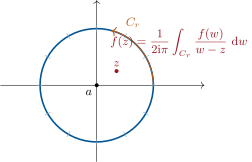
Let , , and the circle run once counterclockwise. Then for every :
Proof. Fix and define on
is continuous on and holomorphic off . Goursat holds for on every triangle , where is a disc slightly larger than inside : if , directly; if , split into small triangles having as a vertex plus triangles avoiding ; on a triangle with vertex the ML bound gives as the triangle shrinks, and the remaining pieces vanish by Goursat — hence in all cases. The proof of Theorem 16.8 used only this triangle property: has a primitive on the convex , so , i.e.
∎
16.4 Analyticity and its cascade
Theorem 16.10 (Holomorphic analytic)
Let and . Then
the coefficients being independent of . Consequently is infinitely -differentiable, , and the Cauchy estimates hold:
Proof. For : expand the Cauchy kernel in the geometric series
normally convergent in on (): integrate term by term against (uniform convergence justifies the interchange) and apply Theorem 16.9. A power series is infinitely differentiable with (Year 2), which also shows the do not depend on . The estimates: bound the coefficient integral by ML. ∎
Example 16.11 (Singularities dictate radii)
Why does the innocent real function have a Taylor series at converging only for , when nothing goes wrong on the real line? Because the theorem above makes the radius of convergence at equal to the distance from to the nearest point where holomorphy fails. Here is holomorphic exactly on , so the expansion at converges on the largest disc avoiding , of radius — and cannot converge on a larger one, since the sum would extend holomorphically to a neighborhood of , where . The real theory sees the mysterious radius ; the complex plane sees two poles. This is the practical rule: to find a radius of convergence, locate the singularities — e.g. the Taylor series of at has radius (nearest zeros of ), and the Bernoulli generating function (Problem 16.1, Part VI) has radius (nearest nonzero zeros of : ).
Corollary 16.12 (Liouville; d’Alembert–Gauss)
A bounded entire function is constant. Consequently every nonconstant polynomial over has a root: is algebraically closed.
Proof. If on : for every and , : , and is constant (on the connected : zero derivative implies locally constant — integrate along segments). If had no root, would be entire and bounded ( as : the leading term dominates, so is small outside a large disc and continuous on the compact disc): constant — absurd for nonconstant . (The weekend problem gives a second, elementary proof and the algebraic consequences.) ∎
Theorem 16.13 (Zeros are isolated; identity theorem)
Let be connected and , . Then every zero of has finite order: with , , and the zeros of have no accumulation point in . Consequently, if two holomorphic functions on agree on a set with an accumulation point in , they agree everywhere.
Proof. Let be the set of points where all derivatives of vanish. is closed (intersection of closed sets) and open: if all at , the power series expansion makes on a disc around . Connectedness: or ; the latter is excluded by . So at a zero , some coefficient is nonzero: let be minimal with ; then on a disc, and the sum defines holomorphic near with ; extend off (holomorphic there). Since and is continuous, has no other zero in a neighborhood of : zeros are isolated, and a set of isolated points has no accumulation point in (an accumulation point of zeros is a zero — continuity — and would not be isolated). Identity: apply to the difference, whose zero set has an accumulation point, forcing it into the branch. ∎
Theorem 16.14 (Mean value and maximum modulus)
Let .
- (Mean value) For : .
- (Maximum principle) If is connected and attains a local maximum at some point of , then is constant. Consequently, for bounded and continuous on : .
Proof. (1) is Cauchy’s formula at the center: parametrize . (2) Say on . If , near . Otherwise, for , the mean value gives
the continuous nonnegative integrand has zero mean, hence vanishes: is constant on the disc. A holomorphic function of constant nonzero modulus on a disc is constant: differentiating gives and ; substituting the Cauchy–Riemann relations , into the second equation yields the linear system
whose determinant is : , so on the disc: constant there. The identity theorem spreads constancy to all of . The boundary form: attains its sup on the compact ; an interior maximum makes constant, and the sup is attained on the boundary in every case. ∎
Theorem 16.15 (Weierstrass convergence theorem)
If converge to uniformly on every compact subset of , then and uniformly on compacts, for every .
Proof. is continuous. For any closed triangle : (uniform convergence on the compact ; Goursat for ). By the argument of Theorem 16.8, has local primitives (discs are convex; only the triangle property was used), i.e. locally with holomorphic; is analytic (Theorem 16.10), hence so is : holomorphic. (This is Morera’s theorem: continuous with vanishing triangle integrals implies holomorphic.) Derivatives: for and , Cauchy’s formula for derivatives (differentiate Theorem 16.9 under the integral, or use the coefficient formula) gives
uniformly on ; cover a compact by finitely many such discs, and iterate for higher . ∎
Method 16.16
The daily toolkit. To prove a function holomorphic: exhibit it as a power series, a composition, a locally uniform limit (Theorem 16.15), or an integral with holomorphic parameter (Exercise 16.7 — differentiate under or apply Morera–Fubini). To prove identities: prove them on a segment or subdomain and invoke the identity theorem. To bound: Cauchy estimates on the largest circle available. To prove constancy/nonexistence: Liouville or the maximum principle. Always know where your function is holomorphic and which discs fit in .
16.5 Exercises
Exercise 16.1 ★
(a) At which points are , , complex-differentiable? Holomorphic on an open set? (b) Show that is the real part of a holomorphic function on , found explicitly, and determine all of them.
Solution
Solution of Exercise 16.1.
(a) : , , so : nowhere -differentiable. : , : Cauchy–Riemann demands : differentiable at only — and holomorphic nowhere (no open set). : : nowhere.
(b) : works. All solutions: if with holomorphic on the connected , then has ; Cauchy–Riemann gives : is an imaginary constant. Answer: , .
Exercise 16.2 ★
Compute from the definitions: for all , the unit circle; along the segment and along the two-segment path through : conclude that has no primitive on any neighborhood of these paths.
Solution
Solution of Exercise 16.2.
On the unit circle :
For : along , : . Along : . Different values between the same endpoints: by Proposition 16.5, has no primitive on any open set containing both paths.
Exercise 16.3 ★★
(a) Show that the principal logarithm () is holomorphic on with derivative (primitive of on the star-shaped cut plane: Theorem 16.8; fix the constant). (b) Show that no continuous logarithm exists on (its derivative-free obstruction: the index of the unit circle). (c) Expand in power series on .
Solution
Solution of Exercise 16.3.
(a) The cut plane is star-shaped about , and : Theorem 16.8 provides a primitive with . Then : with (at ). Writing : and with continuous, , ( is a continuous argument of on the connected , so its image avoids the odd multiples of — no point of lies on — and, containing , stays in : is the principal argument): .
(b) If were a continuous logarithm on : satisfies , so , and by continuity for a fixed integer . Then and : contradiction.
(c) On : — both sides vanish at and have derivative (Example 16.3); a primitive is unique up to a constant on the connected disc.
Exercise 16.4 ★★
(a) Let be entire with . Show that is a polynomial of degree (Cauchy estimates on large circles). (b) Let be entire with bounded above. Show that is constant (consider ). (c) Deduce “little Picard for affine maps”: an entire function omitting a half-plane is constant.
Solution
Solution of Exercise 16.4.
(a) Expand at (radius ): by the Cauchy estimates on , as for : .
(b) If : is entire with : constant by Liouville. Then with nonvanishing: , and is constant.
(c) If omits the half-plane , an affine map sends into ; apply (b) to .
Exercise 16.5 ★★
(a) Let be holomorphic on a connected with for all large . Determine . (b) Does some holomorphic on satisfy for all ? Justify. (c) Exhibit two distinct holomorphic functions on agreeing on : where does the identity theorem use connectedness?
Solution
Solution of Exercise 16.5.
(a) vanishes at the points , which accumulate at : by the identity theorem ( connected), : .
(b) Yes: is holomorphic on (composition) and . No contradiction with (a): the accumulation point of the interpolation nodes does not belong to , so the identity theorem is silent — two distinct functions ( and, say, the one from another interpolation) may share these values.
(c) everywhere, versus on and on : holomorphic on the disconnected union, equal on , different. The identity theorem’s open-closed argument needs connectedness to propagate from one component to the other — and cannot.
Exercise 16.6 ★★
Let be holomorphic on the open unit disc , continuous on , with on the boundary circle. (a) If has no zero in , show is constant (apply the maximum principle to and to ). (b) Give an example with a zero where is not constant.
Solution
Solution of Exercise 16.6.
(a) By the maximum principle applied on the bounded domain: . Since has no zeros, is holomorphic on , continuous on the closure, with boundary modulus : likewise , i.e. . So : the modulus attains an interior maximum, and Theorem 16.14(2) forces constant.
(b) : boundary modulus , zero at the origin, nonconstant — the zero is exactly what blocks the argument.
Exercise 16.7 ★★
(Holomorphy under the integral) Let be a finite measure on a space and with: for each , measurable in , and with integrable, locally uniformly in . Show is holomorphic on . (Morera: triangle integrals vanish by Fubini and Goursat; continuity by dominated convergence. Then apply to on .)
Solution
Solution of Exercise 16.7.
Continuity of : dominated convergence with dominator (locally uniform bound). Holomorphy by Morera (established inside Theorem 16.15): for a closed triangle in a disc where ,
the interchange by Fubini () and the inner vanishing by Goursat. For : on the strip (), , integrable on : is holomorphic on (the measure is only -finite, but the argument needs only the integrable dominator). By the identity theorem, the functional equation , proved on (Example 10.16), holds on the whole half-plane.
Exercise 16.8 ★★★
(Gauss–Lucas) Let be nonconstant. Show that every root of lies in the convex hull of the roots of . (Write at a root of that is not a root of , take conjugates, and read a convex combination.) Illustrate on .
Solution
Solution of Exercise 16.8.
Write (Problem 16.1). Let . If , then is one of the : in the hull. Otherwise, the logarithmic derivative gives
conjugating, with : , a convex combination of the roots. For : roots the cube roots of unity, with double root — the centroid of the equilateral triangle.
Exercise 16.9 ★★★
Let be entire and doubly periodic: for all . Show that is constant. (Bound on the compact fundamental square, then everywhere; Liouville.) Moral: nonconstant elliptic functions must have poles — the theme of Chapter 17.
Solution
Solution of Exercise 16.9.
The closed unit square is compact: . Every differs from a point of by an element of (subtract integer parts), and is invariant under those translations (iterate the two relations): on . Liouville: is constant. Hence any nonconstant doubly periodic meromorphic function — the elliptic functions of the classical theory — must have poles.
Exercise 16.10 ★★
(a) Show that of a holomorphic satisfies the mean value property and is harmonic: (differentiate Cauchy–Riemann; use Theorem 16.10 for the needed smoothness). (b) Deduce the maximum principle for real parts of holomorphic functions on bounded domains.
Solution
Solution of Exercise 16.10.
(a) Take real parts in the mean value formula (Theorem 16.14(1)). Smoothness: is analytic, so ; differentiating Cauchy–Riemann: (Schwarz symmetry of second derivatives): .
(b) If attained an interior maximum on a connected : has attaining an interior maximum, so , hence , is constant (Theorem 16.14(2)). On a bounded domain with continuity up to the boundary, .
Exercise 16.11 ★★★
(Schwarz reflection) Let , , and holomorphic on , continuous on , real-valued on . Define
(a) Show that is well defined and continuous on , and holomorphic on (for : check Cauchy–Riemann for , or expand in local power series and conjugate coefficients). (b) Show that is holomorphic on all of by Morera’s criterion: for every triangle (split triangles at and push their horizontal sides off the axis by , using uniform continuity). (c) Deduce: a holomorphic function on the disc, real on a diameter, satisfies ; and a nonconstant holomorphic function cannot be real-valued on any nonempty open subset of its (connected) domain.
Solution
Solution of Exercise 16.11.
(a) The two formulas agree on ( and real there: ), and is continuous on as a composition of continuous maps: is continuous on . Holomorphy on : near , expand near ; then
a convergent power series: holomorphic.
(b) Triangles avoiding are handled by Goursat in . For a triangle meeting , cut it by the real axis into at most three triangles/quadrilaterals, each with one side on ; for such a piece contained in, say, , the contour integral is the limit as of the integral over -type translates (uniform continuity of on the compact piece makes the boundary integrals converge, the side on being approached from above), and each translate lies in where Goursat gives . Summing the pieces: . Morera (the criterion inside Theorem 16.15): is holomorphic on .
(c) On the disc, is holomorphic by (a)’s computation and agrees with on the diameter, a set with accumulation points: everywhere (identity theorem). If were real on a nonempty open set : on both partials of vanish, and Cauchy–Riemann transfers this to (, ), so on : is constant on , hence everywhere by the identity theorem ( connected).
Exercise 16.12 ★★
(The complex Pythagorean equation) Find all pairs of entire functions with . (a) Show that is entire and zero-free, and that every zero-free entire function is for some entire ( is entire, hence has a primitive on the star-shaped ; adjust the constant and show is constant). (b) Conclude , with entire, and check the converse. What are the entire solutions of ?
Solution
Solution of Exercise 16.12.
(a) , so never vanishes (its cofactor would have to blow up). For zero-free entire : is entire, and is star-shaped, so it has a primitive (Theorem 16.8); then : with , and absorbing a constant into (any complex logarithm of ): .
(b) With and :
Writing with entire, these read , : the entire solutions are exactly the pairs with entire, and the converse is the identity . For : in the integral domain ( connected: zero divisors would violate the identity theorem): with arbitrary entire.
16.6 Problem: the fundamental theorem of algebra, twice
Problem 16.1
Weekend problem — is algebraically closed: d’Alembert’s proof, Liouville’s proof, and the harvest
Let , . We prove twice that has a root, then collect what algebra has been waiting for since Chapter 4.
Part I — Coercivity and the minimum.
- Show that as : precisely, for suitable.
- Deduce that attains a global minimum on : there is with (compactness of a large closed disc, Corollary 6.17).
Part II — d’Alembert’s descent. Suppose, for contradiction, .
- Expand as a polynomial in : with , , a polynomial.
Choose the direction of descent: for small , set where (why does such exist? — prove the existence of -th roots of any complex number via polar form, independently of the theorem being proved). Show
for small, with an explicit constant .
- Conclude for small — contradicting the minimality of . Hence : every nonconstant complex polynomial has a root (d’Alembert–Argand).
Part III — Liouville’s one-liner, in full.
- Write out carefully the proof of Corollary 16.12: if has no root, verify that is entire, bounded (quantify, using question 1), hence constant, and conclude. Compare the two proofs: which ingredients does each use? (Compactness appears in both — where?)
Part IV — The harvest.
- Show that every of degree splits: with (induction, Euclidean division by ).
- Show that the irreducible polynomials of are the linear ones and the quadratics with negative discriminant (pair conjugate roots); deduce that every real polynomial of odd degree has a real root, and give a second, order-theoretic proof of that last fact (intermediate value theorem) — checking they agree on .
- Deduce the debts this book can now repay: (i) every endomorphism of a nonzero finite-dimensional -vector space has an eigenvalue, so every complex matrix has a Jordan form (Theorem 3.18); (ii) the field of algebraic numbers used in Remark 4.10 is indeed an algebraic closure of .
- (Finale) Pinpoint where each proof would break over a field like : which steps use the existence of -th roots (question 4), and which use compactness or completeness (questions 2 and 6)? Conclude in five lines: the theorem is genuinely analytic — every proof somewhere invokes the completeness or connectedness of — even though its statement is purely algebraic.
Part V — The rigidity ladder of entire functions. Liouville is the first rung of a ladder; we climb it.
(Cauchy estimates) From the Cauchy formula on the circle of radius around , prove
and recover Liouville as the case , .
- (Polynomial growth) Show that an entire with for all is a polynomial of degree (kill the Taylor coefficients beyond with question 11).
- (Bounded real part) Show that an entire with bounded above is constant (apply Liouville to ).
- (Double periodicity) Let be entire with and for all . Show is constant. Conclude: a nonconstant “elliptic” function must have singularities — the historical reason poles enter complex analysis.
- (Dense range) Show that the range of a nonconstant entire function is dense in : if misses a disc , then is entire and bounded. (Picard proved the range misses at most one point; density is the level our tools reach.)
- (Proper polynomial) Suppose is entire and as . Show: the zeros of are finite in number (, with multiplicities ); the quotient is entire and zero-free; has polynomial growth, hence (question 12) is a polynomial, necessarily constant (zero-free); conclude that is a polynomial. So among entire functions, polynomials are exactly the proper ones — fails properness along .
Part VI — Harmonic shadows and a mean value of Gauss.
Let be holomorphic on an open set. Verify that satisfies the mean value property
(real part of the Cauchy formula), and deduce the maximum principle for on a bounded domain, with the same connectedness proof as for .
(Gauss’s mean value) For and with , prove
(if : is the real part of a holomorphic logarithm on a neighborhood of the closed disc — why does one exist? — so question 17 applies; if : factor and reuse the first case).
(Mahler measure) For , deduce Jensen’s formula for polynomials:
the geometric mean of on the unit circle reads off the roots outside the disc. Verify on and on .
- (Bernoulli numbers) Define the coefficients by near (why is the left side analytic at ?). Derive the recurrence () from , compute , and show for (the function is even). These numbers will price every in Chapter 17.
- (Reality) Show that an entire function taking real values on satisfies everywhere (compare Taylor coefficients at , or apply the identity theorem to ); deduce again that nonreal roots of real polynomials come in conjugate pairs (question 8’s pairing, reproved analytically).
- (The moral) Assemble the rigidity ladder: bounded constant; polynomially bounded polynomial; proper polynomial; missing a disc constant; doubly periodic constant. Contrast in a short paragraph with real functions (bump functions, Theorem 12.9): why does holomorphy, a purely local condition, impose global law and order?
Part VII — Last harvest.
(Landau’s inequality) For , prove the mean value (orthogonality of the ), then, using the pointwise bound to compare the means of and , deduce from question 19 that
the product of the roots outside the unit disc is controlled by the size of the coefficients (handle roots on the circle by applying the inequality to and letting ). Check it on .
(Bernoulli numbers grow factorially) Show that the radius of convergence of is exactly : at least because extends holomorphically to , at most because the sum would otherwise stay bounded near , where . Deduce
Bernoulli numbers grow factorially. Admitting (the recurrence of question 20, run further), compare with the sharper prediction at — four matching digits of an asymptotic law that Chapter 17 will prove exactly, via .
- (Roots move continuously) Let be monic of degree with coefficients converging to those of (monic) . Prove the Cauchy bound: every root of a monic satisfies ; deduce that the roots of the stay in a fixed compact set, and, by extracting convergent subsequences of root vectors and passing to the limit in the factorization of question 7, that the root multisets of converge to that of . Show finally that continuity is the best one can say: for , a perturbation of size moves the double root by — Hölder exponent at an -fold root, never Lipschitz: numerically, multiple roots cost half the digits.
Solution
Solution of Problem 16.1.
1. For :
for , .
2. Choose with . On the compact the continuous attains a minimum, at some ; outside, : the minimum is global.
3. is a polynomial in with ; it is nonconstant ( is), so some coefficient beyond the constant is nonzero: with minimal, , .
4. Roots: any has the -th root , where exists by the intermediate value theorem applied to on — no circularity. Pick with . Then
with (note on ).
5. For : , i.e. — contradicting global minimality. So : d’Alembert–Argand’s proof is complete.
6. Liouville version: if never vanishes, is entire; by question 1, outside , and is continuous on that compact disc, hence bounded there too: bounded entire, so constant (Corollary 16.12), making constant: absurd. Ingredients: d’Alembert uses compactness (existence of the minimum) and the polar-form existence of -th roots; Liouville uses the entire Cauchy apparatus (Goursat — itself a nested-compacts argument — and the Cauchy estimates) plus the same coercivity. Compactness of closed discs is the common, irreducible core.
7. If , pick a root (questions 5); divide: , with ; induct. Grouping equal factors: , .
8. For real : , and multiplicities agree (conjugate the factorization): nonreal roots come in pairs, contributing , a real quadratic with discriminant . Hence the stated list of irreducibles, and a real polynomial of odd degree, having an even number of nonreal roots, must have a real one. Direct proof: as (odd degree, positive leading coefficient say), so changes sign, and the intermediate value theorem applies. For : both arguments give the single real root (and a conjugate pair).
9. (i) is nonconstant: it has a root , and gives an eigenvector; the elementary-divisor machinery of Theorem 3.18 then applies to any complex matrix, always splitting. (ii) Let be nonconstant. As a polynomial over it has a root ; is algebraic over , hence over by transitivity (Corollary 4.5), so : every nonconstant polynomial over has a root in .
10. Over , question 4 already fails: -th roots need not exist (no ), and even granting roots, question 2 fails — a minimizing sequence need not converge, lacking completeness; in Liouville’s route, Goursat’s nested compact triangles have empty intersection over -points. Both proofs consume the completeness (equivalently, via bounded monotone convergence, the order-completeness) of ; connectedness powers the intermediate value theorem behind polar form. The statement “ is algebraically closed” is algebra; every known proof of it is analysis smuggled through the definition of .
11. By Theorem 16.10 at , with
the Cauchy estimates, in the displayed form after multiplying by . If on : for every and every , as , so and is constant on the connected — Liouville recovered.
12. Expand at (radius ). For : as , so : is a polynomial of degree at most .
13. is entire with : constant by question 11. Then with zero-free: and is constant.
14. Let on the compact closed unit square . Every differs from a point of by an element of (subtract integer parts), and iterating the two periodicity relations leaves unchanged: on all of , and question 11 makes constant. So a nonconstant function invariant under the lattice cannot be entire: the elliptic functions of the classical theory must carry poles — the historical gateway to Chapter 17.
15. If misses the disc , then for all , so is entire with : constant by Liouville, hence constant. Contrapositive: the range of a nonconstant entire function meets every disc — it is dense in .
16. Choose with outside . The zeros of lie in the compact ; were they infinite, they would accumulate there, and Theorem 16.13 would force — impossible. Call them , with multiplicities , put and . Factoring each zero out of the power series, is entire and zero-free. For : and , so ; on the remaining compact disc is continuous, hence bounded: everywhere. By question 12, is a polynomial; it is zero-free, so by question 7 it is a nonzero constant : is a polynomial. Conversely, question 1 makes every nonconstant polynomial proper. And is honestly excluded: along , while .
17. Parametrize Theorem 16.9 at the center: with , ,
taking real parts gives the mean value property of . If attains a maximum at an interior point of the connected : attains an interior maximum, so is constant by Theorem 16.14(2), and is constant. On a bounded domain with continuity up to the boundary, , exactly as for .
18. Case . Pick with : on the convex disc the function is holomorphic and zero-free, and has a primitive there (Theorem 16.8); after adjusting the constant, gives : a holomorphic logarithm exists, and . Question 17’s mean value property at , radius :
Case . From , the mean equals plus the mean of . The substitution , then — writing , , the case being trivial — the shift (both preserve means over a period) turn this into the mean of : the first case with , which gives . Total: in both cases.
19. , each root repeated per its multiplicity; averaging in and applying question 18 with to each root off the unit circle yields . Checks. For the formula predicts ; directly, and the mean of is : mean . For the root sits on the circle; the formula predicts . Directly, the mean of is , and with :
The substitution and give (each half equals by the symmetries of ), so (the improper integrals converge, being integrable at the endpoints): the mean is . The formula survives roots on the circle.
20. is entire and equals at : its reciprocal is holomorphic near (on in fact, the nearest other zeros of being ), so is analytic at . Multiplying the two series and reading the coefficient of , , in :
Successively: , , , , , , . Evenness: with ,
is even, so for (the lone odd coefficient was absorbed by ). Forward pointer: gives , so the Laurent coefficients of the cotangent — hence, by Chapter 17, every — are priced by Bernoulli numbers:
21. Write (radius ); then is entire. On : , so and agree on a set with accumulation points in the connected : Theorem 16.13 gives , that is (equivalently: all are real). For a real polynomial : , and the same identity applied to the real derivatives preserves multiplicities: nonreal roots pair up — question 8’s pairing, reproved analytically.
22. The ladder, assembled: bounded constant (11); dominated by polynomial (12); real part bounded above constant (13); doubly periodic constant (14); range missing a disc constant (15); proper polynomial (16). Every rung is the Cauchy formula: the value at a point is a circle average, so all Taylor coefficients are priced by the size of on large circles, and a growth cap annihilates coefficients wholesale. Nothing of the sort constrains real functions: a bump function (Theorem 12.9) is bounded, compactly supported and wildly nonconstant, and its derivatives at any point outside the support all vanish without the function vanishing anywhere near. Smoothness couples the derivatives at distinct points not at all; holomorphy chains every derivative to a single integral over a distant circle. A local condition with a global informer — that is why entire functions obey law and order.
23. Expanding and averaging kills every term : the mean is . Suppose first that has no zero on the unit circle, so is continuous. The bound applied to gives, after averaging,
so the geometric mean of is at most ; question 19 identifies that geometric mean as : Landau’s inequality. Roots on the circle: pick distinct from every ; the polynomial , with roots off the unit circle and coefficients , satisfies the inequality; both sides are continuous in , and letting gives the general case. On : roots and , so the left side is , and the right side is : true, with room.
24. Write with entire, . Since exactly on , has no zero in (for because , at by ), so is holomorphic on and its Taylor series at — by definition — converges on the whole disc: . If , the sum would be holomorphic on , and it agrees with on ; both are holomorphic on the connected open set , so by the identity theorem they agree there. But as , (numerator , denominator ) while is continuous at : contradiction. Hence exactly, and Hadamard’s formula gives ; the odd coefficients being zero from on, the is carried by the even indices, which is the stated formula with . Numerically at : and , so , against . The ratio, , is exactly to the digits shown: the residue-calculus formula of Chapter 17 explains both the factor and the tiny excess.
25. Cauchy bound: if with , then
so : all roots lie in . The coefficients of the converge, hence are bounded by some : all roots of all (and of ) lie in the compact . Let be a vector listing the roots of with multiplicity (question 7). Every subsequence of has a further subsequence converging to some ; the coefficients of are, up to sign, the elementary symmetric functions of — continuous — so along that subsequence they converge to the coefficients of ; but they converge to those of by hypothesis, so : every subsequential limit of is a permutation of the root vector of . If the matching distance did not tend to , a subsequence would keep while its root vectors converge to a permutation of the roots of — forcing along it: contradiction. So the root multisets converge. Sharpness: has roots : the double root moves by , e.g. by for . In general, if is an -fold root, then near one has , so a size- perturbation displaces the cluster of roots by about : Hölder continuity of exponent and no better — which is why a numerical solver near a double root retains only half the working digits.