University Mathematics — Year 3 · Bachelor Year 3
9Measure Theory
How long is a subset of ? The naive answer — assign to every set a translation-invariant length extending that of intervals — is impossible: Vitali’s construction, at the end of this chapter, produces a set with no consistent length. Measure theory is the disciplined retreat: restrict attention to a rich class of measurable sets, on which a countably additive length exists and is unique. The rewards are immense — Lebesgue’s integral (Chapter 10), the spaces of functional analysis, and the whole of modern probability (Chapter 22) are built on the three theorems proved here: Dynkin’s uniqueness lemma, Carathéodory’s extension theorem, and the existence of Lebesgue measure.
9.1 -algebras
Definition 9.1
A -algebra on a set is a family of subsets containing , stable under complement and under countable unions (hence countable intersections, set differences, and it contains ). The pair is a measurable space; members of are measurable sets. For any family of subsets, denotes the smallest -algebra containing (the intersection of all of them — an intersection of -algebras is one).
Definition 9.2
The Borel -algebra of a topological space is . On : is also generated by the open intervals, by the closed intervals, by the rays , and by rays with rational endpoints (Exercise 9.1) — each family generates the opens by countable operations, e.g. every open set of is a countable union of open intervals with rational data.
Definition 9.3
A -system is a family stable under finite intersections. A -system (Dynkin class) is a family with: ; , ; and , .
Theorem 9.4 (Dynkin’s – lemma)
If a -system contains a -system , then .
Proof. Let be the smallest -system containing (intersection of all such); it suffices to show is a -algebra, since then . A -system stable under finite intersections is a -algebra: complements ( with ), finite unions (), and countable unions via . So we prove is a -system, in two steps. Let
is a -system (all three axioms are verified by intersecting with : e.g. , a proper difference within ) and contains (-system): . Now let
By the previous step, ; and is a -system by the same verification: , which says exactly that is stable under intersections. ∎
9.2 Measures
Definition 9.5
A measure on is a map with that is -additive: for pairwise disjoint ,
is a measure space; is finite if , a probability measure if , -finite if is a countable union of sets of finite measure. Examples: counting measure on ; the Dirac mass ; and, the object of this chapter, Lebesgue measure.
Proposition 9.6
Let be a measure. (a) Monotonicity: . (b) Countable subadditivity: . (c) Continuity from below: . (d) Continuity from above: with .
Proof. (a) . (b) Disjointify: are disjoint with the same union, and . (c) (): the partial sums of are . (d) Apply (c) to and subtract from — finiteness makes the subtraction legitimate. Counterexample without it: for Lebesgue measure: but . ∎
Theorem 9.7 (Uniqueness)
Let be measures on , a -system, with on . If there are sets with and , then on all of .
Proof. Fix and consider the finite measures and on : they agree on , since (-system), and they assign the same finite value . The class is a -system: ; proper differences by subtraction (finite values); increasing limits by continuity from below (Proposition 9.6(c)). It contains the -system , so Dynkin (Theorem 9.4) gives : everywhere. Finally, for any , continuity from below along gives . ∎
9.3 Outer measures and Carathéodory’s theorem
Definition 9.8
An outer measure on is a map with , monotone, and countably subadditive. A set is -measurable (Carathéodory) if it splits every set additively:
( always holds by subadditivity; the content is ).
Theorem 9.9 (Carathéodory)
The -measurable sets form a -algebra , and is a measure. Moreover every set with belongs to (the measure is complete).
Proof. contains and is stable under complement (the defining condition is symmetric in , ). Finite unions: let and arbitrary; splitting by , then each piece by :
The first three pieces cover , so subadditivity gives : . By induction, finite unions; with complements, finite disjointness manipulations are available.
Additivity on : for disjoint and any : (split by ); by induction,
Countable unions: let be disjoint (suffices, by disjointification within the algebra ), , arbitrary. Using and monotonicity:
by (). Let and use countable subadditivity backwards:
all inequalities are equalities. This proves both and, taking , countable additivity of on .
Null sets: if , then for any : : . ∎
9.4 Lebesgue measure on
Definition 9.10
The Lebesgue outer measure of is
(countable covers by open intervals).
Lemma 9.11
is an outer measure, invariant under translations, and (the length) for every interval .
Proof. Outer measure: is covered by arbitrarily small intervals; monotonicity is clear; subadditivity: given covers of each within of the infimum, their union covers with total length . Translation invariance: translate the covers.
Length: it suffices to treat (other types differ by endpoints, which have outer measure : cover by tiny intervals; then squeeze -type comparisons). : cover by . Conversely let : by compactness (Borel–Lebesgue, Theorem 6.16), finitely many intervals suffice, say . We show by induction on : choose ; if done (); else the segment is covered by the remaining intervals, and induction gives , while : sum up. ∎
Theorem 9.12 (Lebesgue measure)
Every Borel set of is -measurable. The restriction of to the -algebra (the Lebesgue -algebra) is the unique measure on assigning to each interval its length; it is translation-invariant and -finite.
Proof. By Theorem 9.9 it suffices to show each ray is -measurable (rays generate , Definition 9.2). Let with and a cover with . Each splits into the two intervals and (an interval minus a ray is an interval) with ; the cover and the cover (enlarge each to an open interval of length to stay within the definition), so
Uniqueness: two measures agreeing with length on the -system of intervals (finite on them) agree on by Theorem 9.7 with . -finiteness: . ∎
Theorem 9.13 (Regularity)
For every :
Proof. Outer: a cover with is an open set with (subadditivity); if the statement is trivial. Inner: first let be bounded, . Choose an open with ; then is compact, , and
For general : (continuity from below) and apply the bounded case inside. ∎
Example 9.14
The Cantor set (Exercise 6.10) has : , a union of intervals of length , so . An uncountable null set — cardinality does not see measure. Conversely, fat Cantor sets (Exercise 9.5) are nowhere dense with positive measure: topology does not see measure either. The weekend problem pushes this interplay to its striking conclusion: there are Lebesgue-measurable sets that are not Borel.
Theorem 9.15 (Vitali)
There is no measure on all subsets of that is translation-invariant and assigns to each interval its length. In particular : non-measurable sets exist.
Proof. Suppose were one. On , consider the equivalence ; by the axiom of choice pick one representative in per class: a set . For , the translates are pairwise disjoint (two points of differing by a rational would be equivalent yet distinct representatives) and
the first inclusion since every differs from its representative by a rational . Monotonicity and -additivity give
An infinite sum of the constant is or : both bounds cannot hold. So no such exists — and , since on has all the properties used. ∎
Remark 9.16
In the failure is more dramatic: the Banach–Tarski paradox decomposes a ball into five pieces that reassemble, by rotations and translations, into two balls of the same radius — so not even a finitely additive rotation-invariant volume on all subsets of exists. The pieces are, of course, non-measurable. Measurability is not bureaucratic caution; it is the boundary of coherence.
Method 9.17
The good sets principle: to prove that all sets of have a property, show that the good sets form a -algebra (or a -system, if the property is measure-theoretic and is a -system — then Dynkin) containing . Almost every proof of this chapter and the next is an instance. To prove two measures equal: check them on a generating -system plus -finiteness (Theorem 9.7). To build a measure: build an outer measure by covers and quote Carathéodory.
9.5 Exercises
Exercise 9.1 ★
(a) Show that or is countable is a -algebra: the one generated by singletons. (b) Show that is generated by each of: open intervals; closed intervals; rays ; rays with . (c) Is the family of finite disjoint unions of intervals a -algebra? An algebra (stable under complement and finite unions)?
Solution
Solution of Exercise 9.1.
(a) Complementation swaps the two defining cases. A countable union of countable sets is countable; if one member is co-countable, the union is co-countable: stability holds. It contains the singletons, and any -algebra containing them contains all countable sets (countable unions) and their complements: it is .
(b) Write . Every open subset of is a countable union of open intervals with rational endpoints (around each rational point of the open set, a rational-radius interval inside it), so opens . Conversions: ; ; and conversely ; rational rays: . Each family generates the others by countable operations: all four generate .
(c) With finite endpoints only, the family is not even an algebra: the complement of contains unbounded rays. Allowing infinite endpoints (, ) it becomes an algebra (complements and finite unions of such unions are such), but not a -algebra: is not a finite union of nondegenerate intervals.
Exercise 9.2 ★
(a) Prove inclusion–exclusion for a finite measure: , and the three-set version. (b) Give an example showing that continuity from above (Proposition 9.6(d)) fails without the finiteness assumption. (c) Show that a countable set has Lebesgue measure zero. Deduce and .
Solution
Solution of Exercise 9.2.
(a) , so (finiteness permits the subtraction). Three sets: apply the two-set formula twice,
(sums over the obvious index sets).
(b) For Lebesgue measure, , but .
(c) A point lies in an interval of length : ; countable subadditivity kills countable sets. Hence and, by additivity, : the irrationals carry all the length.
Exercise 9.3 ★★
Let be probability measures on with for all . Show . (This makes the distribution function a complete invariant — the foundation of Chapter 22.)
Solution
Solution of Exercise 9.3.
The rays form a -system (the intersection of two is the smaller) generating (Exercise 9.1). The sets increase to with : Theorem 9.7 applies, and on . Thus the distribution function determines the measure.
Exercise 9.4 ★★
(Borel–Cantelli, measure version) Let be measurable with , and (the points belonging to infinitely many ). Show . Application: for almost every , only finitely many satisfy for the -th rational of an enumeration of .
Solution
Solution of Exercise 9.4.
For every , , so , the tail of a convergent series: let . Application: with ( the -th rational), is summable: , i.e. almost every belongs to only finitely many . (Yet every is a limit of rationals: the point is the speed .)
Exercise 9.5 ★★
(Fat Cantor set) Repeat the Cantor construction on , but at step remove from each of the intervals a centered open interval of length only. Show that the resulting is compact, has empty interior (no interval survives), and
a nowhere dense set of measure . Deduce a meagre subset of of full measure , and an open dense subset of measure .
Solution
Solution of Exercise 9.5.
is an intersection of finite unions of closed intervals: compact. At stage there remain intervals of common length (each stage halves and shrinks); an interval would lie inside a single stage- interval for every , forcing : empty interior. The measure removed is , all removals being disjoint open intervals: .
Variant: removing central intervals of length leaves a nowhere dense compact of measure . Then is meagre (countable union of nowhere dense sets) of measure : a meagre set of full measure — and its complement in is a dense of measure (topologically fat, metrically null). The complement of in is open, dense, of measure .
Exercise 9.6 ★★
Let be a measure on , invariant under translations, with . Show on . (Compute on dyadic intervals by dividing into translates, then invoke Theorem 9.7.)
Solution
Solution of Exercise 9.6.
Cutting into translates of : , so . By translation invariance and additivity, on every interval with a dyadic rational and any ; a general is an increasing union of such ( dyadic steps from ), and continuity from below extends the equality. The intervals form a -system generating , with of finite measure (): Theorem 9.7 gives on .
Exercise 9.7 ★★
(Approximation) Let with and . Show there is a finite union of intervals with ( = symmetric difference). (Regularity: squeeze and use the structure of the open as a countable union of intervals, plus compactness of .)
Solution
Solution of Exercise 9.7.
By regularity (Theorem 9.13) choose with compact, open, (both approximations within , and ). Write as a countable disjoint union of open intervals (the components of the open set); the compact is covered by finitely many, . Then and : — start from to land below .
Exercise 9.8 ★★★
(Steinhaus) Let with . Show that contains an interval around . (Reduce to ; by Exercise 9.7-style regularity, find an interval with ; then for , the sets and both sit in an interval of length and have total measure : they must intersect.)
Solution
Solution of Exercise 9.8.
Replacing by of positive measure (some works, by continuity from below), assume . Take open with and decompose into disjoint open intervals: . If every had , summing would give : some interval satisfies . Set and let : both and lie in the interval , of length . If they were disjoint: would exceed the containing interval’s measure — impossible. So : some writes with , and . Hence .
Exercise 9.9 ★★★
Show that every with contains a non-measurable subset. (Intersect with the translates of Vitali’s set: if all were measurable, each would be null by the argument of Theorem 9.15 — Steinhaus (Exercise 9.8) helps: a measurable set of positive measure inside would give an interval, contradicting that this difference set meets only at ; conclude with subadditivity.)
Solution
Solution of Exercise 9.9.
The Vitali translates partition (every real is equivalent to exactly one representative). Suppose all the sets were measurable. Any two elements of differ by an irrational or zero (two distinct representatives are inequivalent), so meets only in : it contains no interval, and Steinhaus (Exercise 9.8) forces . Then , contradicting . So some is non-measurable.
Exercise 9.10 ★★
Show that with is Lebesgue-measurable iff for every there is an open with , iff there is a set with . (So Lebesgue sets are Borel sets modulo null sets.)
Solution
Solution of Exercise 9.10.
Measurable -approximation: by outer regularity (Theorem 9.13) pick open with ; measurability allows the subtraction . -version -version: take with and : a with . -version measurable: is -null, hence measurable by completeness (Theorem 9.9), and is measurable ( is Borel). So Lebesgue sets are exactly “Borel modulo null”.
Exercise 9.11 ★★
(Continuity along monotone limits, and its sharpness) (a) Show that for measurable sets, (Fatou for sets), and that if , also . (b) Exhibit, for Lebesgue measure on , a sequence with for all yet : the finiteness hypothesis in the second inequality is not decorative. (c) Deduce: if then (Borel–Cantelli again), and if the increase or decrease (with in the decreasing case), .
Solution
Solution of Exercise 9.11.
(a) is an increasing union of the sets , so (continuity from below); and , whose limit is . For the : apply the same to the complements inside the finite-measure ambient — continuity from above on the decreasing requires , and gives .
(b) The moving interval : every point belongs to at most two of the and to none eventually, so ; yet . Thus : without a finite-measure envelope, the second inequality of (a) fails — the mass escapes to infinity, where no fixed set can catch it.
(c) If : and has measure . Monotone cases: increasing is continuity from below; decreasing with is continuity from above — both proved in Chapter 9’s basic properties; the counterexample (decreasing to with ) shows the finiteness is again essential.
Exercise 9.12 ★★★
(Egorov’s theorem) Let and pointwise, all measurable (real-valued). For set
(a) Show that for fixed , as , and deduce with . (b) Conclude Egorov’s theorem: for every there is a measurable with such that uniformly on — pointwise convergence is uniform convergence off an arbitrarily small set. (c) Show the theorem fails on : the moving bumps converge pointwise to but uniformly on no complement of a finite-measure set. Where did (a) use ?
Solution
Solution of Exercise 9.12.
(a) The sets increase with (fewer constraints), and every eventually satisfies for all (pointwise convergence): . Continuity from below: , so ; choose accordingly.
(b) Let : . On : for every , all satisfy — exactly uniform convergence on .
(c) For the moving bump, uniform convergence on requires to eventually avoid every — more precisely forces to be empty for large , so contains a tail , of infinite measure. In (a), finiteness converted “” into “the complements’ measures tend to ”: continuity from above needs a finite start, and on infinite-measure spaces the escape to infinity is precisely what it cannot see.
9.6 Problem: the Cantor–Vitali staircase and a measurable set that is not Borel
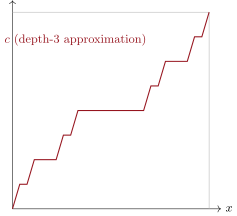
Problem 9.1
Weekend problem — the devil’s staircase, and
We construct the Cantor–Vitali function (devil’s staircase), use it to transport measure pathologically, and conclude with a theorem that no soft argument gives: there exist Lebesgue-measurable sets that are not Borel. Notation: is the Cantor set, its -th stage ( intervals of length ), and every has ternary digits , (Exercise 6.10).
Part I — The staircase. Define and from by
- Show that each is continuous, nondecreasing, with , , and that .
- Deduce that converges uniformly to a continuous nondecreasing with , (the Cantor–Vitali function), which satisfies the same self-similar relations as the above.
- Show that is constant on each connected component of , and that for , : the staircase reads Cantor digits in binary (Problem 6.1’s function , made monotone and global).
Deduce that is differentiable, with , at every point of : -almost everywhere (Example 9.14). Conclude that the fundamental theorem of calculus fails for :
(the integral being over the full-measure set where ; anticipating Chapter 10, null sets do not affect integrals). Which hypothesis of the fundamental theorem is violated?
- Show that : the null set is mapped onto a set of full measure.
Part II — The crooked homeomorphism. Let .
- Show that is a homeomorphism (strictly increasing, continuous, surjective).
- Show that : on each gap of length , acts as an affine map of slope , and the gaps have total length .
- Deduce : the homeomorphic image of a null set can have positive measure. (Where does this contradict naive intuition about “size”?)
Part III — A measurable set that is not Borel.
- By Exercise 9.9, choose a non-measurable . Show that is Lebesgue-measurable. (It is a subset of a null set; completeness, Theorem 9.9.)
- Show that the preimage of a Borel set under a continuous map is Borel. (Good sets principle: is a -algebra containing the open sets — mind the direction of the map.)
Conclude that is not Borel: if it were, would be Borel (apply question 10 to the continuous ), hence measurable — contradiction. Therefore
and completeness genuinely enlarges the Borel world.
- Exhibit a Lebesgue-measurable function and a continuous function such that is not Lebesgue-measurable: measurability, unlike continuity, does not compose. (Take and , anticipating the definition of measurable functions from Chapter 10: preimages of Borel sets are Lebesgue sets. Where must one be careful about which -algebra is used on the target?)
Part IV — Epilogue.
- Sort the following classes by strict inclusion and justify each strictness with an example from this chapter and its problem: countable sets; Borel null sets; Lebesgue null sets; Borel sets; Lebesgue sets; arbitrary sets.
Part V — The Cantor measure: mass on a null set. The staircase is the distribution function of a remarkable measure, which we now build with this chapter’s own tools.
(Lebesgue–Stieltjes, existence) Let be nondecreasing, continuous, bounded. On half-open intervals define and, for ,
Show that is an outer measure and that (imitate the compactness argument of Theorem 9.12, enlarging each to an open interval at -cost — where is continuity of used?).
- Show that every Borel set is -measurable in the Carathéodory sense (as in the Lebesgue case, it suffices to test half-lines; follow the proof of Theorem 9.9’s application), so that restricted to is a measure with : the Lebesgue–Stieltjes measure of .
Apply this to the staircase ( extended by on and on ): the Cantor measure . Show , that every gap of the Cantor set is -null ( is constant there), and conclude
and live on disjoint carriers ( and its complement). Two measures in this position are called mutually singular, written .
- Show that has no atoms: for every (continuity of ). An atomless probability measure carried by a Lebesgue-null compact: compare with the only measures seen so far.
- (Coin tossing in disguise) For a word , let be the set of whose ternary digits satisfy for (one of the Cantor pieces of depth ). Show (the staircase climbs across that piece: use Part I, question 3). The Cantor measure is the law of an infinite sequence of fair coin flips read in ternary — Chapter 22 will make this exact.
Prove the self-similarity: for every Borel ,
where (check it on the generating intervals via the self-similar relations of , then invoke uniqueness, Theorem 9.7).
- Show that the reflection preserves : (via , which follows from the symmetry of the construction — prove it).
Compute the first two moments of , i.e. of a random point with law (the integrals may be handled as limits of sums over the depth- pieces, anticipating Chapter 10): symmetry gives , and self-similarity gives
Compare with the uniform law on (variance ): the Cantor mass, pushed to the edges, spreads more.
- Show that the (topological) support of — the smallest closed set of full measure — is exactly .
- (Synthesis) The staircase is continuous and nondecreasing yet fails the fundamental theorem of calculus (Part I); the measure is a probability, atomless, singular with respect to . Explain in a short paragraph how these are two faces of one phenomenon, and state the general moral: nondecreasing functions correspond to measures (), differentiability a.e. corresponds to the “absolutely continuous part”, and is the standard witness that a continuous can carry no absolutely continuous part at all.
(The sharp modulus of continuity) Let . Show that is Hölder continuous of exponent :
and that no exponent can work, even locally. Deduce the measure-theoretic form: for every and every ,
(Compare a depth- triadic grid with the scale of ; question 18 gives the climb across each piece. The exponent is the Hausdorff dimension of , as later courses will say.)
(Self-similarity characterizes ) Prove the converse of question 19: if is a probability measure on carried by and satisfying
then . (Iterate the relation times to spread over the depth- Cantor pieces, estimate against the count of pieces inside , and let ; finish with Theorem 9.7.)
Solution
Solution of Problem 9.1.
1. Induction. Continuity: the three formulas agree at the junctions ( and ); each piece is continuous. Monotonicity and the boundary values are inherited. For the contraction estimate: on , ; on the middle third the difference is ; on the right third, the same as the left.
2. : the series of increments converges uniformly, so uniformly; is continuous, nondecreasing, , (all preserved by uniform limits), and passing to the limit in the defining recursion shows itself satisfies the three self-similar identities.
3. By the middle identity, on , the first gap. Every gap of is the image of the first gap under a composition of the two affine contractions , ; the identities transport constancy accordingly (with values the dyadic rationals). For the digit formula, take : if then and with having digits ; if then and , same shift. By induction, the first binary digits of are for every : .
4. Off , is locally constant: differentiable with derivative . Since (Example 9.14), almost everywhere. Yet : the fundamental theorem in its form requires to be differentiable everywhere with continuous (or at least integrable, plus absolute continuity — see Chapter 10) derivative; is not differentiable at points of , and more fundamentally fails absolute continuity: it climbs on a null set.
5. Given (), the point has by question 3: , a set of measure — the null set carries, through , the whole interval.
6. is continuous, and strictly increasing ( is, is nondecreasing); , , so by the intermediate value theorem is a continuous bijection of ; a continuous bijection from a compact space to a Hausdorff one is a homeomorphism (Corollary 6.14).
7. On a gap (length ), is constant, so is affine with slope : is an interval of length . The gaps are disjoint and is injective: the images are disjoint, of total measure .
8. and is compact (continuous image), hence measurable, with
A homeomorphism can inflate a null set to measure : “topological size” (category, dimension) and “measure” are transported by homeomorphisms very differently — only the former is a topological invariant.
9. has : a null set, hence Lebesgue-measurable by completeness (Theorem 9.9).
10. Let be continuous and . Preimages commute with complements and countable unions, so is a -algebra; it contains the open sets (continuity): — preimages of Borel sets under continuous maps are Borel.
11. If were Borel, apply question 10 to the continuous : would be Borel, hence Lebesgue-measurable — contradicting the choice of . So : Lebesgue’s -algebra strictly contains Borel’s.
12. is Lebesgue-measurable () and is continuous, but is not measurable: is not Lebesgue-measurable. The care needed: “Lebesgue-measurable function” means preimages of Borel sets land in ; composing requires preimages of Lebesgue sets to be Lebesgue, which continuity does not grant (here even though is a homeomorphism).
13. The chains, with witnesses for strictness:
Witnesses: is Borel, null, uncountable (first gap); is Lebesgue null but not Borel (second and, inside , sixth); a fat Cantor set is Borel, nowhere dense, of positive measure (separating null sets from Borel sets); Vitali’s is not in (last gap). Measure, topology and cardinality slice along genuinely different lines.
14. Outer measure: (cover by a vanishing interval), monotonicity is clear, and countable subadditivity follows by splicing -optimal covers, exactly as for . The one-interval cover gives . Conversely let . By continuity of , pick with , and with . The compact is covered by the open : finitely many suffice, and the chaining argument of Theorem 9.12 (walk from to through overlapping intervals, telescoping -increments, monotonicity absorbing overlaps) yields . Let : equality. (Continuity of is what allowed opening the intervals at arbitrarily small -cost.)
15. It suffices to prove each half-line Carathéodory-measurable, since the measurable sets form a -algebra (Theorem 9.9) and half-lines generate . Given and an -optimal cover of : each interval splits as (one piece possibly empty), with -costs adding up exactly to ; the first pieces cover , the second . Hence , and the reverse inequality is subadditivity. Restricting the resulting measure to : the Lebesgue–Stieltjes measure .
16. (continuity of the measure along ). On a gap of , is constant, so every half-open subinterval is -null and so is the gap (countable union); outside , is constant too. Hence , , while (Example 9.14): each of is carried by a set the other declares null — mutually singular.
17. by continuity of : no atoms. So is an atomless probability measure carried by a Lebesgue-null compact — neither diffuse-with-density like ’s restrictions, nor atomic like counting measures: a third species.
18. The piece spans a ternary interval of length , and Part I question 3 shows that across the staircase climbs exactly (the first binary digits of are frozen to , the rest sweep everything). Hence : depth- digit cylinders all have mass , the law of fair coins.
19. The right-hand side defines the Borel measure evaluated at — probability measure. Pointwise, with globally extended, one checks case by case (; the three thirds; ) the identity
e.g. on : . Evaluating on therefore gives , and two finite measures agreeing on the -system of half-open intervals coincide on (Theorem 9.7): .
20. By induction on : , and if has the symmetry, then for : ; the middle third mirrors around ; the right third is the left case reflected. In the limit . Pushforward: ( atomless, question 17, so boundary conventions cost nothing) : by uniqueness.
21. Let (integrals of continuous functions against exist as limits of Riemann-type sums over the depth- pieces, each of mass , with sampling error ; Chapter 10 will systematize this). Symmetry: , so . Self-similarity: has the law of with probability and of with probability , , so
whence and . The uniform law has variance : Cantor mass hugs the endpoints.
22. is closed and . If an open meets at , the depth- pieces containing shrink to , so some and : no smaller closed set can carry . Points off have gap neighborhoods of -measure . Hence exactly.
23. One phenomenon, two dialects. Part I says the growth of is invisible to its derivative: a.e., all the climbing concentrated on the null set . Part V says the associated measure puts all its mass on that same null set: , so no density can satisfy — a density forces vanishing on -null sets. The dictionary: nondecreasing bounded finite measure (questions 14–15); an integral of its derivative has a density (the “absolutely continuous” case); and in general , which exists a.e. for monotone (Lebesgue’s differentiation theorem, beyond this chapter), recovers only the density part. The staircase is the extreme: continuous, with derivative a.e. — its measure is purely singular, and the fundamental theorem of calculus, far from failing by accident, fails by the exact amount of singular mass.
24. Fix in and choose with . Across any triadic interval the staircase climbs at most : such an interval is either one of the pieces of , where the climb is exactly (question 18), or it is contained in the closure of a single gap of some stage , where is constant. Since , the interval meets at most two consecutive depth- triadic intervals, so
using and . Optimality: the endpoints of a depth- Cantor piece satisfy and ; a Hölder bound with would force (since ), and every subinterval of contains such pieces, so the failure is local as well. Measure form: (values of extended to as in question 16; has no atoms, question 17).
25. Write and ; the hypothesis says . Iterating times,
Since is carried by and , the depth- Cantor piece indexed by , each is a probability measure carried by ; the pieces are pairwise disjoint closed intervals of length . Fix and let be the number of pieces . A piece meeting without being contained in it must contain or , and a point lies in at most one piece, so
The same double inequality holds for (question 19 gives the identical iteration), with the same count . Hence : and agree on the -system of half-open intervals, and both are probability measures, so Theorem 9.7 gives . The staircase measure is thus the fixed point of the two-map averaging scheme — the measure-level statement of the self-similarity of .