Microstructure and Execution · Execution
23Request for Quote and Dealer Markets in Theory
A client who asks five dealers for a price on a corporate bond gets a better price than one who asks two, up to a point: every dealer asked learns that someone is selling, and the ones who lose the request can trade on it. This chapter gives the theory behind the markets that have no central book: a search-and-bargaining model of dealer spreads, the request for quote as an auction with private values, common values and leakage, the number of dealers a client should ask, and the networks and relationships through which dealers trade.
23.1 Search and bargaining
Definition 23.1 (Over-the-counter search model, search friction, bargaining power)
An over-the-counter search model describes a market in which traders find counterparties one at a time, at random times, and agree prices bilaterally. A search friction is the delay and cost of finding a counterparty; a trader’s bargaining power is the share of the gains from a trade it captures when a counterparty is found.
Duffie, Gârleanu and Pedersen (2005) computed the prices at which investors trade with dealers in a dynamic model with search and bargaining, and found that bid–ask spreads are lower when investors can more easily find other investors or reach several dealers. This chapter solves a version of their dealer market (firm_otcsearch.dgp). An asset pays one a year; investors are of a high type or a low type, the low type paying a holding cost ; types switch at rates (to high) and (to low). Low-type owners sell to dealers and high-type non-owners buy from them, meeting a dealer at rate (a Poisson process, One Quant Book 4, chapter 6); dealers lay off every trade in an inter-dealer market and keep a share of each trade’s surplus. With a supply below the high types’ share , buyers are the long side and the inter-dealer price is their reservation value.
In steady state the low-type owners flow in from switching and out to dealers and to the high type: , with . The reservation values (the value of owning over not owning, for type ) solve two linear equations (the Bellman equations of a continuous-time Markov chain, One Quant Book 4, chapter 8):
and the ask is , the bid , the spread .
    phi = lam_u / (lam_u + lam_d)
    if s >= phi:
        raise ValueError("this version needs s below the high types' share")
    mu_lo = lam_d * s / (lam_u + lam_d + rho)   # in from switching, out to high and dealers
    mu_ho = s - mu_lo
    mu_hn = phi - mu_ho
    mu_ln = 1 - phi - mu_lo
    # r dVh = 1 + lam_d (dVl - dVh) - rho (dVh - A), A = M = dVh
    # r dVl = 1 - delta + lam_u (dVh - dVl) + rho (1 - z) (M - dVl)
    k = rho * (1 - z)
    a = np.array([[r + lam_d, -lam_d], [-lam_u - k, r + lam_u + k]])
    dvh, dvl = np.linalg.solve(a, [1.0, 1.0 - delta])
    ask = dvh
    bid = z * dvl + (1 - z) * dvh
    return {"mu": (mu_ho, mu_hn, mu_lo, mu_ln), "dV": (dvh, dvl), "bid": bid, "ask": ask,
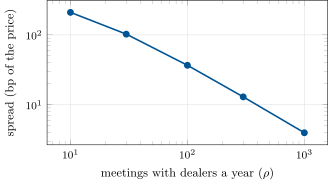
"spread": ask - bid, "spread_share": (ask - bid) / ((ask + bid) / 2)}With , and a year, , and , the spread falls from 210 basis points of the price when investors meet a dealer ten times a year to 36.7 at a hundred and 4.0 at a thousand (Figure 23.1): faster search leaves low types less time to bear their holding cost, which is the surplus dealers bargain over.
mx_otc.dgp_study.23.2 Dealer networks
Definition 23.2 (Core–periphery network)
A core–periphery network of dealers has a small core of dealers who trade with each other and with many others, and a large periphery whose dealers trade mostly with the core.
Li and Schürhoff (2019) found that municipal bond dealers form such a network, with 10 to 30 hubs and over 2 000 peripheral broker-dealers; bonds flow from the periphery to the core and partly back; central dealers charge investors up to double the round-trip markups of peripheral ones but provide immediacy by matching buyers and sellers more directly. The chapter’s toy network (core_periphery) has 10 core dealers and 200 peripheral ones linked to two core dealers each; a bond passes along the shortest path from the seller’s dealer to the buyer’s, and each dealer on the path charges a markup, 4 basis points in the core and 2 in the periphery. A client of a core dealer is reached in 1.77 hops on average and pays 9.2 basis points; a client of a peripheral dealer, 2.58 hops and 10.4. The chain’s length is part of the price; the empirical finding that the core charges more comes from its markups, which this toy sets by hand.
23.3 The request for quote as an auction
A request for quote (One Quant Book 2, chapter 22) is a first-price sealed-bid auction among the dealers asked (One Quant Book 4, chapter 29). Each dealer’s value for the bond has a private part (its inventory, its axes: standard deviation ) and it estimates the common value with an error (). The client sells to the best bid, and each losing dealer, who now knows that a seller is about, costs the client a leakage on average. A dealer who wins when its estimate of the common value is the highest has overestimated it: it shades its bid by (the winner’s curse, One Quant Book 2, chapter 30, and chapter 22’s risk bids). The client’s expected cost below the common value is
with the dealers’ markup: competition helps through the private values, the common part mostly cancels against the shading, and every extra dealer adds leakage (rfq_cost, on Book 2’s firm.rfq; a simulation of the auction agrees to 0.001 basis points).
def rfq_cost(n: int, markup: float, sigma_p: float, sigma_c: float, leak: float) -> float:
    sd = math.sqrt(sigma_p**2 + sigma_c**2)
    return expected_cost(n, markup, sd, leak) + sigma_c * expected_max_normal(n)


def best_n(markup: float, sigma_p: float, sigma_c: float, leak: float,
           n_max: int = 20) -> int:
    def cost(n):
        return rfq_cost(n, markup, sigma_p, sigma_c, leak)
return min(range(1, n_max + 1), key=cost)23.4 How many dealers to ask
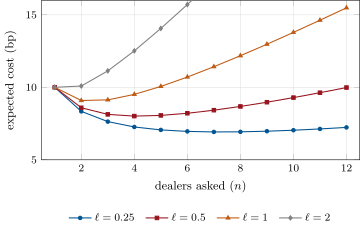
With a markup of 10 basis points, and , Figure 23.2 draws for four leakage costs, and Table 23.1 gives the optimum.
mx_otc.rfq_study.| leakage per losing dealer (bp) | 0.1 | 0.25 | 0.5 | 1 | 2 | 3 |
|---|---|---|---|---|---|---|
| dealers to ask | 16 | 7 | 4 | 2 | 1 | 1 |
| expected cost (bp) | 5.52 | 6.92 | 8.02 | 9.09 | 10.00 | 10.00 |
mx_otc.rfq_study.The optimum falls fast: from 16 dealers when a loser costs a tenth of a basis point to 4 at half a basis point and a single dealer from 2 basis points. The common-value part matters too: at half a basis point of leakage, a client should ask 6 dealers if the dealers’ estimates had no common error, 4 with and 3 with , because the common part adds noise that the winner shades away without adding competition. Riggs, Onur, Reiffen and Zhu (2020) found that customers on the two largest dealer-to-customer swap execution facilities for index CDS typically contact few dealers, and modelled why: the benefit of wider exposure is mitigated by the winner’s curse and by customer–dealer relationships.
23.5 Relationships and information chasing
Definition 23.3 (Information chasing)
Information chasing is a dealer’s quoting of better prices to clients whose trades carry information, because what it learns from their flow is worth more to it, in its trading with others, than the adverse selection it suffers on their trades.
In a competitive quote, a dealer’s spread to a client is its cost plus the adverse selection it expects, less the value of what it learns. With a cost of 2 basis points and adverse selection of 1.5 on an informed client’s trade, the informed client is quoted 3.5 when its information is worth nothing to the dealer, the same 2.0 as an uninformed client when it is worth 1.5, and 0.5 when it is worth 3 (chase): the informed client gets the better price. Relationships work the same way: Hendershott, Li, Livdan and Schürhoff (2020) found in insurers’ corporate bond trades that execution prices first improve with the number of dealers in a client’s network and worsen beyond about twenty, as repeat business with a few dealers trades off against competition among many; Di Maggio, Kermani and Song (2017) found that dealers charge lower spreads to the dealers with whom they have the strongest ties, more so in turmoil, and that systemically important dealers charge peripheral dealers and clients more.
23.6 Tutorial: dealers, searches and auctions
Goal. Solve a search-and-bargaining dealer market, find the cost-minimising number of dealers in a request for quote, and trace intermediation chains in a core–periphery network. End state: Figures 23.1 and 23.2, Table 23.1 and the numbers of sections 2 and 5.
- Search.
firm_otcsearch.dgp(lam_u, lam_d, rho, s, r, delta, z);mx_otc.dgp_study(). - Auction.
rfq_cost,best_n,rfq_simulate;rfq_study(),common_study(). - Networks and chasing.
core_periphery,intermediation,chase;network_study(),chase_study(); draw withfig_otc.py.
What to change next. Let investors also meet each other directly (Duffie, Gârleanu and Pedersen’s other channel); make leakage depend on the losers’ inventories; let peripheral dealers choose their core links.
23.7 Build: OTC search and auctions
Purpose. The theory behind chapter 21’s bond adapter and the desk’s dealer choices: prices from search, the right number of dealers, and intermediation chains.
Interface. dgp(lam_u, lam_d, rho, s, r, delta, z), rfq_cost(n, markup, sigma_p, sigma_c, leak), best_n, rfq_simulate, chase(cost, adverse, info_value), core_periphery(n_core, n_periph, links, seed), intermediation(adj, n_core, markup_core, markup_periph, trials, seed).
Rules. The asset pays one a year; costs in basis points below the common value; the version of the search model with buyers on the long side.
Acceptance tests. code/firm/otcsearch/tests/: the steady state’s flow balance and masses; the spread falls with the contact rate and vanishes without dealer bargaining power; the RFQ formula against Book 2’s and against simulation; the optimum’s monotonicity in leakage; chasing lowers the informed spread; peripheral trades take longer chains.
Stretch. Investor-to-investor search; endogenous dealer entry; inventory-dependent leakage.
Sources and further reading
- D. Duffie, N. Gârleanu and L. H. Pedersen, “Over-the-counter markets”, Econometrica 73(6), 2005.
- P. Di Maggio, A. Kermani and Z. Song, “The value of trading relations in turbulent times”, Journal of Financial Economics 124(2), 2017.
- D. Li and N. Schürhoff, “Dealer networks”, Journal of Finance 74(1), 2019.
- L. Riggs, E. Onur, D. Reiffen and H. Zhu, “Swap trading after Dodd–Frank: evidence from index CDS”, Journal of Financial Economics 137(3), 2020.
- T. Hendershott, D. Li, D. Livdan and N. Schürhoff, “Relationship trading in over-the-counter markets”, Journal of Finance 75(2), 2020.
23.8 Exercises
Exercise 23.1 ★
With , , and , compute the mass of low-type owners in steady state.
Solution
Solution of Exercise 23.1.
.
Exercise 23.2 ★
Compute for and with the chapter’s parameters and a leakage of 1 basis point.
Solution
Solution of Exercise 23.2.
(no competition, no leakage); basis points.
Exercise 23.3 ★
At what value of an informed trade’s information does a dealer quote informed and uninformed clients the same spread?
Solution
Solution of Exercise 23.3.
When it equals the adverse selection, 1.5 basis points: both clients are then quoted the dealer’s cost, 2.0.
Exercise 23.4 ★★
Why does the spread vanish when dealers have no bargaining power, and why does it fall with the contact rate?
Solution
Solution of Exercise 23.4.
With the dealer passes the whole surplus to the investor: bid and ask both equal the inter-dealer price. The spread is , and the gap between the types’ reservation values shrinks when a low type can sell sooner: it bears the holding cost for less time.
Exercise 23.5 ★★
Why does a common-value error reduce the number of dealers a client should ask?
Solution
Solution of Exercise 23.5.
The common part adds to the dispersion of bids but each dealer shades for it, so it adds leakage-free noise without lowering the expected winning price as much: the benefit per extra dealer falls while the leakage per dealer does not.
Exercise 23.6 ★★
In the toy network, why do clients of peripheral dealers go through longer chains, and what would make them pay less?
Solution
Solution of Exercise 23.6.
A peripheral dealer reaches most sellers only through the core, so the bond passes through more dealers (2.58 hops on average against 1.77) and each charges a markup. Links to more core dealers, or direct links between peripheral dealers, would shorten the chains.
Exercise 23.7 ★★★
Coding. With no common-value error and a leakage of 1 basis point, how many dealers should the client ask, and what does it cost?
Solution
Solution of Exercise 23.7.
Three dealers, 7.77 basis points (against two dealers and 9.09 with ).
Exercise 23.8 ★★★
Find the flaw. “More dealers always means more competition, so our RFQs go to every dealer on the platform.”
Solution
Solution of Exercise 23.8.
Each dealer asked and not chosen learns that a seller is about and costs the client leakage; beyond a few dealers the leakage grows faster than the competition helps (at half a basis point per losing dealer, four is best and twelve costs 2 basis points more).
23.9 Problem: How Many Dealers to Ask
Problem 23.1
Weekend problem — how many dealers to ask
A fund’s bond desk sends every RFQ to eight dealers. The head of trading asks whether that is right.
Part I — Search.
- Define a search friction and bargaining power.
- State the search model’s types, rates and trades.
- Derive the steady-state mass of low-type owners.
- Write the Bellman equations for the reservation values and the bid and ask.
- How does the spread depend on the contact rate?
Part II — The auction.
- Why is an RFQ a first-price sealed-bid auction?
- Derive the winner’s-curse shading for a common-value error.
- Write the client’s expected cost and explain each term.
- How closely does a simulation of the auction agree?
Part III — The number of dealers.
- State the named result: the cost-minimising number of dealers and its dependence on the leakage cost per losing dealer.
- How does the common-value error change it?
- What did Riggs, Onur, Reiffen and Zhu find about how many dealers customers contact, and why?
- Is eight dealers right for this desk? What would you need to know?
Part IV — Networks and relationships.
- Define a core–periphery network and give Li and Schürhoff’s findings.
- What does the toy network show about chains?
- Define information chasing and give the spreads it implies.
- What did Hendershott, Li, Livdan and Schürhoff find about network size and prices?
- What did Di Maggio, Kermani and Song find about dealer ties in turmoil?
- How would you measure the leakage per losing dealer from a desk’s own data?
- In one sentence: what does a client trade off when it asks one more dealer?
Solution
Solution of Problem 23.1.
1. See the definition. 2. High and low types switching at and ; low owners sell and high non-owners buy through dealers met at rate ; dealers keep a share of the surplus. 3. with : . 4. See section 1; ask , bid . 5. It falls: 210 basis points at 10 meetings a year, 36.7 at 100, 4.0 at 1 000. 6. Dealers submit one price each without seeing the others’, and the best price wins at its own price. 7. The winner is the dealer with the highest estimate of the common value; its expected overestimate is . 8. : the markup, the competition among private values, the leakage. 9. Within 0.001 basis points for five dealers. 10. Named result: 16 dealers at 0.1 basis point of leakage per losing dealer, 7 at 0.25, 4 at 0.5, 2 at 1, and a single dealer from 2 basis points, with expected costs of 5.52, 6.92, 8.02, 9.09 and 10.00. 11. At 0.5 of leakage: 6 dealers without common-value error, 4 with , 3 with . 12. A typical customer contacts few dealers; wider exposure is mitigated by the winner’s curse and relationships. 13. Only if leakage per losing dealer is near a quarter of a basis point; measure it before deciding. 14. A few hubs among many peripheral dealers; bonds flow to the core; central dealers charge up to double the round-trip markups but offer immediacy. 15. Clients of peripheral dealers go through longer chains (2.58 hops against 1.77) and pay 10.4 basis points against 9.2. 16. See the definition; with the chapter’s numbers, 3.5 to 0.5 basis points for the informed client as its information’s value rises from 0 to 3, against 2.0 for the uninformed. 17. Prices improve with the number of dealers up to about twenty and worsen beyond. 18. Dealers charge lower spreads to their closest counterparties, more so in turmoil; systemically important dealers charge the periphery and clients more. 19. Compare the price move after RFQs with many and few dealers, or after RFQs that were not traded, against similar bonds without RFQs. 20. The competition of one more bid against the information one more loser takes away.
23.10 Interview questions
Interview question 23.1 ★ trader
You need to sell an illiquid corporate bond. How many dealers do you ask, and why?
Solution
Solution of Interview question 23.1.
Few: two to four, chosen for their axes and past pricing, because each losing dealer learns there is a seller in a bond that trades rarely; more when leakage is low (the bond is liquid) or the private-value dispersion is high.
What the interviewer is looking for: Competition against leakage.
Interview question 23.2 ★★ researcher
Explain the winner’s curse in an RFQ and how a dealer should bid.
Solution
Solution of Interview question 23.2.
Winning means having the most optimistic estimate of the common value; a dealer should bid its estimate less the expected overestimate conditional on winning, which grows with the number of competitors and the estimates’ dispersion.
What the interviewer is looking for: Conditioning on winning; shading grows with n.
Interview question 23.3 ★★ researcher
In a search model, why are spreads lower when investors can find dealers more easily?
Solution
Solution of Interview question 23.3.
The surplus a dealer bargains over is the low type’s cost of holding the asset while it waits; easier contact shortens the wait, shrinking the gap between the types’ reservation values and so the spread.
What the interviewer is looking for: Reservation values and waiting.
Interview question 23.4 ★★ bank
Why might a dealer quote a tighter price to a client it knows is informed?
Solution
Solution of Interview question 23.4.
Because what it learns from the flow is worth more in its other trades than the adverse selection on this one: information chasing.
What the interviewer is looking for: Information value against adverse selection.
Interview question 23.5 ★★ developer
Design the data an RFQ platform should keep to let clients measure leakage.
Solution
Solution of Interview question 23.5.
Every RFQ with the dealers asked, their quotes and timestamps, the winner, and the market’s prices and trades in the bond and related bonds before and after; so that price moves after RFQs can be compared by number of dealers.
What the interviewer is looking for: Request-level data; before-and-after prices.
Interview question 23.6 ★★★ risk
The core dealers of a bond market are hit by a shock. What happens to intermediation chains and to clients’ costs?
Solution
Solution of Interview question 23.6.
Chains lengthen and markups rise as peripheral dealers route around the weakened core, and clients who need immediacy pay more; after 2008 chains lengthened by 20% (Di Maggio, Kermani and Song).
What the interviewer is looking for: Chains, markups, immediacy.