সব বই

পেশাদার

1 Markets I: The Ecosystem and Exchange-Traded Marketsবাজার অনলাইনইংরেজি 2 Markets II: Rates, FX and Creditবাজার অনলাইনইংরেজি 3 Markets III: Commodities, Energy and Cryptoবাজার অনলাইনইংরেজি 4 Quantitative Methodsপদ্ধতি অনলাইনইংরেজি 5 Derivatives and Volatilityডেরিভেটিভস অনলাইনইংরেজি 6 Rates, Credit, XVA and Riskসুদহার, ঋণ ও ঝুঁকি অনলাইনইংরেজি 7 Research Craft: Predictors, Backtests, Measurement, Portfoliosগবেষণা অনলাইনইংরেজি 8 Strategies I: Equities and Futuresকৌশল অনলাইনইংরেজি 9 Strategies II: Volatility, Relative Value, Macro and the Bank Desksকৌশল অনলাইনইংরেজি 10 Microstructure and Executionএক্সিকিউশন অনলাইনইংরেজি 11 Market Making and High-Frequency Tradingমার্কেট মেকিং অনলাইনইংরেজি 12 Machine Learning for Marketsমেশিন লার্নিং অনলাইনইংরেজি 13 Low-Latency Softwareপ্রযুক্তি অনলাইনইংরেজি 14 Networks, Hardware and Trading Infrastructureপ্রযুক্তি অনলাইনইংরেজি 15 Research, Data and Risk Platformsপ্রযুক্তি অনলাইনইংরেজি 16 The Desk and the Firmপ্রতিষ্ঠান অনলাইনইংরেজি 17 The Industry: Firms, Roles and Careersক্যারিয়ার অনলাইনইংরেজি 18 Interviews I: Maths, Probability and Speedক্যারিয়ার অনলাইনইংরেজি 19 Interviews II: Markets, Trading Games and the Final Roundক্যারিয়ার অনলাইনইংরেজি 20 Interviews III: Codeক্যারিয়ার অনলাইনইংরেজি
অ্যাপ পরিচিতি Coach সাইন ইন পড়া শুরু করো

বইগুলো এখনো বাংলা ভাষায় পাওয়া যায় না — العربية সংস্করণ দেখানো হচ্ছে।

الرياضيات · পরিভাষা

cosh⁡ و sinh⁡ و tanh⁡ কী?

অন্য নাম: دوال زائدية

تعريف 4.17 الرياضيات الجامعية — السنة 1 · অধ্যায় 4 — الدوال المعيارية

من أجل x∈Rx \in \R:

cosh⁡x=ex+e−x2,sinh⁡x=ex−e−x2,tanh⁡x=sinh⁡xcosh⁡x\cosh x = \frac{\eu^x + \eu^{-x}}{2}, \qquad \sinh x = \frac{\eu^x - \eu^{-x}}{2}, \qquad \tanh x = \frac{\sinh x}{\cosh x}

(جيب التمام الزائدي والجيب الزائدي والظل الزائدي). والدالة cosh⁡\cosh زوجية، والدالتان sinh⁡\sinh و tanh⁡\tanh فرديتان.

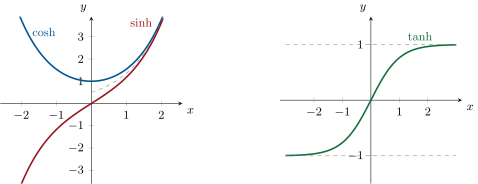
إلى اليسار:  و ، ملتصقتان مقاربيًا بالمنحني x/2 (المتقطع). وإلى اليمين: ، متزايدةً من -1 إلى 1.
إلى اليسار: cosh⁡\cosh و sinh⁡\sinh، ملتصقتان مقاربيًا بالمنحني ex2\frac{\eu^x}{2} (المتقطع). وإلى اليمين: tanh⁡\tanh، متزايدةً من −1-1 إلى 11.

উদাহরণ

مثال 4.20 (صيغة الجمع للدالة tanh⁡\tanh)

بقسمة صيغتَي الجمع في القضية 4.18 (3) على cosh⁡xcosh⁡y\cosh x\cosh y:

tanh⁡(x+y)=sinh⁡xcosh⁡y+cosh⁡xsinh⁡ycosh⁡xcosh⁡y+sinh⁡xsinh⁡y=tanh⁡x+tanh⁡y1+tanh⁡x tanh⁡y,\tanh(x + y) = \frac{\sinh x\cosh y + \cosh x\sinh y} {\cosh x\cosh y + \sinh x\sinh y} = \frac{\tanh x + \tanh y}{1 + \tanh x\,\tanh y} ,

وهي شقيقة صيغة جمع الظل الزائدية — مع إشارة ++ حيث تضع المثلثات إشارة −-. ومن فوائدها: بما أن ∣tanh⁡∣<1\abs{\tanh} < 1، يكون الطرف الأيمن قاعدةَ «جمع سرعات» لا تغادر (−1, 1)\intoo{-1}1 أبدًا: فإذا كان u,v∈(−1, 1)u, v \in \intoo{-1}1 فإن u+v1+uv∈(−1, 1)\frac{u + v}{1 + uv} \in \intoo{-1}1 كذلك (اكتب u=tanh⁡au = \tanh a و v=tanh⁡bv = \tanh b، وهذا ممكن بالتقابلية، واقرأ الصيغة بالمقلوب). والتحقق من ذلك جبريًا، دون دوال زائدية، تمرين مؤلم بعض الشيء؛ أمّا الوسْط بالدالة tanh⁡\tanh فيجعله سطرًا واحدًا — وهي الاستراتيجية نفسها التي توفّرها الدوال الدائرية لدائرة الوحدة.

مثال 4.22 (الصيغ المغلقة في العمل)

حلّ المعادلة cosh⁡t=2\cosh t = 2 حيث t≥0t \geq 0 هو، بالصيغة المغلقة، t=arcosh⁡2=ln⁡(2+3)≈1.317t = \operatorname{arcosh} 2 = \ln(2 + \sqrt3) \approx 1.317؛ والحل الآخر هو −t-t بالزوجية — وبالفعل ln⁡(2−3)=ln⁡12+3=−ln⁡(2+3)\ln(2 - \sqrt3) = \ln\frac1{2 + \sqrt3} = -\ln(2 + \sqrt3): أي أن جذرَي المعادلة من الدرجة الثانية u2−4u+1=0u^2 - 4u + 1 = 0، وهما u=etu = \eu^t، مقلوبان أحدهما للآخر، كما يقتضيه جداؤهما 11 (فييت). ويُظهر هذا الحساب الصغير النمط العام: فالمعادلات الزائدية تتحول إلى معادلات من الدرجة الثانية في et\eu^t، ويظهر التناظر t↦−tt \mapsto -t في صورة التناظر u↦1/uu \mapsto 1/u للمعادلة من الدرجة الثانية — ويجدر تذكّر ذلك عند حلّ التمرين 4.7.

প্রসঙ্গসহ পড়ো ←