Biology · Glossary

What is Carbon fixation?

Definition 14.8 University Biology — Year 1 · Chapter 14 — Photosynthesis and Autotrophy

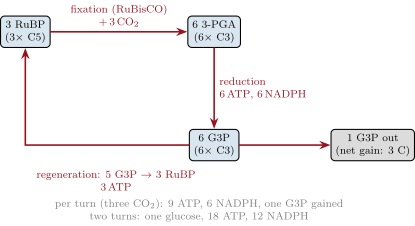
The Calvin cycle in the stroma fixes CO2\mathrm{CO_2} into sugar in three stages. Fixation: RuBisCO (ribulose bisphosphate carboxylase/oxygenase) adds CO2\mathrm{CO_2} to ribulose-1,5-bisphosphate (RuBP, five carbons), and the six-carbon product splits at once into two molecules of 3-phosphoglycerate (3-PGA, three carbons). Reduction: each 3-PGA is phosphorylated by ATP and reduced by NADPH to glyceraldehyde-3-phosphate (G3P), the first sugar. Regeneration: five of every six G3P are rearranged, at the cost of ATP, back into three RuBP, and one G3P leaves the cycle as the net product. The stoichiometry for one G3P (three carbons) is

3CO2+9ATP+6NADPH+6H+G3P+9ADP+8Pi+6NADP+;3\,\mathrm{CO_2} + 9\,\mathrm{ATP} + 6\,\mathrm{NADPH} + 6\,\mathrm{H^+} \to \text{G3P} + 9\,\mathrm{ADP} + 8\,\mathrm{P_i} + 6\,\mathrm{NADP^+} ;

two G3P make one glucose: 1818\, ATP and 12NADPH12\,\mathrm{NADPH} per glucose.

The Calvin cycle for three molecules of CO_2: three RuBP fixed into six 3-PGA, reduced to six G3P, of which one leaves and five regenerate the three RuBP. Carbon is conserved at every step (15 + 3 = 18 = 3 + 15).
The Calvin cycle for three molecules of CO2\mathrm{CO_2}: three RuBP fixed into six 3-PGA, reduced to six G3P, of which one leaves and five regenerate the three RuBP. Carbon is conserved at every step (15+3=18=3+1515 + 3 = 18 = 3 + 15).
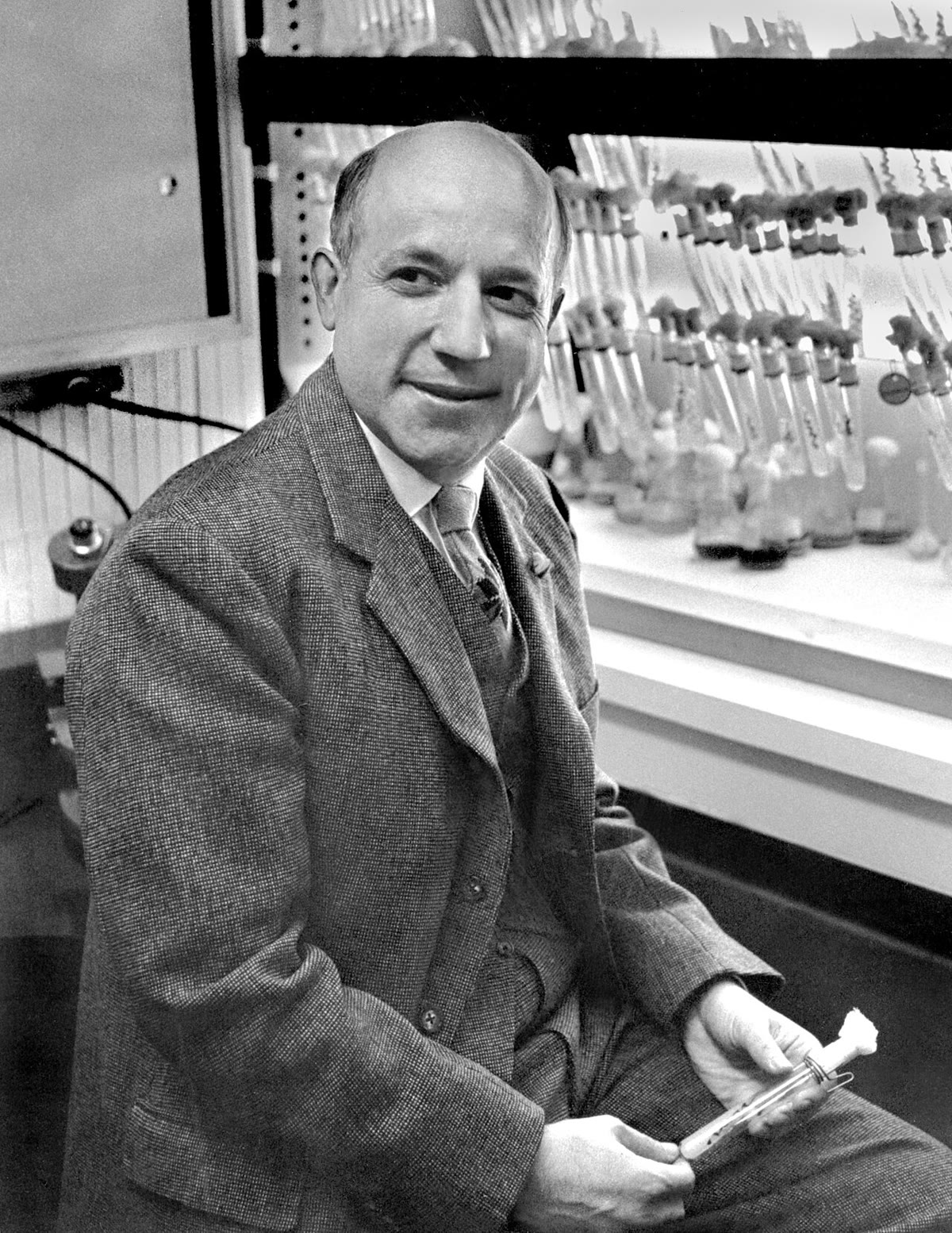
Melvin Calvin (1911–1997), who with Benson traced the path of carbon from CO_2 to sugar with radioactive carbon and paper chromatography. Photograph: Lawrence Berkeley Laboratory, public domain.
Melvin Calvin (1911–1997), who with Benson traced the path of carbon from CO2\mathrm{CO_2} to sugar with radioactive carbon and paper chromatography. Photograph: Lawrence Berkeley Laboratory, public domain.

Examples

Example 14.7 (Cyclic and non-cyclic flow)

The linear path from water to NADPH gives, per O2\mathrm{O_2}, two NADPH and about three ATP; the Calvin cycle needs a ratio of three ATP to two NADPH exactly, and other work of the chloroplast needs more ATP. When ATP runs short, electrons from ferredoxin return to plastoquinone instead of going to NADP+\mathrm{NADP^+} (cyclic photophosphorylation): PSI alone, pumping protons and making ATP without oxygen or NADPH. The two modes are balanced to the demand.

Read in context →