 Coach
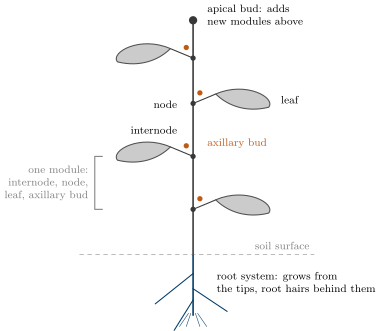
CoachThe vegetative body of a flowering plant is made of three kinds of organ. The root anchors the plant and absorbs water and mineral ions from the soil; it grows from its tip, branches, and bears root hairs just behind the tip. The stem carries the leaves toward the light and conducts between roots and leaves; it is built of repeated units, each a node bearing a leaf and an axillary bud, and an internode between two nodes. The leaf is the organ of photosynthesis: a flat blade of large surface and small thickness, held by a petiole. Roots form the root system; stems and leaves, the shoot system.
Examples
Example 3.6 (Where the exchanges happen)
Carbon dioxide enters a leaf through its stomata, crosses the air spaces of the spongy layer and dissolves in the wet walls of the palisade cells; water arrives in the xylem of the veins and leaves, as vapour, through the same stomata. Water and ions enter the root through the root hairs and cross the cortex to the xylem at the centre. Both organs put their exchange surface on the outside and their conducting tissue in the middle.
Example 3.10 (The oak’s two surfaces)
An oak whose crown shades at carries of leaf. Its fine roots, at a few kilometres per cubic metre through of soil, offer several hundred square metres, and their root hairs a thousand more: the absorbing surface underground is several times the photosynthetic surface above, over the same square metres of ground.