 Coach
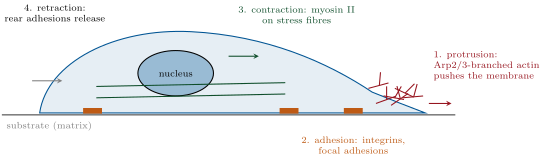
CoachA crawling cell repeats a cycle of four steps. Protrusion: at the leading edge actin polymerises against the membrane in a sheet, the lamellipodium, whose branched network is built by the Arp2/3 complex, which nucleates a new filament from the side of an existing one at , while capping protein limits each filament’s growth and cofilin recycles the network a few micrometres back; finger-like filopodia of bundled filaments probe ahead. Adhesion: the new protrusion attaches to the substrate through integrins, transmembrane receptors that bind matrix proteins outside and, through adaptor proteins, actin inside, clustered in focal adhesions. Contraction: myosin II pulls on the stress fibres anchored at the adhesions, dragging the cell body forward. Retraction: the adhesions at the rear release and the tail is pulled in. The cycle is coordinated by three small GTPases of the Rho family — Rac drives lamellipodia, Cdc42 filopodia, Rho stress fibres and contraction — which are the targets of the receptors that read the direction of a chemical gradient (chemotaxis) or the stiffness and pattern of the substrate.
Examples
Example 9.8 (Listeria’s comet)
The bacterium Listeria monocytogenes, once inside a cell, displays on its surface a single protein, ActA, that recruits the host’s Arp2/3 complex. Actin polymerises at the bacterial surface and is left behind as a tail; the bacterium is pushed through the cytoplasm at up to and into neighbouring cells without ever leaving the cytosol. The tail is a lamellipodium turned inside out, with one protein where the cell uses dozens, and it showed that actin polymerisation alone — without any motor — generates the force of protrusion: each subunit that inserts between the network and the membrane, when a thermal fluctuation has opened a gap, ratchets the front forward by .