 Coach
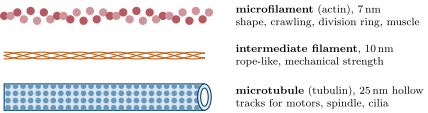
CoachThe cytoskeleton is a network of protein filaments that gives the cell its shape, anchors its organelles, and moves them and the cell itself. Three kinds: microfilaments of actin (, two twisted strands of globular subunits), concentrated under the plasma membrane, responsible for cell shape, crawling, the contractile ring of division and muscle contraction with myosin; microtubules ( hollow tubes of tubulin), radiating from the centrosome, tracks along which motor proteins (kinesin outward, dynein inward) carry vesicles and organelles, the spindle of division, and the core of cilia and flagella; intermediate filaments (, rope-like, of keratins and related proteins), the mechanically resistant fibres that stiffen cells and anchor at desmosomes. Microfilaments and microtubules assemble and disassemble continuously from their subunit pools.
Examples
Example 6.13 (Moving a vesicle)
A secretory vesicle leaving the Golgi is picked up by kinesin, a motor that walks along a microtubule toward the cell’s periphery at about , spending one ATP per step; in a neuron the same motor carries vesicles the length of an axon a metre long — a journey of ten days. Near the surface, the vesicle passes to the actin cortex and to myosin for the last micrometre. Diffusion would take a vesicle of about a minute to cross a cell of , and years to travel a metre: organelles are carried, not left to wander.