 Coach
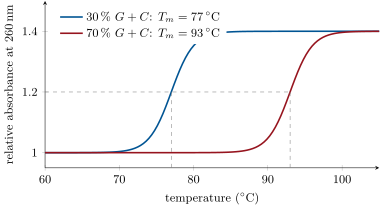
CoachHeating, or extreme pH, separates the two strands of DNA: denaturation (melting), a cooperative transition over a few degrees, whose midpoint is the melting temperature . It is followed by the hyperchromic effect: single strands absorb about more ultraviolet light at than the same bases stacked in a helix. rises with the content ( per percent), with the salt concentration, and with length; in salt a long DNA of melts near . Cooled slowly, the strands find their complements and re-form the helix: renaturation, or hybridisation when the strands come from different sources.

Examples
Example 11.11 (A probe finds a gene)
A twenty-nucleotide probe complementary to one gene, at below its own , binds its exact complement and nothing else in three billion base pairs: a single mismatch in twenty lowers by several degrees and the mismatched hybrid melts. The specificity of base pairing, multiplied over twenty positions, is what every DNA test, from paternity to pathogen detection, relies on.