
সব বই

পেশাদার

1 Markets I: The Ecosystem and Exchange-Traded Marketsবাজার অনলাইন 2 Markets II: Rates, FX and Creditবাজার অনলাইন 3 Markets III: Commodities, Energy and Cryptoবাজার অনলাইন 4 Quantitative Methodsপদ্ধতি অনলাইন 5 Derivatives and Volatilityডেরিভেটিভস অনলাইন 6 Rates, Credit, XVA and Riskসুদহার, ঋণ ও ঝুঁকি অনলাইন 7 Research Craft: Predictors, Backtests, Measurement, Portfoliosগবেষণা অনলাইন 8 Strategies I: Equities and Futuresকৌশল অনলাইন 9 Strategies II: Volatility, Relative Value, Macro and the Bank Desksকৌশল অনলাইন 10 Microstructure and Executionএক্সিকিউশন অনলাইন 11 Market Making and High-Frequency Tradingমার্কেট মেকিং অনলাইন 12 Machine Learning for Marketsমেশিন লার্নিং অনলাইন 13 Low-Latency Softwareপ্রযুক্তি অনলাইন 14 Networks, Hardware and Trading Infrastructureপ্রযুক্তি অনলাইন 15 Research, Data and Risk Platformsপ্রযুক্তি অনলাইন 16 The Desk and the Firmপ্রতিষ্ঠান অনলাইন 17 The Industry: Firms, Roles and Careersক্যারিয়ার অনলাইন 18 Interviews I: Maths, Probability and Speedক্যারিয়ার অনলাইন 19 Interviews II: Markets, Trading Games and the Final Roundক্যারিয়ার অনলাইন 20 Interviews III: Codeক্যারিয়ার অনলাইন
অ্যাপ পরিচিতি Coach সাইন ইন পড়া শুরু করো

বইগুলো এখনো বাংলা ভাষায় পাওয়া যায় না — ইংরেজি সংস্করণ দেখানো হচ্ছে।

Biology · পরিভাষা

Denaturation, melting temperature কী?

অন্য নাম: denaturation (DNA) · melting temperature · hybridisation

Definition 11.9 University Biology — Year 1 · অধ্যায় 11 — Nucleotides and Nucleic Acids

Heating, or extreme pH, separates the two strands of DNA: denaturation (melting), a cooperative transition over a few degrees, whose midpoint is the melting temperature TmT_m. It is followed by the hyperchromic effect: single strands absorb about 40 %40\,\% more ultraviolet light at 260 nm260\,\mathrm{nm} than the same bases stacked in a helix. TmT_m rises with the G+CG + C content (0.4 ∘C0.4\,{}^{\circ}\mathrm{C} per percent), with the salt concentration, and with length; in 0.15 mol/L0.15\,\mathrm{mol}/\mathrm{L} salt a long DNA of 50 %50\,\% G+CG + C melts near 90 ∘C90\,{}^{\circ}\mathrm{C}. Cooled slowly, the strands find their complements and re-form the helix: renaturation, or hybridisation when the strands come from different sources.
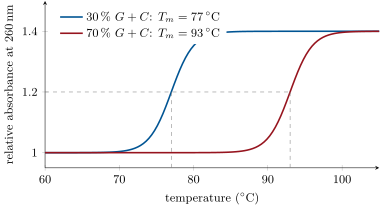

Melting curves of two DNAs in the same salt. The absorbance rises by 40\,\% as the strands separate, over a few degrees; the midpoint, T_m, is higher for the DNA richer in G–C pairs.
Melting curves of two DNAs in the same salt. The absorbance rises by 40 %40\,\% as the strands separate, over a few degrees; the midpoint, TmT_m, is higher for the DNA richer in G–C pairs.
DNA precipitated by cold ethanol from a cell lysate and spooled onto a glass rod: a few milligrams of the molecule, visible as fibres because each is millions of base pairs long.

উদাহরণ

Example 11.11 (A probe finds a gene)

A twenty-nucleotide probe complementary to one gene, at 5 ∘C5\,{}^{\circ}\mathrm{C} below its own TmT_m, binds its exact complement and nothing else in three billion base pairs: a single mismatch in twenty lowers TmT_m by several degrees and the mismatched hybrid melts. The specificity of base pairing, multiplied over twenty positions, is what every DNA test, from paternity to pathogen detection, relies on.

প্রসঙ্গসহ পড়ো →