
Biology · Glossary

What is Diabetes?

Definition 32.6 High School Biology · Chapter 32 — Blood Glucose and Diabetes

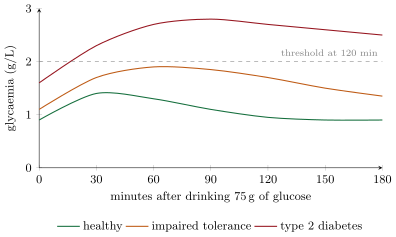
Diabetes is a chronic excess of glycaemia: above 1.26g/L1.26\,\mathrm{g}/\mathrm{L} fasting, or above 2g/L2\,\mathrm{g}/\mathrm{L} two hours after a standard glucose load. Its early signs follow from the excess: glucose in the urine, which drags water with it (abundant urine, thirst), and weight loss when cells cannot use the glucose around them. Its late damage — to the small vessels of the eye and kidney, to nerves, to the arteries — comes from years of glucose reacting with proteins. Two diseases share the name.
The glucose tolerance test: glycaemia after a standard drink of 75\, g of glucose. A healthy person is back near 1\, g/ L in two hours; a diabetic starts high, climbs above 2\, g/ L and stays there. The intermediate curve is the warning stage, usually reversible.
The glucose tolerance test: glycaemia after a standard drink of 75g75\,\mathrm{g} of glucose. A healthy person is back near 1g/L1\,\mathrm{g}/\mathrm{L} in two hours; a diabetic starts high, climbs above 2g/L2\,\mathrm{g}/\mathrm{L} and stays there. The intermediate curve is the warning stage, usually reversible.
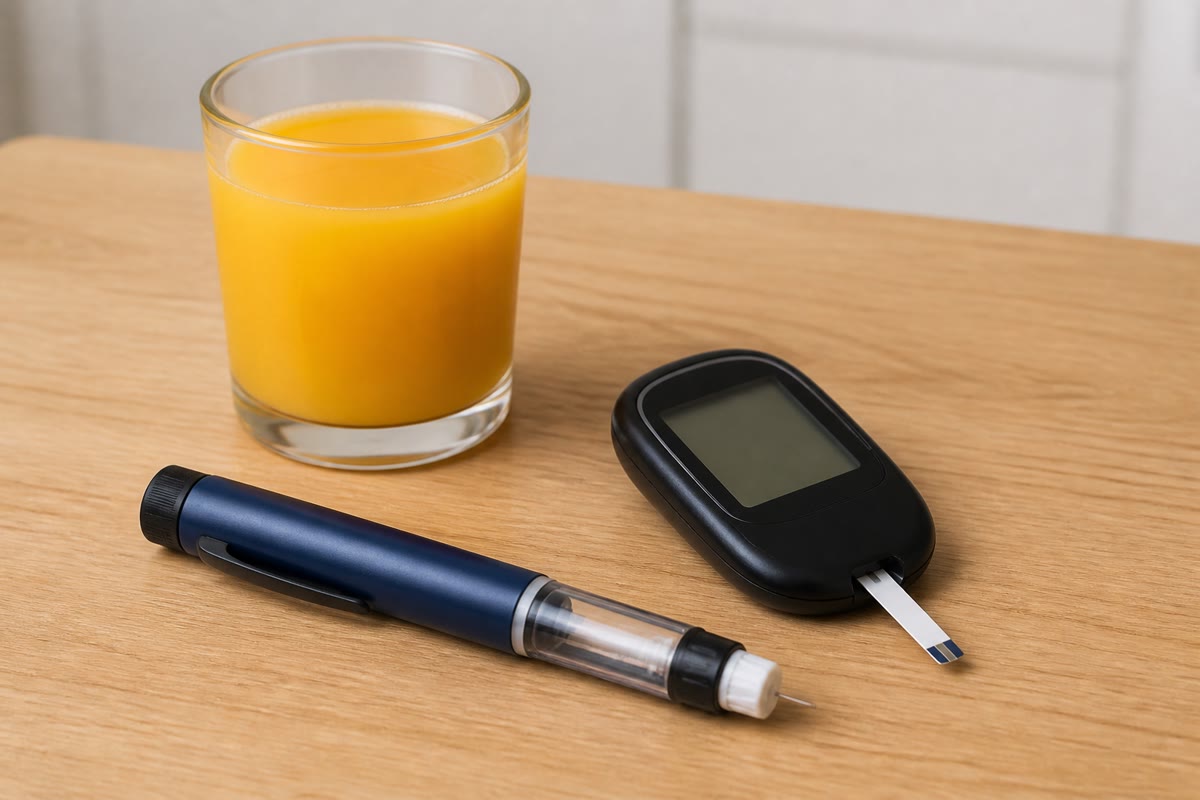
The tools of a type 1 diabetic: a meter that reads the glycaemia from a drop of blood, and a pen that injects a measured dose of insulin. The loop of the islets, run by hand several times a day.
Read in context →