Coach
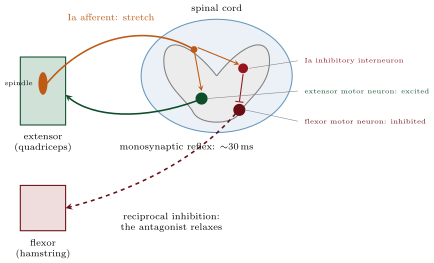
CoachA reflex arc is the shortest path from a sensor to an effector: in the knee jerk, a muscle-spindle afferent enters the cord and synapses directly on the motor neurons of the same muscle, which contract it about after the tap — one synapse, no brain. The same afferent excites an inhibitory interneuron to the motor neurons of the opposing muscle (reciprocal inhibition), so that the extensor’s contraction is not fought by the flexor. Most circuits are built from a few motifs: divergence, one neuron driving many, and convergence, many onto one, which sums evidence; feedforward inhibition, in which an input excites both a target and an interneuron that inhibits the target a millisecond later, sharpening the response in time; feedback inhibition, in which the target’s own output excites an interneuron that inhibits it, limiting firing and, spread to neighbours, producing the lateral inhibition that sharpens contrast (Chapter 18); and disinhibition, inhibiting an inhibitor, the basal ganglia’s way of releasing a movement.