
সব বই

পেশাদার

1 Markets I: The Ecosystem and Exchange-Traded Marketsবাজার অনলাইন 2 Markets II: Rates, FX and Creditবাজার অনলাইন 3 Markets III: Commodities, Energy and Cryptoবাজার অনলাইন 4 Quantitative Methodsপদ্ধতি অনলাইন 5 Derivatives and Volatilityডেরিভেটিভস অনলাইন 6 Rates, Credit, XVA and Riskসুদহার, ঋণ ও ঝুঁকি অনলাইন 7 Research Craft: Predictors, Backtests, Measurement, Portfoliosগবেষণা অনলাইন 8 Strategies I: Equities and Futuresকৌশল অনলাইন 9 Strategies II: Volatility, Relative Value, Macro and the Bank Desksকৌশল অনলাইন 10 Microstructure and Executionএক্সিকিউশন অনলাইন 11 Market Making and High-Frequency Tradingমার্কেট মেকিং অনলাইন 12 Machine Learning for Marketsমেশিন লার্নিং অনলাইন 13 Low-Latency Softwareপ্রযুক্তি অনলাইন 14 Networks, Hardware and Trading Infrastructureপ্রযুক্তি অনলাইন 15 Research, Data and Risk Platformsপ্রযুক্তি অনলাইন 16 The Desk and the Firmপ্রতিষ্ঠান অনলাইন 17 The Industry: Firms, Roles and Careersক্যারিয়ার অনলাইন 18 Interviews I: Maths, Probability and Speedক্যারিয়ার অনলাইন 19 Interviews II: Markets, Trading Games and the Final Roundক্যারিয়ার অনলাইন 20 Interviews III: Codeক্যারিয়ার অনলাইন
অ্যাপ পরিচিতি Coach সাইন ইন পড়া শুরু করো

বইগুলো এখনো বাংলা ভাষায় পাওয়া যায় না — ইংরেজি সংস্করণ দেখানো হচ্ছে।

Biology · পরিভাষা

Elementary circuits কী?

Definition 17.4 University Biology — Year 3 · অধ্যায় 17 — Organization of Nervous Systems

A reflex arc is the shortest path from a sensor to an effector: in the knee jerk, a muscle-spindle afferent enters the cord and synapses directly on the motor neurons of the same muscle, which contract it about 30 ms30\,\mathrm{ms} after the tap — one synapse, no brain. The same afferent excites an inhibitory interneuron to the motor neurons of the opposing muscle (reciprocal inhibition), so that the extensor’s contraction is not fought by the flexor. Most circuits are built from a few motifs: divergence, one neuron driving many, and convergence, many onto one, which sums evidence; feedforward inhibition, in which an input excites both a target and an interneuron that inhibits the target a millisecond later, sharpening the response in time; feedback inhibition, in which the target’s own output excites an interneuron that inhibits it, limiting firing and, spread to neighbours, producing the lateral inhibition that sharpens contrast (Chapter 18); and disinhibition, inhibiting an inhibitor, the basal ganglia’s way of releasing a movement.
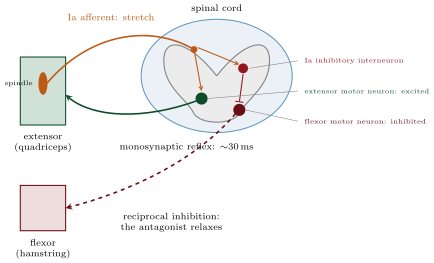
The stretch reflex. A tap stretches the extensor’s spindles; the Ia afferent excites the extensor’s motor neurons directly (one synapse) and, through an inhibitory interneuron, silences the flexor’s.
প্রসঙ্গসহ পড়ো →