University Biology — Year 3 · Bachelor Year 3
17Organization of Nervous Systems
A jellyfish has a few thousand neurons in a net with no centre and can swim, feed and right itself. An octopus has half a billion, two thirds of them in its arms, each of which can solve a problem the brain has not been told about. You have eighty-six billion, joined by a hundred trillion synapses, running on twenty watts — a fifth of your energy for two per cent of your mass — and Santiago Ramón y Cajal, drawing them cell by cell in the 1890s from silver-stained slices, saw that they were separate cells that touched without fusing and that signals flowed through them in one direction. The previous volume treated the neuron: its resting potential, its action potential, its synapse. This chapter treats what neurons are wired into: the passive cable that limits how far a signal spreads and how fast, the circuits — reflex, oscillator, inhibitory surround — from which behaviour is assembled, the plan of the vertebrate nervous system and of the glia that keep it running, its energy budget, and the ways different animals have distributed their neurons.
17.1 Neurons and glia
Definition 17.1 (The cells of the nervous system)
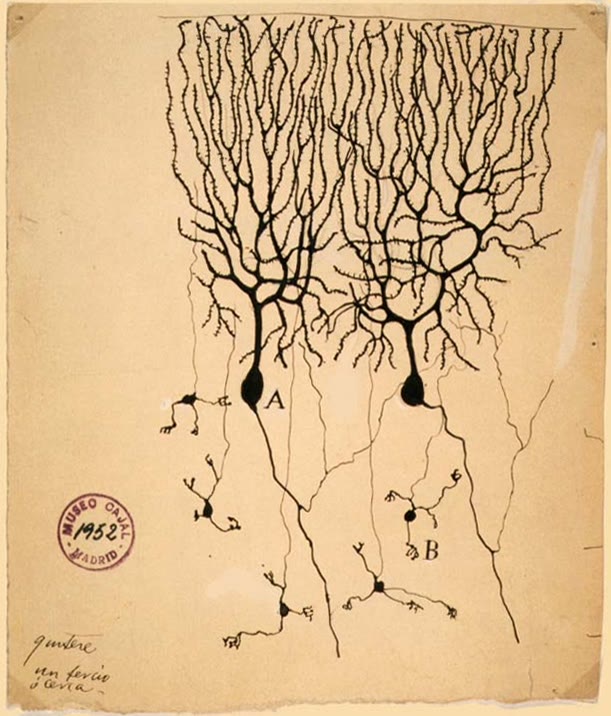
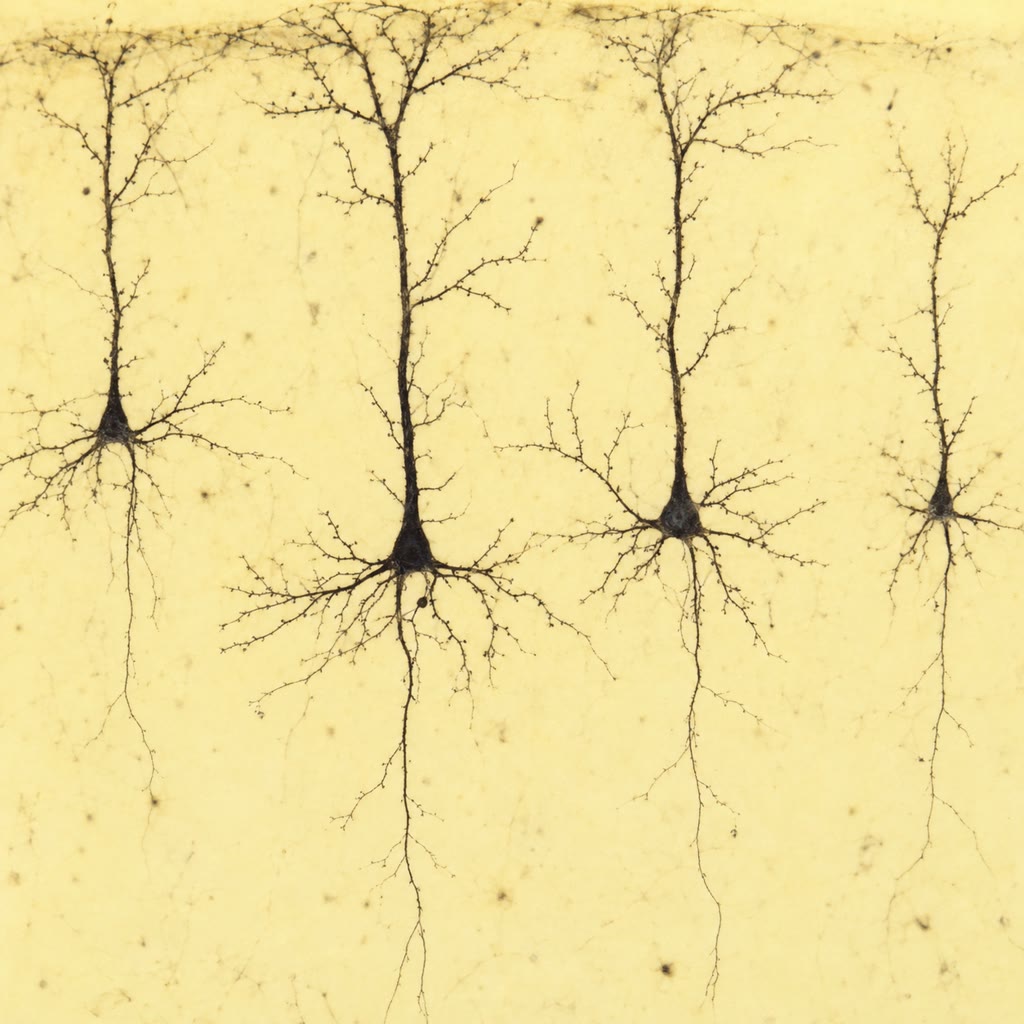
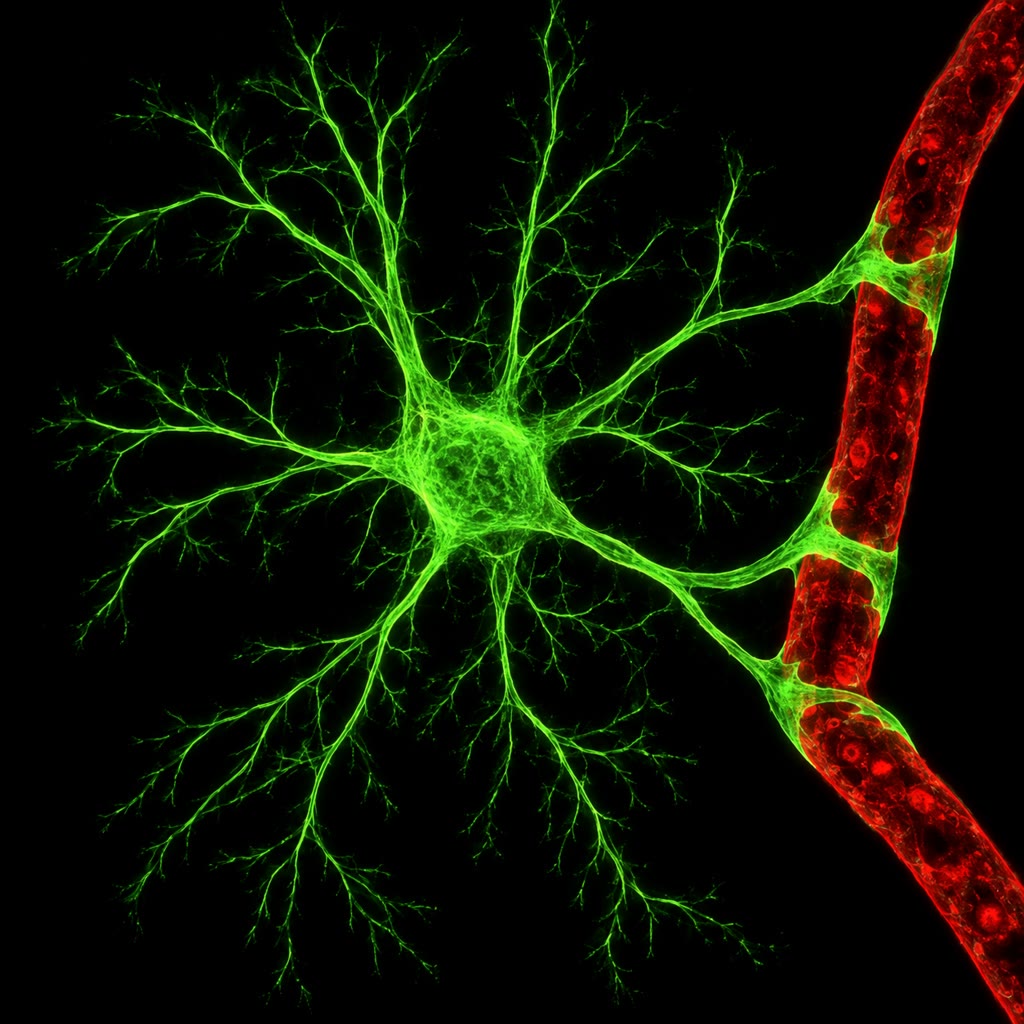
Neurons come in a few architectures that recur across the brain: pyramidal cells, the excitatory projection neurons of the cortex, with a long apical dendrite and an axon that may travel a metre; Purkinje cells of the cerebellum, whose flat dendritic tree receives two hundred thousand synapses; sensory neurons with one process to the periphery and one to the cord; and interneurons, short-axon cells that stay within a region, most of them inhibitory. About four in five cortical neurons release glutamate and excite; one in five release GABA and inhibit. The glia, as numerous as the neurons, do the rest. Astrocytes wrap synapses and blood vessels: they take up the potassium that firing neurons release and the glutamate that synapses spill, supply lactate, regulate blood flow locally, and induce and maintain the blood–brain barrier. Oligodendrocytes in the central nervous system and Schwann cells in the periphery wrap axons in myelin, dozens of layers of membrane that insulate the axon between the nodes where the channels sit. Microglia are the brain’s resident macrophages, pruning synapses in development and clearing debris. Ependymal cells line the ventricles and make the cerebrospinal fluid.
Evidence. Golgi’s silver chromate stain (1873) blackened, for unknown reasons, about one neuron in a hundred, completely, leaving the rest invisible — so that a single cell could be seen whole in a tangle of millions. Golgi read his own preparations as a continuous reticulum; Cajal, from 1888, using the same stain on embryonic tissue where the cells are simpler, saw that each cell ended freely, that dendrites and axon differed, and that axons ended on the dendrites and bodies of other cells without joining them. From the arrangement of sensory and motor cells he inferred the direction of flow — dendrite to body to axon — the law of dynamic polarisation. Sherrington named the gap the synapse in 1897; the electron microscope showed it in 1954. ∎
17.2 The neuron as a cable
Theorem 17.2 (The steady-state cable equation)
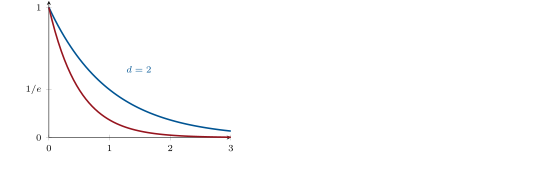
Model a dendrite or unmyelinated axon as a cylinder of diameter whose cytoplasm has resistivity and whose membrane has specific resistance (resistance times area) and capacitance per area. Per unit length the axial resistance is and the membrane resistance . A steady voltage applied at spreads along the fibre as
where is the length constant: the distance over which a passive signal falls to , growing with the square root of the diameter. The membrane charges with the time constant , independent of geometry. An action potential, which regenerates itself, travels along an unmyelinated axon at a speed proportional to and hence to ; along a myelinated axon, where it jumps from node to node, at a speed proportional to — about per micrometre of diameter.
Proof. Let be the axial current. Ohm’s law along the core gives ; conservation of charge at steady state says that the axial current lost between and leaks through the membrane, . Differentiating the first and substituting the second, , a linear second-order equation whose solution bounded as is . Substituting and gives . The time constant is that of a resistor and capacitor in parallel, . For the velocities: a regenerating wave must charge the membrane a length constant ahead in about a time constant, so ; between nodes of a myelinated axon the internodal membrane has a resistance raised and a capacitance lowered by the hundred-odd layers of myelin, the internode length scales with , and the result is . The proportionality constants are admitted. ∎
Example 17.3 (Numbers for a dendrite and two axons)
A dendrite of with and : — a synaptic potential at the tip of a millimetre-long dendrite reaches the cell body at a third of its size, which is why the geometry of a dendritic tree is part of its computation. , the window within which inputs must arrive to sum. A squid giant axon of , unmyelinated, conducts at about ; to do the same a vertebrate uses a myelinated axon of , fifteen thousand times smaller in cross-section — the reason a vertebrate nerve can carry ten thousand fast fibres in the space of one squid axon. A motor axon conducts at ; when multiple sclerosis strips its myelin the velocity falls tenfold and conduction may fail altogether at the bare stretches.
17.3 Circuits
Definition 17.4 (Elementary circuits)
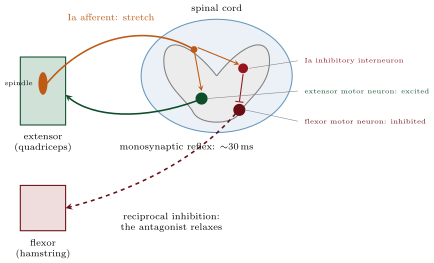
A reflex arc is the shortest path from a sensor to an effector: in the knee jerk, a muscle-spindle afferent enters the cord and synapses directly on the motor neurons of the same muscle, which contract it about after the tap — one synapse, no brain. The same afferent excites an inhibitory interneuron to the motor neurons of the opposing muscle (reciprocal inhibition), so that the extensor’s contraction is not fought by the flexor. Most circuits are built from a few motifs: divergence, one neuron driving many, and convergence, many onto one, which sums evidence; feedforward inhibition, in which an input excites both a target and an interneuron that inhibits the target a millisecond later, sharpening the response in time; feedback inhibition, in which the target’s own output excites an interneuron that inhibits it, limiting firing and, spread to neighbours, producing the lateral inhibition that sharpens contrast (Chapter 18); and disinhibition, inhibiting an inhibitor, the basal ganglia’s way of releasing a movement.
Proposition 17.5 (Central pattern generators)
Rhythmic movements — breathing, walking, swimming, chewing — are produced by circuits in the brainstem and spinal cord that oscillate on their own, central pattern generators, which sensory feedback adjusts but does not create: a cat’s spinal cord cut from the brain and deprived of its sensory nerves still produces the alternating pattern of stepping. The simplest design is Brown’s half-centre (1911): two groups of neurons that each inhibit the other. Whichever fires silences its partner; but a firing group tires — its channels inactivate, its inhibition of the partner weakens — and the partner, released, fires and in turn silences the first: alternation, with a period set by the time constant of the fatigue, not by any clock. The respiratory rhythm arises in a cluster of a few thousand neurons in the medulla (the pre-Bötzinger complex), which fires in bursts from birth to death; the lamprey’s swimming is a chain of half-centres along its cord, each delayed on the last so that a wave travels tailward.

Method 17.6 (Tracing a circuit)
To establish that neuron A drives neuron B and that the pathway matters for a behaviour: (1) anatomy — inject a tracer that travels along axons (a dye, a modified rabies virus that crosses one synapse backward) and find the connected cells; (2) physiology — record from B while stimulating A, and measure the latency (a monosynaptic connection gives a fixed delay of about a millisecond) and the sign (excitation or inhibition); (3) necessity — silence A, by lesion, by cooling, or by expressing in it a light-driven chloride pump and shining light (optogenetics), and see whether the behaviour fails; (4) sufficiency — activate A alone, with a light-driven cation channel, and see whether the behaviour appears; (5) in an intact animal, image the activity of the whole population with a calcium indicator while the behaviour is performed. A circuit is established when all five agree; most published circuits have two or three.
17.4 The plan of the vertebrate nervous system
Definition 17.7 (Central and peripheral divisions)
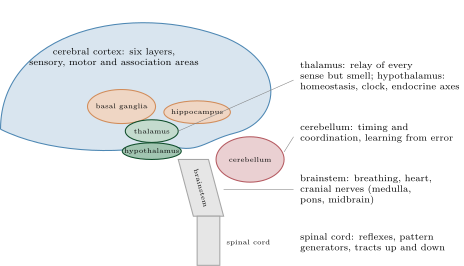
The central nervous system is the brain and spinal cord; the peripheral is everything else. The spinal cord receives sensory axons through its dorsal roots and sends motor axons through its ventral roots, its grey matter a butterfly of cell bodies, its white matter the myelinated tracts running up and down. The brainstem — medulla, pons, midbrain — holds the nuclei of the cranial nerves and the centres that keep breathing, heart rate and blood pressure going without thought; a brainstem death is death. The cerebellum, with more neurons than the rest of the brain, tunes the timing and coordination of movement and learns from error. The thalamus relays every sense but smell to the cortex and the cortex’s answers back; the hypothalamus beneath it runs homeostasis — temperature, hunger, thirst, the clock, the endocrine axes of Chapter 21. The basal ganglia select among possible actions; the hippocampus makes memories (Chapter 19); and the cerebral cortex, a sheet of six layers of cells two to four millimetres thick and a quarter of a square metre in area, folded to fit, does the rest, in areas mapped for each sense and movement and in association areas between them. The peripheral system’s autonomic division runs the organs: the sympathetic chain, releasing noradrenaline, mobilises (heart up, gut down, pupils wide); the parasympathetic nerves, releasing acetylcholine, conserve and digest; and the enteric nervous system, half a billion neurons in the gut wall, runs digestion on its own.
Proposition 17.8 (The blood–brain barrier and the brain’s budget)
The capillaries of the brain are sealed by tight junctions between their endothelial cells, wrapped in astrocyte endfeet, and equipped with transporters that admit glucose and amino acids and pump out much else: the blood–brain barrier, which keeps the ionic composition of the brain’s extracellular fluid constant for the sake of the neurons’ electrical behaviour, and which excludes most drugs ( of small molecules, all antibodies) — the central problem of neuropharmacology. The brain floats in of cerebrospinal fluid, made at half a millilitre a minute and renewed four times a day, which cushions it and carries away waste, especially during sleep. The brain’s cost: some in an adult, of the resting metabolism, almost all as glucose burnt to ATP, and most of that ATP spent by the sodium pump restoring the gradients that action potentials and synaptic currents run down. At per mole of ATP, is mol of ATP per second, molecules; divided among neurons, about ATP per neuron per second. A cortical action potential with its synaptic consequences costs of the order of ATP, so the budget allows an average firing rate of a few spikes per second per neuron — and cortical neurons do fire at about that rate. The brain is built to a strict energy limit, which is why its signals are sparse, its axons thin, and its information coded by few spikes in many cells.
Proof. Admitted at this level. ∎
17.5 Nervous systems across animals
Definition 17.9 (Nerve nets, ganglia and brains)
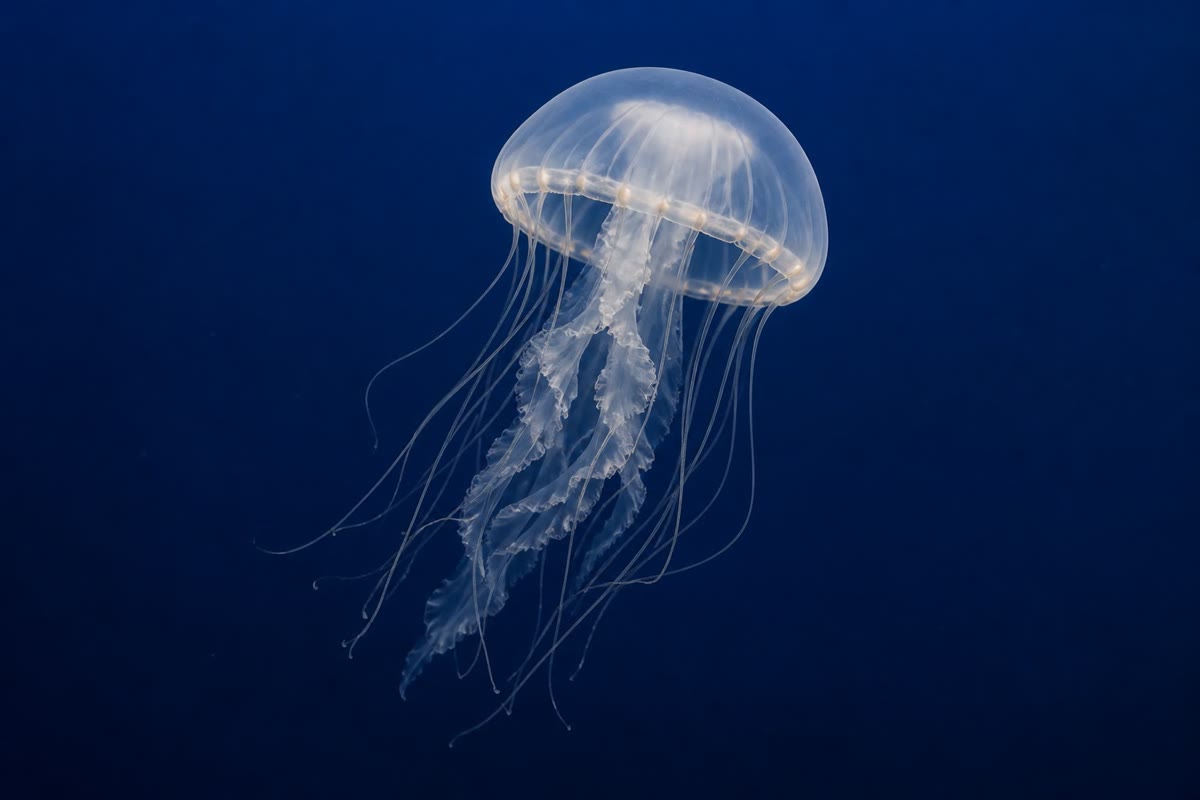
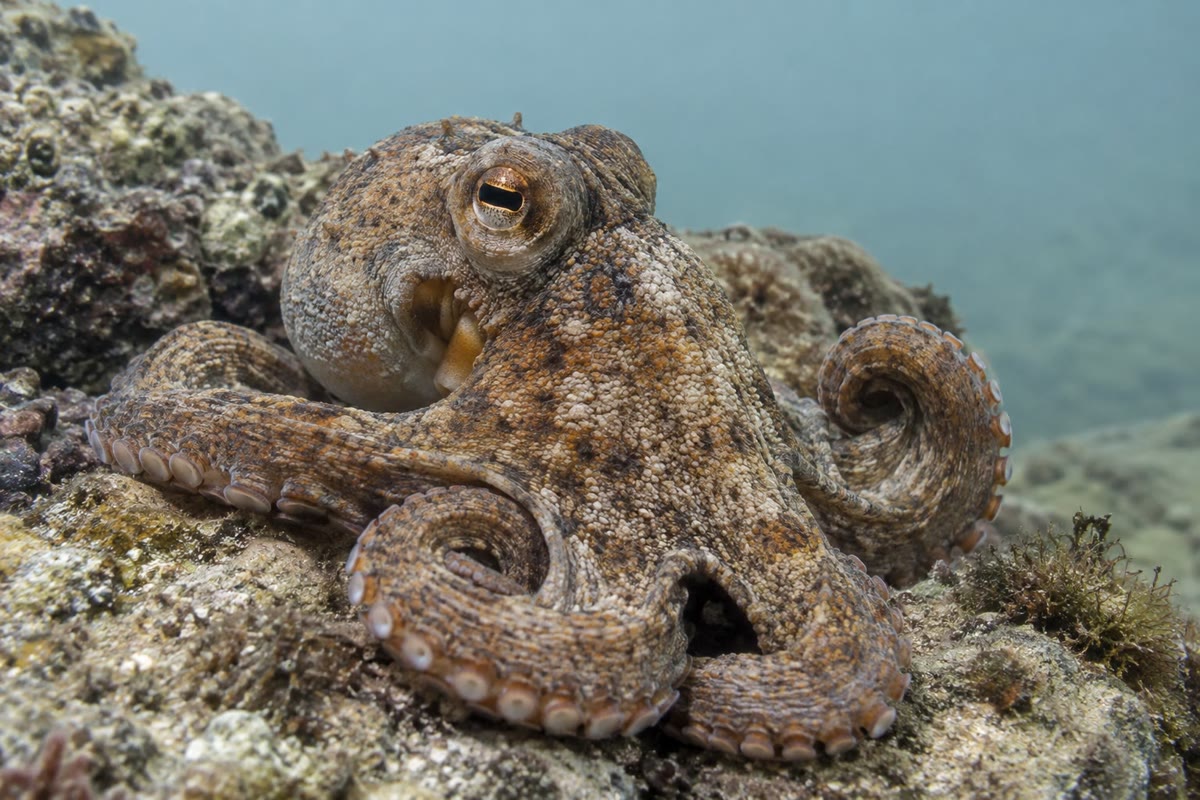
Cnidarians (jellyfish, hydra) have a nerve net: neurons distributed through the body wall, connected in every direction, with ring-shaped condensations around the bell margin that coordinate swimming — no centre, and conduction in both directions along each cell. Bilaterian animals concentrate neurons into ganglia — clusters with a shared neuropil — arranged along a ventral cord in arthropods and annelids, with a head ganglion enlarged where the sense organs are: cephalisation. Molluscs vary from the simple ganglia of a clam to the octopus, whose half-billion neurons are the most of any invertebrate and two thirds of which lie in the arms, each arm’s cord controlling its own reaching and grasping. Vertebrates build a dorsal hollow tube, expanded at the front into the brain of the previous section, protected by bone and a barrier, and myelinated. The same signalling molecules, channels, transmitters and many of the same developmental genes (the Hox code of the hindbrain, the eye-patterning factors) run all of them: the parts are ancient and shared, the arrangements diverse.
Example 17.10 (Counting neurons)
A nematode has neurons, every one named and every synapse mapped; a fruit fly ; a honeybee ; a mouse ; an octopus ; a human ; an elephant , most of them in its cerebellum. Brain mass scales with body mass across mammals roughly as , so a mouse’s brain is a larger fraction of its body than an elephant’s; species above the line for their size — dolphins, primates, humans by a factor of seven — are said to be encephalised. What tracks cognition best is not brain mass but the number of neurons in the cerebral cortex: about in a human, in the elephant with its three-times-larger brain, in a chimpanzee. The human brain is not special in its cells or its plan; it has more cortical neurons than any other, packed more densely, and it is the number, not the weight, that seems to count.
Remark 17.11 (What a nervous system is for)
Plants, fungi and sponges have none; an animal that moves needs one, and the elaboration of nervous systems tracks the demands of movement, of sensing at a distance, and of predicting what will happen next. The cable equation sets the physics — how far and how fast a signal travels for a given diameter and insulation; the energy budget sets the economics; and within those limits the same neurons, arranged as nets, ganglia or a cortex, produce a jellyfish’s pulse, an octopus’s camouflage or this sentence. The next two chapters take the input end and the storage: how the senses turn the world into spikes, and how synapses change so that the world, once met, is remembered.
17.6 Exercises
Exercise 17.1 ★
Name the four kinds of glia and one function of each, and say which two make myelin and where.
Solution
Solution of Exercise 17.1.
Astrocytes: buffer potassium and glutamate, feed neurons, induce the blood–brain barrier, regulate local blood flow. Oligodendrocytes: myelinate axons in the central nervous system. Schwann cells: myelinate peripheral axons (and guide their regeneration). Microglia: the brain’s macrophages, pruning synapses and clearing debris. (Ependymal cells line the ventricles and make cerebrospinal fluid.)
Exercise 17.2 ★
What did Golgi’s stain make possible, what did Cajal conclude from it, and what did Golgi conclude? Which was right, and how was it settled?
Solution
Solution of Exercise 17.2.
The stain blackened a few neurons completely and left the rest invisible, so a single cell could be seen entire. Cajal concluded that neurons are separate cells contacting one another without fusing, with a fixed direction of flow from dendrites to axon; Golgi concluded that they formed a continuous network. Cajal was right; the electron microscope showed the synaptic gap in 1954.
Exercise 17.3 ★
Describe the knee-jerk reflex arc and explain why it takes only while a voluntary kick takes ten times longer.
Solution
Solution of Exercise 17.3.
A tap stretches the quadriceps; its muscle spindles fire; the Ia afferents enter the cord and synapse directly on the quadriceps motor neurons, which fire and contract the muscle, while an interneuron inhibits the hamstring motor neurons. One synapse, short axons at : about . A voluntary kick passes through the brain — perception, decision, motor planning, descending tracts, several synapses — and takes .
Exercise 17.4 ★
List the sympathetic and parasympathetic effects on the heart, the pupil, the gut and the airways, and the transmitter each division uses at the target.
Solution
Solution of Exercise 17.4.
Sympathetic (noradrenaline at the target): heart faster and stronger, pupil dilated, gut motility and secretion reduced, airways dilated. Parasympathetic (acetylcholine): heart slowed, pupil constricted, gut motility and secretion increased, airways constricted.
Exercise 17.5 ★★
Compute the length constant of an axon of with and , and the fraction of a signal remaining after . What diameter would double ?
Solution
Solution of Exercise 17.5.
cm . After : . Doubling needs four times the diameter, .
Exercise 17.6 ★★
A sensory axon of runs from the toe to the cord, and a motor axon of runs back. With per micrometre and per synapse, estimate the minimum latency of a spinal withdrawal reflex with one interneuron. How long would it take with unmyelinated axons of the same diameter at ?
Solution
Solution of Exercise 17.6.
Sensory: , . Motor: , . Two synapses, : about . Unmyelinated: and : — too slow to save the foot.
Exercise 17.7 ★★
Using the brain’s budget from Proposition 17.8, estimate how many ATP a neuron can spend per second, and, if a spike with its synapses costs ATP, the mean firing rate the budget allows. What does this predict about the code?
Solution
Solution of Exercise 17.7.
ATP per neuron per second; at per spike, about on average. The code must be sparse: few spikes, information carried by which neurons fire and when, not by high rates everywhere.
Exercise 17.8 ★★
Explain why a half-centre oscillator needs fatigue (or another slow process) to oscillate, and what would happen with two mutually inhibitory neurons that never tire.
Solution
Solution of Exercise 17.8.
Two neurons that inhibit each other without tiring form a switch: the first to fire suppresses the other for as long as the drive lasts, and nothing ever hands over. Oscillation needs a slow process that weakens the winner’s grip — adaptation of its firing, depression of its inhibitory synapse, or a rebound of the loser after release — whose time constant sets the period.
Exercise 17.9 ★★
The blood–brain barrier excludes L-dopa’s product dopamine but admits L-dopa. Explain how this is exploited in Parkinson’s disease and why antibodies against brain proteins are hard to deliver.
Solution
Solution of Exercise 17.9.
L-dopa is carried across the barrier by the transporter for large neutral amino acids; dopamine, polar and charged, is not. Patients take L-dopa (with an inhibitor of the peripheral enzyme so that it is not converted before crossing), and the brain’s own enzyme makes dopamine from it where it is needed. Antibodies, at , cross neither the tight junctions nor any transporter; delivery needs a shuttle that hijacks a receptor for transcytosis, or injection into the cerebrospinal fluid.
Exercise 17.10 ★★★
Derive the cable equation’s time-dependent form, , by adding the capacitive current to the membrane current, and show that the steady-state solution of the theorem follows. (State the form; solving it is not required.) Why is the ratio a velocity?
Solution
Solution of Exercise 17.10.
The membrane current per unit length is the resistive plus the capacitive ; charge conservation gives , and with , ; multiplying by : . With the theorem’s equation returns. is a length and a time, so is a speed — the natural scale for how fast a disturbance spreads.
Exercise 17.11 ★★★
A squid giant axon of conducts at . Using , what diameter of unmyelinated axon would be needed for ? Compute the cross-sectional area and compare with the myelinated axon that achieves it. What does this imply about the number of fast fibres a nerve can carry, and about the evolution of myelin?
Solution
Solution of Exercise 17.11.
: four times the speed needs sixteen times the diameter, . Area against : a ratio of . A nerve of fast unmyelinated fibres is impossible — one such fibre would be as thick as the nerve — so an animal with many fast channels needs myelin, which is why vertebrates (and a few invertebrates independently) evolved it.
Exercise 17.12 ★★★
Brain mass scales as across mammals. A mouse has a brain. Predict the brain mass of a mammal on the line, compare with the human , and discuss why cortical neuron number rather than brain mass is the better correlate of cognitive capacity.
Solution
Solution of Exercise 17.12.
; for : . The human is ten times the prediction. Brain mass follows body mass because a larger body needs more sensory and motor neurons, and because neurons themselves grow with brain size; what tracks cognition is the number of neurons in the cortex, which depends on how densely they are packed — primates pack more per gram than other mammals, and humans most of all.
17.7 Problem: Wiring a Body
Problem 17.1
Weekend problem — a body’s wiring costed in length constants, milliseconds and watts: the cable numbers of a dendrite and two axons, the latency of a reflex from toe to cord and back, the energy the brain can afford per spike, and the scaling of brains across animals, ending on the length constant, the reflex latency and the mean firing rate a brain can pay for
Data: , , . Myelinated velocity per micrometre; unmyelinated m/s with in micrometres; synaptic delay . Brain: , neurons, synapses, ATP ; a spike costs ATP and each synaptic transmission ATP; a neuron has synapses. Scaling: with a mouse having a brain.
Part I — Cables.
- Compute for dendrites of and , and .
- A synapse from the soma on the dendrite produces locally. What arrives at the soma? On the dendrite?
- Explain why a neuron can weight its inputs by where on the tree they land, and why inputs must arrive within about to sum.
- Compute the velocity of a myelinated axon, and of an unmyelinated axon of the same diameter. What diameter of unmyelinated axon would match the myelinated one?
- Cross-sectional areas of the axon and of the unmyelinated equivalent. How many myelinated axons fit in the space of one equivalent unmyelinated axon?
- A demyelinating disease removes the myelin from a axon over . Estimate the extra delay over that stretch if it conducts as an unmyelinated axon of that diameter, and say why conduction may fail altogether.
Part II — Latencies.
- A toe touches a hot surface. The sensory axon (, ) reaches the cord, one interneuron, and a motor axon (, ) returns to the leg. Minimum latency of the withdrawal?
- The signal also travels up a axon to the brain and through two more synapses before pain is felt. When is the pain felt relative to the withdrawal?
- A pain fibre is unmyelinated, . How long does its signal take to travel the to the brain? Explain the two phases of pain from a stubbed toe.
- A giraffe’s leg is longer. Recompute the reflex latency and comment on the problems of size.
- The knee jerk is monosynaptic, in an adult. Using each way at , one synapse and a neuromuscular junction (), and for the muscle to develop force, account for the .
- A newborn’s axons are unmyelinated. Explain why its reflexes are slow and its movements uncoordinated, and what myelination during the first two years changes.
Part III — The budget.
- Convert into ATP per second, and into ATP per neuron per second.
- A neuron fires one spike: it costs ATP itself and drives synapses at each. Total cost of one spike with its consequences?
- What mean firing rate can the budget sustain if all of it went on spikes? If half goes to resting costs?
- Cortical neurons fire at about on average. What fraction of the budget is that, and what does it imply about how information is coded?
- A brain that fired every neuron at would need how many watts? Compare with the whole body’s .
- Glucose supplies the brain at . How many watts is that ()? Is it enough, and what happens to consciousness within seconds of the supply failing?
Part IV — Scaling.
- Find from the mouse, then predict the brain mass of a mammal and of a elephant on the line.
- Actual values: human , elephant . Compute each species’ ratio to the prediction (the encephalisation quotient).
- The elephant’s brain has neurons but in the cortex; the human and . Where are the elephant’s neurons, and what does that suggest about what cortex does?
- A neuron’s volume grows with its axon’s length, so bigger brains have bigger, sparser neurons. Explain why doubling brain mass does not double neuron number, and why primates, whose neurons stay small as the brain grows, gain more neurons per gram than rodents.
- An octopus has neurons, two thirds in its arms. Propose what an arm can and cannot do without the brain, and one experiment to test it.
- The nematode C. elegans has neurons and about synapses in all, every one mapped. Compare its synapses per neuron with the human figure, and say what a complete wiring diagram can and cannot tell us about behaviour.
- Summarise: the length constant of the dendrite (question 1), the withdrawal reflex latency (question 7), and the mean firing rate the brain’s budget allows with half its energy on spikes (question 15).
Solution
Solution of Problem 17.1.
1. : for , ; for , . . 2. ; . 3. Distal inputs arrive attenuated, so where a synapse lands sets its weight; a potential decays in about , so two inputs sum only if they fall within some of each other — the neuron is a coincidence detector with a window. 4. Myelinated ; unmyelinated ; to reach unmyelinated, : three millimetres. 5. against : about myelinated axons in the space of one. 6. at is ; at , : some of extra delay. Worse, the bare membrane has a large capacitance and few channels, so the current from the last intact node may fail to bring it to threshold: conduction block. 7. Sensory ; two synapses ; motor : about (plus a millisecond at the neuromuscular junction). 8. To the brain: plus two synapses, after the signal enters the cord at : the signal reaches the cortex at about the time the foot moves; the conscious experience of pain needs a few hundred milliseconds more of processing, so the foot is withdrawn before the pain is felt. 9. : . The sharp first pain arrives by thin myelinated fibres within tens of milliseconds; the dull, burning second pain by the unmyelinated C fibres a second or more later. 10. Sensory , motor , synapses : about . Long animals have slow reflexes; they compensate with thicker axons and by delegating more to local circuits. 11. each way, ; synapse , junction , force : , with the spindle’s own transduction and the conduction into the muscle making up the rest of the . 12. Unmyelinated axons conduct at a metre or two per second, so loops that take in an adult take hundreds, with poor timing; myelination raises the speed ten- to fiftyfold and makes timing precise, which is what walking, grasping and speech require. 13. mol/s ATP per second; per neuron per second. 14. ATP. 15. All on spikes: ; half: about . 16. At , of the budget: the code is sparse — most neurons silent most of the time, information in which few fire and when. 17. ATP/s mol/s — twice the whole resting body. 18. : just enough, with no reserve. When the supply stops, the pumps stop within seconds, the gradients run down, and consciousness is lost in about ten seconds. 19. ; : ; : . 20. Human ; elephant . 21. In the cerebellum — of them — coordinating the trunk’s forty thousand muscles. Cortical neuron number, not total, tracks cognition; the cerebellum tracks the motor task of running a huge body. 22. Axons and dendrites lengthen with the brain, so each neuron occupies more volume and the number of neurons grows more slowly than mass. In primates neuron size stays nearly constant as the brain grows, so neuron number grows almost in proportion to mass, and a primate brain of a given weight holds several times the neurons of a rodent brain of that weight. 23. An arm can coordinate its own suckers and joints, reach, grasp, pass food along itself and avoid grasping its own skin, by local circuits; it cannot see, choose a target or learn a discrimination. Test: cut the arm’s nerve cord from the brain and touch the arm with food — it grasps and passes it toward where the mouth would be; an amputated arm does the same for an hour. 24. About synapses per neuron against : three hundred times fewer. The complete map tells which neuron can influence which, but not the strength or sign of each connection, which neuromodulators change them, or the dynamics — so even for the worm the wiring diagram predicts behaviour only in part. 25. for the dendrite; withdrawal latency about ; mean firing rate about with half the budget on spikes.