
Biology · Glossary

What is Fluid compartments?

Also known as: intracellular fluid · extracellular fluid · interstitial fluid · plasma · lymph

Definition 2.5 University Biology — Year 1 · Chapter 2 — Functional Organization of a Mammal

Water makes about 60%60\,\% of a mammal’s mass. Two thirds of it is intracellular fluid, inside the cells; one third is extracellular fluid, the internal environment of Chapter 1, itself divided into the interstitial fluid bathing the cells (three quarters of it) and the blood plasma inside the vessels (one quarter). Lymph is interstitial fluid collected by the lymphatic vessels and returned to the blood. The two extracellular fluids have nearly the same composition — plasma differs by its proteins, which do not cross the capillary wall — and both differ sharply from the intracellular fluid.
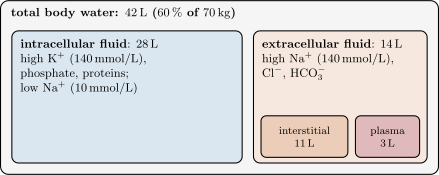
The fluid compartments of a 70\, kg human. Two thirds of the water is inside the cells; the extracellular third, split between the interstitial fluid and the plasma, is the internal environment. Sodium dominates outside, potassium inside — a difference every cell spends energy to maintain ().
The fluid compartments of a 70kg70\,\mathrm{kg} human. Two thirds of the water is inside the cells; the extracellular third, split between the interstitial fluid and the plasma, is the internal environment. Sodium dominates outside, potassium inside — a difference every cell spends energy to maintain (Chapter 7).

Examples

Example 2.7 (A plasma volume)

50mg50\,\mathrm{mg} of Evans blue injected into a 70kg70\,\mathrm{kg} man give, ten minutes later, a plasma concentration of 16.7mg/L16.7\,\mathrm{mg}/\mathrm{L}: V=50/16.7=3.0LV = 50/16.7 = 3.0\,\mathrm{L} of plasma. With a haematocrit of 45%45\,\%, the blood volume is 3.0/0.55=5.5L3.0/0.55 = 5.5\,\mathrm{L}8%8\,\% of the body mass, a proportion that holds from mouse to whale.

Read in context →