University Biology — Year 1 · Bachelor Year 1
2Functional Organization of a Mammal
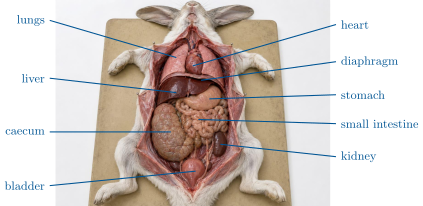
Open a rabbit on the dissecting board and the first impression is of order. A muscular sheet, the diaphragm, divides the trunk into a chest holding the heart and two lungs and an abdomen holding everything else: a liver the size of a fist, a stomach, four metres of intestine ending in a caecum as large as the stomach, two kidneys against the back wall. Each organ has a place, a blood supply, and a job; none of them works alone. This chapter describes how the mammal is built as a functioning whole: its body plan, the systems into which its organs are grouped, the fluid compartments its cells live in, the exchange surfaces through which it meets the outside, and the thermal balance that keeps it at in a January field.
2.1 The body plan of a mammal
Definition 2.1 (Body plan)
The body plan of an animal is the arrangement of its axes, cavities and organs that is shared by all members of its group. The mammalian body plan is that of a vertebrate: bilateral symmetry with a head end carrying the brain and the main sense organs (cephalisation), a dorsal axis of vertebrae enclosing the spinal cord, four limbs, and a ventral body cavity — the coelom — containing the viscera. What is specifically mammalian: the coelom is divided by the muscular diaphragm into a thoracic cavity (heart, lungs) and an abdominal cavity (digestive organs, kidneys, gonads); the body is covered in hair; the young are fed on milk; the temperature is regulated.
Definition 2.2 (Organ, organ system)
An organ is a structure made of several tissues (Chapter 4) arranged to perform a definite function: the heart pumps, the lung exchanges gases, the kidney filters. An organ system is a set of organs cooperating in one broad function: the digestive system runs from mouth to anus with the liver and pancreas attached; the circulatory system is the heart and the vessels; the excretory system, the kidneys and the urinary tract.
2.2 Organ systems and the functions they serve
Proposition 2.3 (Three groups of functions)
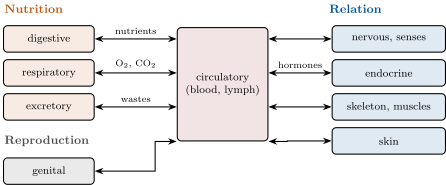
The organ systems of a mammal serve three groups of functions:
- nutrition: taking in and distributing matter and energy and disposing of wastes — the digestive, respiratory, circulatory and excretory systems;
- relation: sensing the environment and acting on it — the sense organs, the nervous system, the endocrine glands, the skeleton and the muscles;
- reproduction: producing offspring — the gonads, the genital tract and, in mammals, the mammary glands.
No system works alone: every organ depends on the blood for supply, on the nervous and endocrine systems for coordination, and on the skeleton and skin for protection.
Example 2.4 (A mouthful of grass)
The rabbit’s grass is cut by the incisors and ground by the molars (skeleton and muscles), tasted and smelt (senses), swallowed and digested in the stomach and small intestine; its sugars and amino acids cross the intestinal wall into the blood and reach the liver, which stores or releases them under hormonal control (endocrine); its cellulose is fermented by bacteria in the caecum; the oxygen to burn the sugars comes through the lungs, the carbon dioxide leaves the same way, the urea from the amino acids leaves through the kidneys, and the heat of the whole process leaves through the skin. Seven systems for one mouthful.
2.3 The compartments of the body
Definition 2.5 (Fluid compartments)
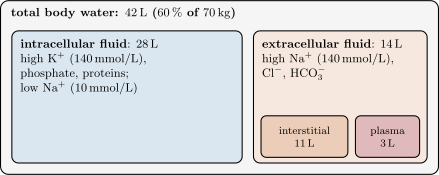
Water makes about of a mammal’s mass. Two thirds of it is intracellular fluid, inside the cells; one third is extracellular fluid, the internal environment of Chapter 1, itself divided into the interstitial fluid bathing the cells (three quarters of it) and the blood plasma inside the vessels (one quarter). Lymph is interstitial fluid collected by the lymphatic vessels and returned to the blood. The two extracellular fluids have nearly the same composition — plasma differs by its proteins, which do not cross the capillary wall — and both differ sharply from the intracellular fluid.
Method 2.6 (Measuring a compartment by dilution)
- Choose a marker that distributes in the compartment and nowhere else: a dye bound to plasma proteins (Evans blue) for the plasma; inulin, a sugar that leaves the vessels but does not enter cells, for the extracellular fluid; heavy water for the total body water.
- Inject a known amount and wait for mixing (minutes for plasma, hours for total water).
- Measure the concentration in a plasma sample, correcting for any loss (urine, metabolism) during the wait.
- The volume is . Intracellular volume is total water minus extracellular; interstitial volume is extracellular minus plasma. Blood volume is plasma volume divided by the plasma fraction of blood ( haematocrit).
Example 2.7 (A plasma volume)
of Evans blue injected into a man give, ten minutes later, a plasma concentration of : of plasma. With a haematocrit of , the blood volume is — of the body mass, a proportion that holds from mouse to whale.
2.4 Exchange surfaces and the circulation
Proposition 2.8 (Every exchange surface is coupled to the blood)
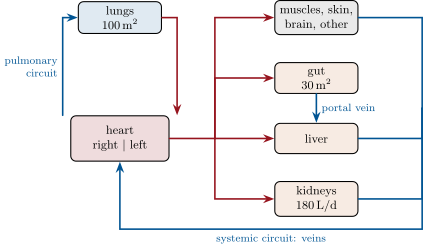
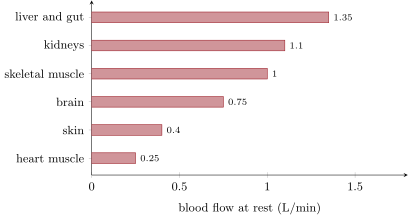
A mammal exchanges with the outside through four surfaces, each folded inside the body and each perfused by a dense capillary network: the intestinal mucosa ( in a human) for nutrients and water, the alveolar surface of the lungs () for oxygen and carbon dioxide, the filtering surface of the kidneys (a million glomeruli, filtering of plasma a day) for wastes and the regulation of the internal environment, and the skin () for heat and a little water. The circulation links them: blood leaving one surface reaches the next within a minute, so that what enters through the gut is oxidised with oxygen from the lung and its waste leaves through the kidney.
Example 2.9 (The circulation time)
With of blood and a cardiac output of , a drop of blood completes the double circuit in about one minute at rest, and in a quarter of that during hard exercise, when the output reaches . Cardiac output scales as (Theorem 1.14): a rabbit’s is about for of blood — the same circulation time within a factor of two, at a heart rate of beats per minute.
2.5 Endothermy and the thermal balance
Proposition 2.10 (The heat budget)
A mammal at steady temperature satisfies
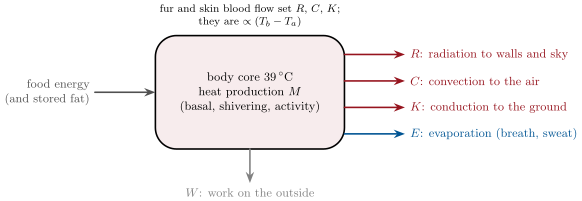
where is the metabolic heat production, the mechanical work done on the outside, and the right side the losses by radiation , convection to the air , conduction to the ground and evaporation (from the lungs, and from sweat or panting). The first three losses are proportional to and are governed by the insulation of the fur and the blood flow to the skin; evaporation is the only route that works when the air is warmer than the body. When the equation is not satisfied, the body temperature drifts at a rate set by the imbalance and by the body’s heat capacity (about ).
Proof. Conservation of energy for the body over a period in which its temperature does not change: the chemical energy released () leaves as work or as heat through the four physical channels. The proportionality of , , to the temperature difference is Newton’s law of cooling (Chapter 1); the independence of from that difference follows from evaporation being driven by the humidity gradient, not the temperature gradient. ∎
Proposition 2.11 (The means of thermoregulation)
Against cold, a mammal reduces loss — erecting its fur, constricting the vessels of the skin and extremities, curling up, huddling — and raises production: shivering (rhythmic contraction of the muscles) and, in small and young mammals, non-shivering thermogenesis in brown adipose tissue, whose mitochondria release the energy of fat directly as heat. Against warmth, it dilates the skin vessels (a rabbit’s ears can shed a third of its heat), and evaporates water by sweating (horse, human) or panting (dog, rabbit). All of it is commanded from the hypothalamus, which holds the set point and reads the temperature of the blood and of the skin.
Evidence. Heating the hypothalamus of a dog with an implanted probe makes it pant and dilate its skin vessels in a cold room; cooling the probe makes it shiver in a warm one. Oxygen consumption of a rat placed at triples within an hour, half of the increase from shivering (recorded as muscle electrical activity) and half from brown fat, whose temperature, measured with a thermocouple, exceeds that of the surrounding tissues. Infrared images of a rabbit at show its ears at nearly body temperature, at at nearly air temperature. ∎
Example 2.12 (The rabbit’s ears)
Two ears of about each, thin, nearly bare and richly vascularised: with their vessels open at in air at , with a bare-skin coefficient of , they lose , a sixth of a resting rabbit’s production. At the vessels close, the ears cool to near air temperature, and the loss through them falls below .
Remark 2.13 (Coordination)
Every adjustment above — a vessel narrowing, a muscle shivering, a gland secreting — is a command carried by a nerve or a hormone. The nervous system acts in milliseconds along fixed wires; the endocrine system acts in minutes to hours through the blood, reaching every cell that carries the right receptor. Their mechanisms are the subject of the Year 2 volume; this year takes them as given and studies what they coordinate.
2.6 Exercises
Exercise 2.1 ★
List the features of the mammalian body plan that are shared with all vertebrates, and those that are specific to mammals.
Solution
Solution of Exercise 2.1.
Vertebrate: bilateral symmetry, cephalisation, dorsal vertebral axis enclosing the spinal cord, ventral coelom with the viscera, four limbs. Mammalian: the diaphragm dividing the coelom into thorax and abdomen, hair, milk, regulated body temperature.
Exercise 2.2 ★
Assign each organ system to one of the three groups of functions, and name one organ of each system.
Solution
Solution of Exercise 2.2.
Nutrition: digestive (stomach), respiratory (lung), circulatory (heart), excretory (kidney). Relation: nervous (brain), sense organs (eye), endocrine (thyroid), skeleton and muscles (femur, biceps), skin. Reproduction: genital (ovary, testis), mammary glands.
Exercise 2.3 ★
A woman: estimate her total body water, her intracellular and extracellular volumes, her interstitial volume and her plasma volume.
Solution
Solution of Exercise 2.3.
Water ; intracellular ; extracellular , of which interstitial and plasma .
Exercise 2.4 ★
From the blood-flow figure, what fraction of the cardiac output goes to the kidneys, and how many times per day is the whole blood volume () pumped through them?
Solution
Solution of Exercise 2.4.
. is a day, i.e. the blood volume 290 times.
Exercise 2.5 ★★
of inulin are injected into a man; after mixing, and after has been lost in the urine, the plasma concentration is . Compute the extracellular volume, and, with the total water at , the intracellular volume.
Solution
Solution of Exercise 2.5.
Remaining inulin ; extracellular; intracellular .
Exercise 2.6 ★★
Explain why the plasma and the interstitial fluid have the same ionic composition but differ in protein content, and what would happen to the interstitial volume if the plasma proteins were lost.
Solution
Solution of Exercise 2.6.
The capillary wall lets water and small ions through freely, so they equilibrate, but holds back proteins. The plasma proteins draw water into the vessels osmotically; without them water would leak into the interstitial space, which would swell (oedema), and the plasma volume would fall.
Exercise 2.7 ★★
Why do the organs of the systemic circuit lie in parallel rather than in series? What would be the consequence of putting the brain downstream of the muscles?
Solution
Solution of Exercise 2.7.
In parallel each organ receives blood at full arterial oxygen and pressure, and its flow can be regulated independently. In series the brain would receive blood already depleted by the muscles, at lower pressure, and its supply would fall precisely during exercise.
Exercise 2.8 ★★
A resting human (, ) in air at loses by evaporation from the lungs and skin. If radiation, convection and conduction together are with and (skin) , find . What happens to the skin temperature when the air reaches ?
Solution
Solution of Exercise 2.8.
; . At air the non-evaporative loss vanishes; the skin must warm above the air (vessel dilation raises it toward ) and sweating must carry the rest.
Exercise 2.9 ★★
An exercising human produces and does of external work. Non-evaporative losses are . How much water must evaporate per hour to keep the temperature steady (latent heat )? If sweating stops, how fast does the temperature rise (, )?
Solution
Solution of Exercise 2.9.
Heat to remove , i.e. , of sweat per hour. Without sweating, , about : in half an hour.
Exercise 2.10 ★★★
Newborn mammals and small species rely on brown fat rather than shivering. Propose two reasons, using the surface-to-volume ratio and the nature of each mechanism.
Solution
Solution of Exercise 2.10.
Small bodies lose heat fastest per gram (large ) and need a continuous, high, reliable production: brown fat produces heat chemically at a steady rate without movement, whereas shivering requires developed muscles (which newborns lack), interferes with movement and feeding, and is intermittent. Brown fat also sits near the great vessels and warms the blood directly.
Exercise 2.11 ★★★
A dog’s hypothalamus is warmed with a probe while the dog sits in a cold room. Predict its responses, and its core temperature after an hour. Then predict the responses of a dog whose hypothalamus is destroyed, placed successively in a cold and in a hot room.
Solution
Solution of Exercise 2.11.
The warmed hypothalamus reads “too hot”: the dog pants and dilates its skin vessels despite the cold, and its core temperature falls, by a degree or two within the hour. Without a hypothalamus there is no set point: the dog neither shivers in the cold nor pants in the heat, and its temperature drifts toward the room’s in both cases.
Exercise 2.12 ★★★
“The internal environment is the mammal’s private ocean.” Discuss the image in a paragraph: what the extracellular fluid is, what keeps it constant, and which organ systems are its shores.
Solution
Solution of Exercise 2.12.
The extracellular fluid (interstitial fluid and plasma), of nearly constant sodium-rich composition, temperature and volume, bathes every cell as sea water bathed the first animals. Its constancy is maintained by negative-feedback loops (kidney for volume and ions, lung for gases, liver and pancreas for glucose, hypothalamus for temperature). Its “shores” are the exchange surfaces — gut, lung, kidney, skin — where it meets the outside, and the circulation is the current that stirs it.
2.7 Problem: A Rabbit’s Day
Problem 2.1
Weekend problem — twenty-four hours of a two-kilogram rabbit in January: its energy, its water, its blood and its heat, ending on its daily energy expenditure and water turnover
A wild rabbit has a mass of and a body temperature of . Its basal metabolic rate follows Kleiber’s law, . Its day: at rest in its burrow within its thermoneutral zone, foraging at three times its basal rate, and at rest outside at , where it must produce twice its basal rate. It eats fresh grass containing dry matter; the dry matter holds , of which it digests .
Part I — Energy.
- Compute the rabbit’s basal metabolic rate in watts.
- Compute the energy spent in each of the three periods, in kilojoules.
- Compute the daily energy expenditure and express it as a multiple of the basal rate over .
- Compute the digestible energy of one gram of fresh grass.
- Compute the mass of fresh grass eaten per day, and the mass of dry matter it contains.
- Express the fresh intake as a fraction of body mass.
- Taking per litre of oxygen consumed, compute the daily oxygen consumption and the mean rate in millilitres per minute.
- With a respiratory quotient of (litres of per litre of ), compute the daily carbon dioxide output in litres and in grams (, ).
Part II — Water. Oxidising the digested dry matter yields of metabolic water per gram. The undigested dry matter leaves in faeces that are water. Urine is per day. The rabbit breathes of air a day; it inhales air at holding of water vapour and exhales air saturated at , . Evaporation through the skin is a day.
- Compute the water taken in with the grass.
- Compute the metabolic water produced.
- Compute the mass of faeces and the water they carry away.
- Compute the water lost in the breath.
- Draw up the water balance: total inputs, total outputs, and the difference.
- Must the rabbit drink? What happens to the difference?
- In August the grass is dry matter. Recompute the water in the food for the same energy intake, and conclude.
Part III — Blood and compartments.
- Compute the rabbit’s total body water, extracellular volume and plasma volume, using the fractions of the chapter.
- of Evans blue is injected; the plasma concentration after mixing is . Compute the plasma volume and compare with the estimate.
- With a haematocrit of , compute the blood volume.
- Cardiac output scales as from a human value of at . Compute the rabbit’s cardiac output and the time a drop of blood takes to complete the circuit.
- With a heart rate of beats per minute, compute the stroke volume.
Part IV — Heat. The rabbit’s surface is ; its fur gives ; each ear is of nearly bare skin with .
- Compute the rabbit’s surface.
- Compute the heat lost through the fur at and compare it with the production assumed for the outdoor period.
- Compute the loss through the two ears if their vessels are open (skin at ) and if they are closed (skin at ). What does the rabbit do in January?
- In August, at , compute the loss through the fur and through the open ears, and compare their sum with the basal production. How does the rabbit stay at ?
- State the result: the rabbit’s daily energy expenditure in megajoules, as a multiple of its basal rate, and its daily water turnover in grams and as a fraction of its mass.
Solution
Solution of Problem 2.1.
1. . 2. Burrow: ; foraging: ; outside: . 3. , i.e. times basal ( over ). 4. . 5. of fresh grass, of dry matter. 6. of its mass. 7. of ; . 8. of , i.e. . 9. . 10. Digested dry matter ; water . 11. Undigested ; faeces , carrying of water. 12. . 13. In: . Out: . Surplus . 14. No: the grass supplies more than it loses; the surplus leaves as extra urine (about in all). 15. Same dry matter in of grass: water in food ; inputs against outputs : a deficit of a day, which it must drink or lose from its body. 16. Water ; extracellular ; plasma . 17. : agrees. 18. , of body mass. 19. ; circuit time , about . 20. per beat. 21. . 22. , against assumed: the rabbit must produce a little more, or reduce loss by posture and shelter. 23. Open: , a quarter of the fur loss again; closed: . It closes them. 24. Fur: ; ears open: ; total against produced. The remaining must leave by evaporation: the rabbit pants ( is of water an hour), lies flat on cool ground and stays in the shade. 25. Daily energy expenditure , times its basal rate; water turnover , of its mass.