Biology · Glossary

What is Gill?

Also known as: counter-current exchange

Definition 21.4 University Biology — Year 1 · Chapter 21 — Respiratory Gas Exchange

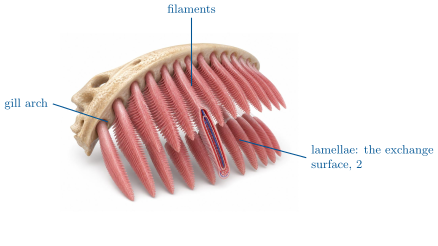
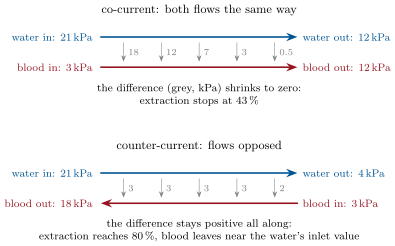
A gill is an evagination of the body surface into the water, folded into filaments and lamellae a few micrometres thick through which blood flows in capillaries. A fish’s gills hang from four bony arches on each side; water drawn in at the mouth and pushed out under the gill covers by a two-pump system flows between the lamellae in one direction, and the blood in the lamellae flows the other way: a counter-current. A trout of a kilogram has some 2000cm22000\,\mathrm{cm}^{2} of lamellar surface, 2µm2\,\text{µ}\mathrm{m} thick.

A gill arch with its filaments and their lamellae. Water flows between the lamellae; blood flows through them the opposite way.
Co-current and counter-current exchange with the same surface and flows. Opposing the flows keeps a gradient along the whole length and lets the blood approach the fresh water’s oxygen pressure.

Examples

Example 21.6 (The price of water)

A resting trout of 1kg1\,\mathrm{kg} takes about 50mL50\,\mathrm{mL} of oxygen an hour. From water at 7mL/L7\,\mathrm{mL}/\mathrm{L}, with 80%80\,\% extraction, it must pump 9L9\,\mathrm{L} of water an hour across its gills — nine kilograms of a medium fifty times more viscous than air, through channels a fraction of a millimetre wide. A tenth of its metabolism goes to breathing; a human at rest spends a fiftieth. Warm the pond to 30C30\,{}^{\circ}\mathrm{C} and the same fish, needing more oxygen from water holding less, must pump three times as much.

Read in context →