University Biology — Year 1 · Bachelor Year 1
21Respiratory Gas Exchange
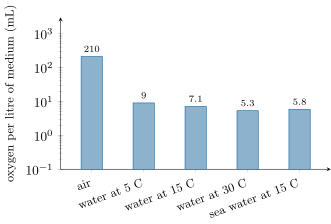
A litre of air holds thirty times more oxygen than a litre of water, weighs eight hundred times less, and lets oxygen diffuse through it ten thousand times faster. A trout must pass a hundred and fifty grams of water over its gills for every milligram of oxygen it takes, and it extracts four fifths of what the water carries; a human moves a few grams of air per milligram and wastes three quarters of it. The two organs are answers to the same equation — the flux of a gas across a surface — in two media. This chapter states the physics, derives what an exchange surface must be, describes gills, lungs and tracheae, follows oxygen and carbon dioxide through the blood, and looks at how ventilation is controlled and what changes at altitude and under water.
21.1 The physics of a gas in two media
Definition 21.1 (Partial pressure, solubility)
In a mixture of gases each gas exerts a partial pressure proportional to its fraction: in air at , oxygen () has , carbon dioxide () . A gas dissolves in a liquid in proportion to its partial pressure (Henry’s law): water in equilibrium with air at holds of oxygen (, of gas), against () in the air itself. The partial pressure — the same in the water and the air at equilibrium — is what drives diffusion between media; the content is what a breather can extract. Carbon dioxide is twenty-five times more soluble than oxygen, so it is never the harder gas to exchange.
Theorem 21.2 (Fick’s law for an exchange surface)
The rate at which a gas crosses a membrane of area and thickness separating two media at partial pressures and is
where , the diffusion (Krogh) constant of the membrane, combines the gas’s diffusivity and solubility in the tissue. The flux is raised by a larger area, a thinner barrier and a larger difference of partial pressure; nothing else.
Proof. Fick’s first law for the dissolved gas in the membrane (Chapter 7) gives a flux per unit area proportional to the concentration gradient; by Henry’s law the concentration at each face is proportional to the partial pressure in the medium there, so the gradient is times the solubility, and the constant absorbs solubility and diffusivity. ∎
Proposition 21.3 (What an exchange surface must be)
An organism of more than a millimetre cannot be supplied by diffusion through its outer surface (Chapter 1). It needs a respiratory surface that is large (to raise ), thin (to lower ), moist (gases cross membranes only in solution), ventilated — the outer medium renewed, so that stays high — and perfused — the blood behind it renewed, so that stays low; and a circulation to carry the gas from the surface to the tissues. Gills, lungs and tracheae are three ways of folding such a surface into a body and moving the two fluids across it.
21.2 Gills and the counter-current
Definition 21.4 (Gill)
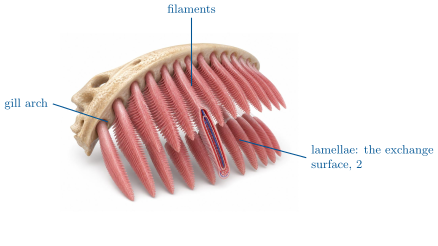
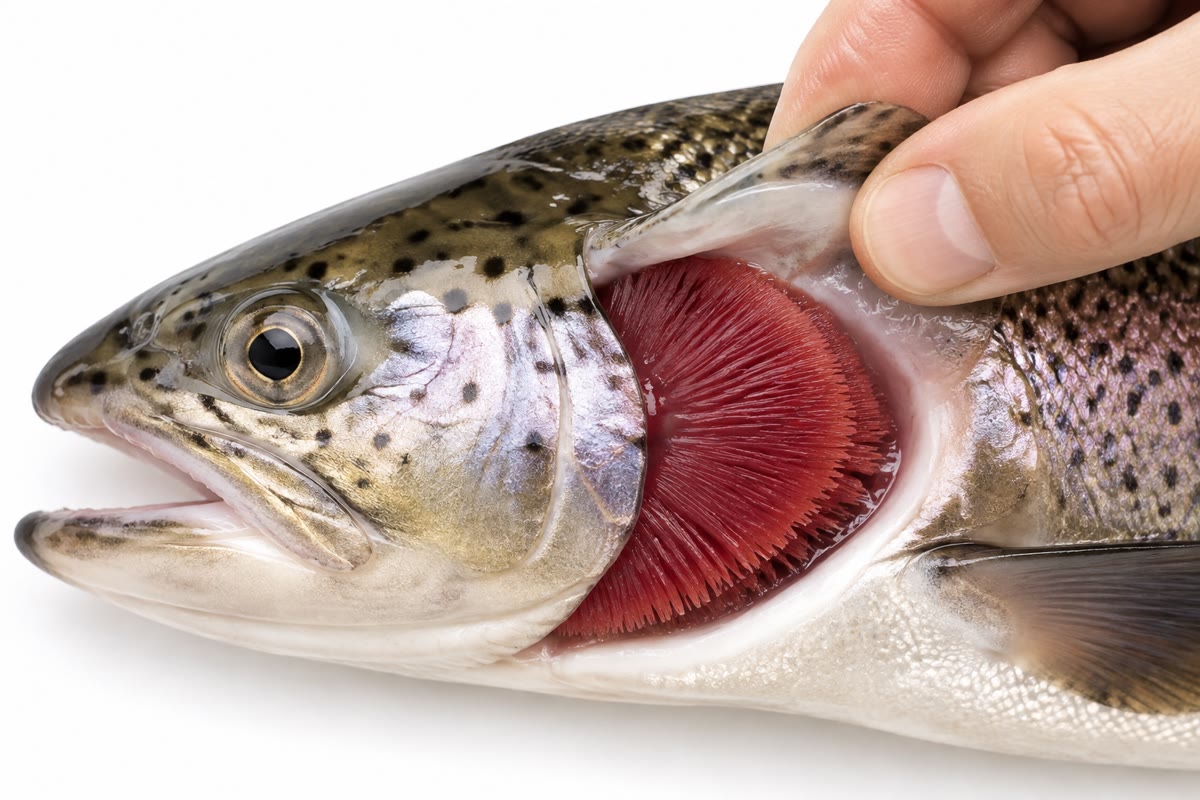
A gill is an evagination of the body surface into the water, folded into filaments and lamellae a few micrometres thick through which blood flows in capillaries. A fish’s gills hang from four bony arches on each side; water drawn in at the mouth and pushed out under the gill covers by a two-pump system flows between the lamellae in one direction, and the blood in the lamellae flows the other way: a counter-current. A trout of a kilogram has some of lamellar surface, thick.
Theorem 21.5 (Counter-current exchange)
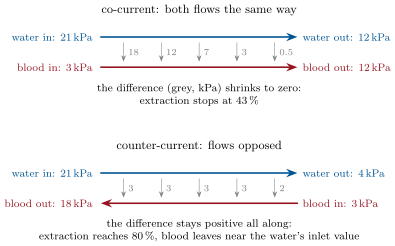
When water and blood flow in opposite directions along an exchange surface, the blood leaving the gill can approach the partial pressure of the water entering it, and the water can be stripped of most of its oxygen: extractions of or more. When they flow in the same direction (co-current), both fluids converge to a common intermediate value and the extraction cannot exceed .
Proof. Along a co-current exchanger the difference falls from its inlet value to zero as the two approach the same pressure; once they are equal no more gas moves, and for equal flows the meeting point is halfway. In counter-current flow the blood, as it moves toward its outlet, meets water that is ever fresher, so a positive difference is maintained along the whole length; blood at its outlet faces the incoming water at , and water at its outlet faces the incoming venous blood at a few kilopascals. The limit is set by the surface, not by an equilibrium. ∎
Example 21.6 (The price of water)
A resting trout of takes about of oxygen an hour. From water at , with extraction, it must pump of water an hour across its gills — nine kilograms of a medium fifty times more viscous than air, through channels a fraction of a millimetre wide. A tenth of its metabolism goes to breathing; a human at rest spends a fiftieth. Warm the pond to and the same fish, needing more oxygen from water holding less, must pump three times as much.
21.3 Breathing air: lungs and tracheae
Definition 21.7 (The mammalian lung)
A lung is an invagination of the body surface into a moist internal chamber, which keeps the surface wet in dry air. The mammalian lung is a tree of airways ending in some three hundred million alveoli, sacs across whose walls — one epithelial cell and one capillary endothelium, in all — add up to in a human, wrapped in a capillary net through which the whole cardiac output passes. It is ventilated tidally: the diaphragm and rib muscles enlarge the chest, air flows in; they relax, air flows out by the same path. A breath moves , of which only fills the airways (dead space) and never reaches an alveolus; the alveolar gas, renewed by a seventh at each breath, stays at and — the pressures the blood equilibrates with.
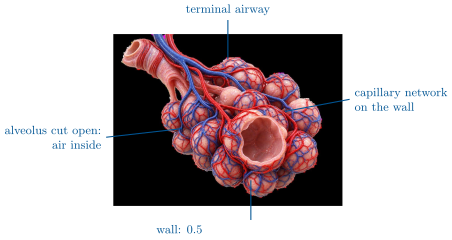
Proposition 21.8 (Three designs for air)
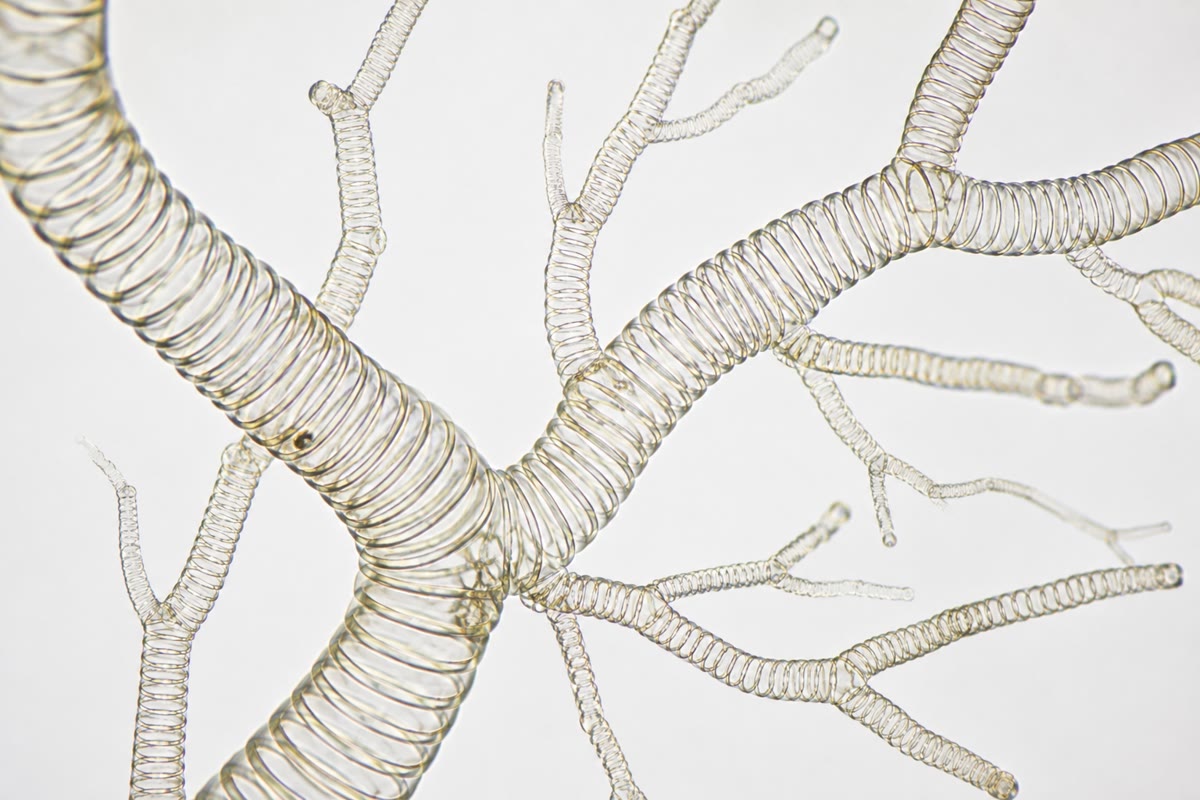
Mammals ventilate tidally: simple, but the fresh air mixes with stale, the alveolar oxygen is two thirds of the atmosphere’s, and extraction is a quarter. Birds pass air in one direction through fine tubes (parabronchi) between two sets of air sacs that act as bellows, so that fresh air flows through the exchange surface during both inspiration and expiration, in a cross-current with the blood: their extraction is higher, and a bar-headed goose flies over the Himalaya where a mammal would faint. Insects have no respiratory blood at all: air enters through valves (spiracles) into tracheae, tubes stiffened by spiral thickenings that branch to a micrometre and deliver oxygen by diffusion directly to every cell, aided by pumping of the abdomen in large or active insects. Diffusion along tubes limits the design to small bodies — which is one reason no insect is larger than a mouse.
Method 21.9 (Reading a ventilation budget)
- Minute ventilation tidal volume breaths per minute; alveolar ventilation (tidal volume dead space) breaths per minute. Only the second exchanges gas.
- Oxygen uptake alveolar ventilation (inspired fraction alveolar fraction); at rest, .
- Extraction uptake (ventilation inspired fraction): a quarter in a tidal lung, four fifths in a counter-current gill.
- On the blood side: uptake cardiac output (arterial venous content); at rest, the same . The two budgets must match.
21.4 Gases in the blood
Proposition 21.10 (Oxygen and carbon dioxide transport)
Plasma dissolves only of oxygen per litre at arterial pressure; haemoglobin (Chapter 12) carries , loading in the lung at and unloading a fifth to a half in the tissues. Carbon dioxide travels three ways: dissolved, bound to the amino groups of haemoglobin, and as bicarbonate: in the red cell, carbonic anhydrase turns and water into carbonic acid within milliseconds, the acid dissociates, the bicarbonate leaves the cell in exchange for chloride (the chloride shift), and the proton is taken up by haemoglobin. The two gases help each other: acid and lower haemoglobin’s affinity for oxygen (Bohr effect), so oxygen is released where is made; and deoxygenated haemoglobin binds protons and better (Haldane effect), so is taken up where oxygen is released, and given up in the lung as oxygen loads.
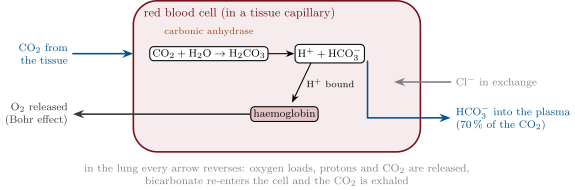
Example 21.11 (A litre of blood through a working muscle)
Arterial blood brings of oxygen per litre and of carbon dioxide (mostly as bicarbonate). In a resting muscle it leaves of oxygen and takes up of ; the venous pH falls by only , because haemoglobin has absorbed the protons. In a sprinting muscle, at pH 7.2 and of , the same litre leaves of oxygen (Chapter 12) and carries away the lactate as well.
21.5 Control, altitude and diving
Proposition 21.12 (Ventilation is controlled by carbon dioxide)
The rhythm of breathing is generated in the brainstem and adjusted by chemoreceptors: central ones, bathed in the fluid around the brain, respond to the pH change that produces; peripheral ones in the carotid arteries respond to a fall of arterial oxygen below about . In ordinary life it is that rules: a rise of in arterial roughly doubles ventilation, while oxygen must fall a third before ventilation responds. Holding one’s breath ends when , not oxygen, reaches the limit; hyperventilating first lowers and lets a diver stay under until oxygen runs out — unconscious before the urge to breathe returns.
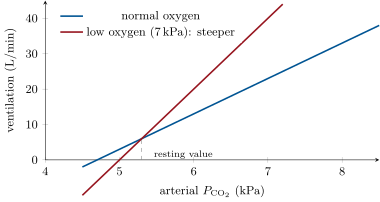
Example 21.13 (Altitude and depth)
At the air holds of oxygen and the alveoli : the carotid bodies drive ventilation up, which blows off and makes the blood alkaline — a brake the kidneys release over days by excreting bicarbonate; the red cells raise their BPG within days and the marrow raises haemoglobin within weeks (Chapter 12). A seal diving for twenty minutes does the opposite: it exhales before diving, slows its heart to a tenth, shuts the blood off from everything but brain and heart, and runs its muscles on the oxygen bound to their own myoglobin, ten times more concentrated than ours, and then on fermentation, tolerating a lactate the body clears at the surface. Its lungs collapse below , which keeps nitrogen out of its blood.
21.6 Exercises
Exercise 21.1 ★
State Fick’s law for an exchange surface and list the four features that raise the flux.
Solution
Solution of Exercise 21.1.
: a larger area, a thinner barrier, a higher outer partial pressure (ventilation) and a lower inner one (perfusion).
Exercise 21.2 ★
Explain why water is a harder medium to breathe than air, with three numbers.
Solution
Solution of Exercise 21.2.
Thirty times less oxygen per litre ( against ); eight hundred times denser and fifty times more viscous, so costly to pump; oxygen diffuses through it ten thousand times more slowly, so the medium must be moved right across the surface.
Exercise 21.3 ★
From the counter-current figure, read the oxygen pressure of the water leaving and of the blood leaving in each arrangement, and the extraction.
Solution
Solution of Exercise 21.3.
Co-current: water and blood both leave at ; extraction . Counter-current: water leaves at , blood at ; extraction .
Exercise 21.4 ★
In what three forms is carbon dioxide carried in the blood, and in what proportions?
Solution
Solution of Exercise 21.4.
Dissolved (), bound to haemoglobin’s amino groups (), as bicarbonate in the plasma ().
Exercise 21.5 ★★
A person breathes times a minute with a tidal volume of and a dead space of . Compute the minute and alveolar ventilations and the oxygen uptake if the alveolar fraction is . Repeat for shallow breaths of .
Solution
Solution of Exercise 21.5.
Minute ; alveolar ; uptake . Shallow: minute still, but alveolar and uptake — half, for the same work of breathing; the dead space is paid at every breath.
Exercise 21.6 ★★
A goldfish bowl at holds of oxygen per litre. A fish uses of oxygen an hour. How much water must cross its gills per hour at extraction, and how many times its own volume is that?
Solution
Solution of Exercise 21.6.
per hour, twenty-two times its volume of .
Exercise 21.7 ★★
A lung of and transfers at a mean pressure difference of . A disease thickens the wall to and halves the area. Compute the transfer at the same difference, and the difference needed to restore . Why can the body not simply raise the difference?
Solution
Solution of Exercise 21.7.
falls by : . To restore , the difference must be — impossible, since the alveolar pressure cannot exceed in air and venous blood cannot fall below zero; the patient can raise it only by breathing oxygen, and even then not eightfold.
Exercise 21.8 ★★
Explain the chloride shift: why bicarbonate leaves the red cell, why chloride enters, and what would happen to the cell’s volume without the exchange.
Solution
Solution of Exercise 21.8.
Carbonic anhydrase is inside the cell, so bicarbonate is made there and accumulates; it diffuses out down its gradient through an exchanger that admits a chloride for each bicarbonate, keeping the charge balanced. Without the exchange, bicarbonate would stay inside with its proton’s partner, raising the cell’s osmolarity, and water would enter: the cell would swell in the tissues (it swells slightly as it is).
Exercise 21.9 ★★
Why does a diver who hyperventilates before a breath-hold dive risk drowning, while one who does not surfaces safely, uncomfortable but conscious?
Solution
Solution of Exercise 21.9.
The urge to breathe comes from rising . Hyperventilation lowers far below normal without adding much oxygen (haemoglobin was already saturated); during the dive oxygen falls to the level of unconsciousness before has climbed back to the level that forces a breath. Without hyperventilation reaches that level while oxygen is still ample, and the diver surfaces.
Exercise 21.10 ★★★
An insect trachea long and across supplies a muscle that uses of oxygen per second. With in air and of oxygen at the spiracle, compute the concentration at the muscle end (Fick: ). Repeat for a trachea long. What limits the size of insects?
Solution
Solution of Exercise 21.10.
; — far more than the available, so a tube this narrow cannot supply the muscle by diffusion at ; a wider tube (: , just possible) or active ventilation is needed. At the requirement is tenfold again. Since the tube length grows with body size and the demand with volume, diffusion through tracheae caps the size of insects at a few centimetres, more only with pumping.
Exercise 21.11 ★★★
Birds and fish both use flows that are not tidal. Compare their exchangers (direction of the medium, relation to the blood flow, extraction) and explain why a tidal lung cannot reach their extraction whatever its surface.
Solution
Solution of Exercise 21.11.
Fish: water in one direction, blood opposed (counter-current), extraction . Birds: air in one direction through parabronchi, blood at right angles (cross-current), extraction intermediate but higher than mammals’, with the exchange surface never receiving stale air. A tidal lung mixes fresh air with the residual gas, so the exchange surface sees at best the alveolar mixture, and the blood can only equilibrate with that: whatever the surface, arterial blood cannot exceed the alveolar pressure, and the alveolar pressure cannot approach the inspired one while a residual volume remains.
Exercise 21.12 ★★★
“The lung is regulated by the gas it excretes, not by the gas it takes in.” Discuss in a paragraph: why makes the better signal at sea level, when the arrangement fails, and how altitude exposes it.
Solution
Solution of Exercise 21.12.
is the better signal because its arterial level responds to ventilation directly and steeply (halve ventilation and it doubles), it is measured with precision through pH by the central receptors, and oxygen, sitting on the flat top of haemoglobin’s curve, changes little over the normal range of ventilation: a thermostat keeps oxygen right as a by-product. It fails when oxygen falls independently of — at altitude, where the inspired oxygen is low but production is not, so the signal says “breathe less” while oxygen says “breathe more”; only the carotid bodies, when oxygen is severely low, override it, and the compromise (hyperventilation with alkalosis) takes days of renal adjustment to settle.
21.7 Problem: A Trout and a Human
Problem 21.1
Weekend problem — a gill and a lung set side by side: oxygen per litre of medium, ventilation and extraction, counter-current and tidal flow, and the blood behind each, ending on the extraction efficiency of the counter-current gill
A resting human takes of oxygen per minute, breathing times a minute with a tidal volume of and a dead space of ; inspired air is oxygen, alveolar gas ; cardiac output , arterial oxygen content . A resting trout of takes of oxygen per hour in water at holding ; its haemoglobin carries when saturated; its blood leaves the gills saturated and returns saturated. Water is times denser than air.
Part I — Two media.
- Express the oxygen content of air and of the trout’s water in millimoles per litre ().
- Compute the ratio of the two contents.
- Compute the mass of medium (air ; water ) that holds of oxygen in each case.
- Compute the volume of the trout’s water that holds as much oxygen as one litre of air.
- Explain in one sentence why fish gills must be ventilated in one direction and lungs may be tidal.
Part II — The lung.
- Compute the minute ventilation and the alveolar ventilation.
- What fraction of each breath is dead space, and what fraction of the minute ventilation is therefore wasted?
- Compute the oxygen delivered to the alveoli per minute and the oxygen taken up (alveolar ventilation the difference of fractions). Check against .
- Compute the extraction efficiency: uptake divided by the oxygen in the inspired minute ventilation.
- Compute the alveolar from the alveolar fraction (total pressure , water vapour to subtract first).
- On the blood side, compute the arteriovenous difference needed for at , and the venous content and saturation.
- During exercise the uptake rises to with a cardiac output of . Compute the arteriovenous difference and the venous saturation.
Part III — The gill.
- Compute the trout’s oxygen uptake in millilitres per minute.
- With extraction (counter-current), compute the water ventilated per minute and per hour.
- With the extraction a co-current exchanger of equal surface would give (), compute the water needed. What does the counter-current save?
- Compute the mass of water pumped per hour, and compare it with the mass of air a human moves per hour.
- Compute the trout’s arteriovenous difference in oxygen content and the cardiac output its uptake requires.
- Compute the ratio of water flow to blood flow at the gill, and the ratio of air flow to blood flow at the human lung (alveolar ventilation over cardiac output). Comment.
- Pumping water costs the trout about of its oxygen uptake. If the water warms to () and its uptake rises by half, by what factor must ventilation rise, and what happens to the fraction spent on breathing?
Part IV — The exchanger itself.
- In the counter-current gill the blood leaves at facing water entering at , and water leaves at facing blood entering at . Compute the pressure difference at each end.
- In a co-current exchanger both fluids leave at . Compute the difference at each end and explain why exchange stops before the water is used up.
- The human lung: alveolar , venous blood arriving at , arterial leaving at . Which arrangement does a tidal lung resemble, and why can its arterial blood not exceed the alveolar value?
- A trout’s lamellae total at thick; a human’s alveoli at . Compute the ratio of the two, and the ratio of their oxygen uptakes. What does the comparison suggest about the mean pressure difference across a lamella relative to an alveolar wall?
- Explain why carbon dioxide is never limiting for a fish although water holds so little oxygen.
- State the result: the extraction efficiency of the trout’s gill and of the human’s lung, and the two features of the gill that make the difference.
Solution
Solution of Problem 21.1.
1. Air ; water . 2. 30. 3. Air: ; water: — times more mass. 4. of water. 5. Water is too heavy and too poor in oxygen to be pushed in and out; it must be passed through once, which also makes the counter-current possible; air is cheap enough to move twice. 6. Minute ; alveolar . 7. of each breath, and of the minute ventilation. 8. Delivered ; uptake , close to . 9. ( of what reaches the alveoli). 10. . 11. ; venous , saturated. 12. ; venous , saturated. 13. . 14. , per hour. 15. : the counter-current halves the water to be pumped, and the work. 16. of water per hour; the human moves of air per hour — a twentieth of the mass, for three hundred times the oxygen ( against an hour). 17. ; cardiac output . 18. Water/blood ; air/blood . The fish must pass fourteen volumes of water per volume of blood because each holds so little oxygen; the human, about one. 19. Uptake from water holding as much: ventilation ; the cost of breathing, roughly proportional to the flow (or more, since it rises faster than linearly), goes from to at least of a larger uptake — the fish works harder to breathe in warm water. 20. Water inlet end: ; water outlet end: : positive at both ends. 21. Inlet end ; outlet end : the two fluids have equilibrated and no gradient is left, though the water still holds of its oxygen. 22. The co-current: the blood equilibrates with a single, well-mixed alveolar gas and leaves at its pressure; it cannot exceed because there is no fresher gas downstream to meet, as there is in the counter-current. 23. Trout (cm per cm); human : ratio . Uptakes . The trout takes seven times more oxygen per unit of : its mean pressure difference across the lamella must be larger — which the counter-current provides, keeping a gradient along the whole surface where the tidal lung’s is small near the end of equilibration. 24. is twenty-five times more soluble in water than oxygen: the water carries it away as fast as it is produced, and a fish’s blood stays very low. 25. Gill about , lung about of the oxygen in the inspired medium; the gill’s one-way flow and its counter-current arrangement of water and blood make the difference.