
Biology · Glossary

What is Maximal oxygen consumption?

Definition 7.5 High School Biology · Chapter 7 — Exercise and the Body’s Energy Needs

The maximal oxygen consumption , written V˙ ⁣O2\dot V\!\mathrm{O_2}max, is the highest rate at which a person’s body can take up and use oxygen, in litres per minute — or, to compare people of different sizes, in millilitres per minute per kilogram of body mass. It sets the highest power that can be sustained by respiration alone. Typical values: 35mL/min35\,\mathrm{mL}/\mathrm{min} per kilogram in a sedentary adult, 5050 in a trained student, 8080 or more in a champion endurance athlete.
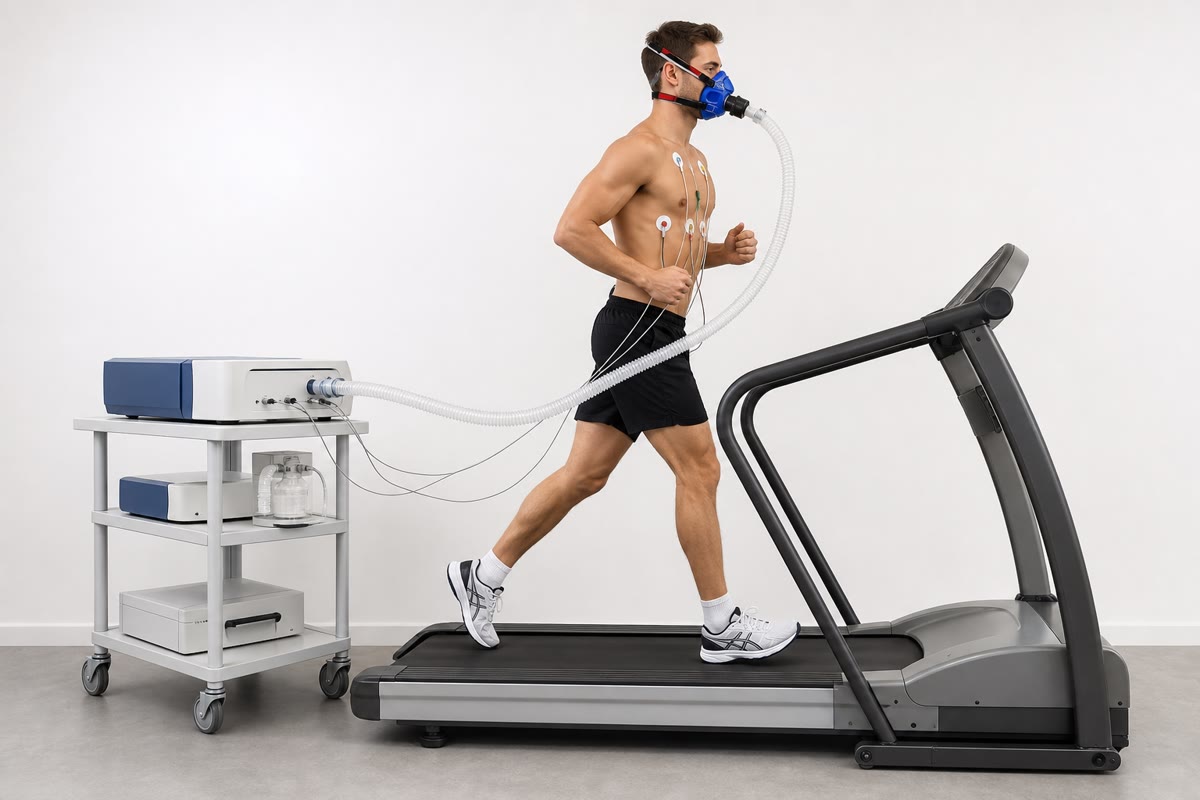
Measuring oxygen consumption during exercise: every breath passes through the mask to a gas analyser that records the oxygen taken up and the carbon dioxide given off, minute by minute, while the treadmill sets the power.

Examples

Example 7.6 (Reading the curve)

In the figure, 100W100\,\mathrm{W} of pedalling costs 1.5L/min1.5\,\mathrm{L}/\mathrm{min} of oxygen: 1.5×20=30kJ1.5 \times 20 = 30\,\mathrm{kJ} per minute, i.e. 500W500\,\mathrm{W} of metabolic power — the 100W100\,\mathrm{W} of work plus 400W400\,\mathrm{W} of heat and resting needs, in line with Proposition 7.2. The ceiling of 3.3L/min3.3\,\mathrm{L}/\mathrm{min} for a 66kg66\,\mathrm{kg} subject is 50mL/min50\,\mathrm{mL}/\mathrm{min} per kilogram.

Read in context →