High School Biology · Grades 10–12
7Exercise and the Body’s Energy Needs
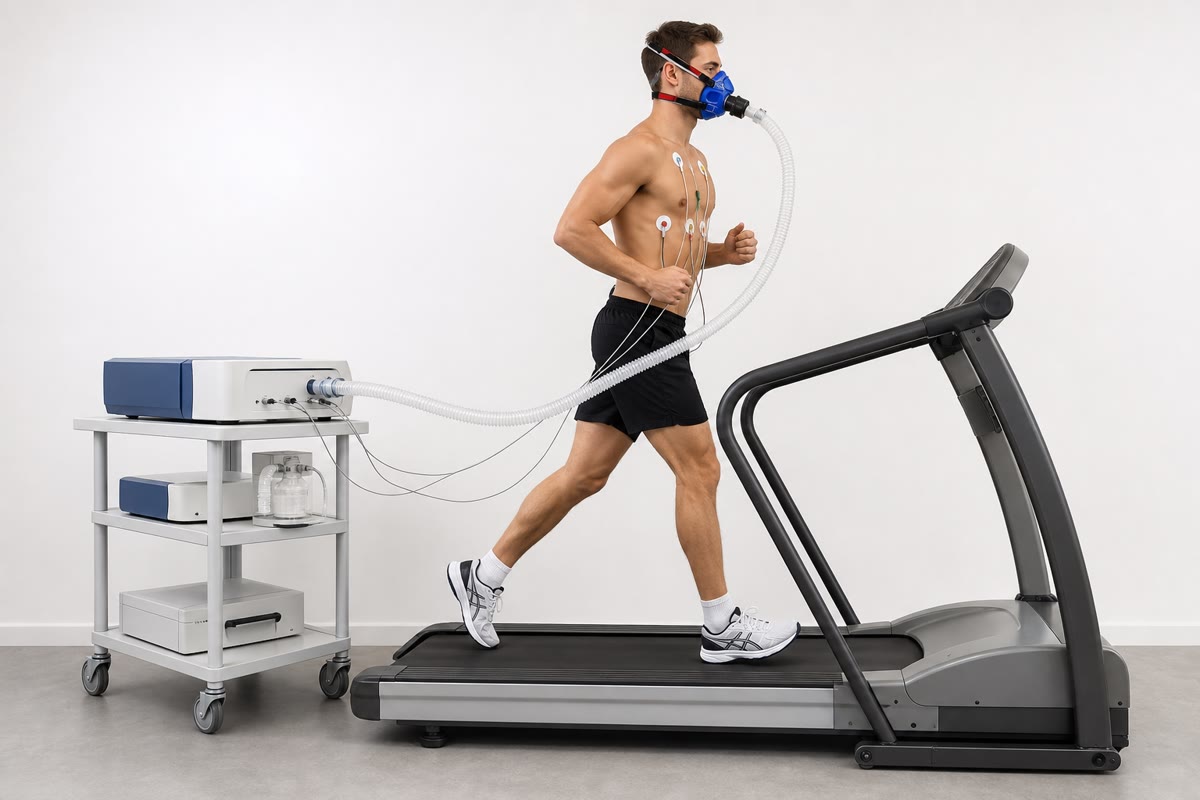
A cyclist on a laboratory bicycle pedals against a brake that measures her power: , then , then . A mask over her face sends every breath to an analyser. The numbers on the screen climb in step with the brake: the more mechanical work she delivers, the more oxygen she consumes and the more carbon dioxide she breathes out. Her muscles are running the respiration of Chapter 4 at full stretch, and the analyser is reading the balance sheet of it. This chapter follows the energy of exercise from the food that supplies it to the oxygen that releases it.
7.1 Energy in, work out
Definition 7.1 (Energy expenditure)
The energy expenditure of the body, in joules, is the total energy its cells release from organic molecules over a given time. Divided by the time, it is a metabolic power, in watts. At rest an adult spends about — some a day — to keep the heart beating, the brain working, the temperature at and the cells alive; this is the basal metabolism. Every activity adds to it.
Proposition 7.2 (Where the energy goes)
A working muscle converts only about a quarter of the energy it releases into mechanical work; the other three quarters leave as heat. Delivering a mechanical power therefore costs the body a metabolic power of about above rest: a cyclist at on the pedals is spending some in her muscles, and her body must get rid of of heat — by sweating, mostly.
Proof. Admitted at this level. ∎
Example 7.3 (Daily budgets)
A student sitting in class, walking to school and sleeping spends about a day; an hour of football adds some ; a day in the mountains with a pack, in all. A cyclist on a mountain stage of a race spends , and cannot eat enough during the day to cover it. The energy comes from food (Chapter 1): per gram of carbohydrate or protein, per gram of lipid.
7.2 Oxygen consumption measures energy expenditure
Proposition 7.4 (The oxygen equivalent)
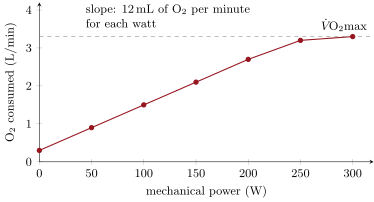
Since the energy of exercise is released by cellular respiration, which consumes oxygen, the body’s oxygen consumption measures its energy expenditure: each litre of oxygen consumed corresponds to about released, whatever the mixture of glucose and lipids burned. At rest a person consumes about of oxygen per minute; during exercise the consumption rises in proportion to the power delivered, up to a personal ceiling.
Evidence. The respiration equation of Chapter 4 gives for of oxygen, i.e. per mole, and a mole of gas occupies about : per litre. For lipids the figure is , for carbohydrates , so the mixture hardly matters. Measurements in sealed chambers, where the heat released by a subject is collected directly, agree with the oxygen figure to within a few per cent. ∎
Definition 7.5 (Maximal oxygen consumption)
The maximal oxygen consumption , written max, is the highest rate at which a person’s body can take up and use oxygen, in litres per minute — or, to compare people of different sizes, in millilitres per minute per kilogram of body mass. It sets the highest power that can be sustained by respiration alone. Typical values: per kilogram in a sedentary adult, in a trained student, or more in a champion endurance athlete.
Example 7.6 (Reading the curve)
In the figure, of pedalling costs of oxygen: per minute, i.e. of metabolic power — the of work plus of heat and resting needs, in line with Proposition 7.2. The ceiling of for a subject is per kilogram.
7.3 The fuels of the muscle
Proposition 7.7 (Three sources of ATP)
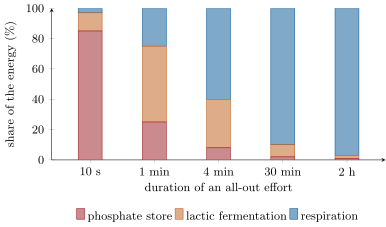
Muscle contraction is paid for in ATP, and the cell keeps only a few seconds’ worth. It is renewed by three routes, each with its own speed and capacity:
- a small store of a phosphate compound in the muscle, which re-forms ATP instantly but lasts about ten seconds — the sprint;
- lactic fermentation of glucose in the cytoplasm, fast but wasteful, sustaining an all-out effort for one to two minutes and producing lactic acid;
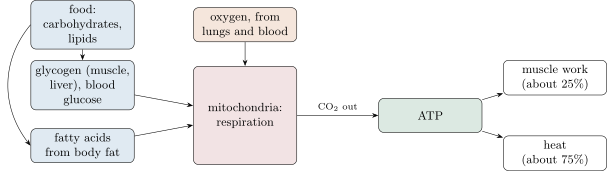
- cellular respiration in the mitochondria, slower to reach full rate but almost unlimited in duration, burning glucose from the blood, glycogen from the muscle, and fatty acids from the body’s fat.
The share of each depends on the intensity and duration of the exercise.
Proof. Admitted at this level. ∎
Definition 7.8 (Glycogen)
Glycogen is the animal form of stored carbohydrate: a branched chain of glucose units, held as granules in the muscle cells (about in an adult) and in the liver (about ). Muscle glycogen fuels the muscle that stores it; liver glycogen is broken down into glucose released into the blood, keeping the blood glucose near for the brain and the other tissues. Fat, stored in adipose cells, is the far larger reserve (Chapter 1), but it can be burned only slowly and only with oxygen.
Example 7.9 (The marathon wall)
Running consumes about per kilogram of body mass per kilometre; a runner spends , and a marathon costs . The glycogen stores hold about . If the runner burns glycogen too fast, the stores run out around the thirtieth kilometre; the muscles must then rely on fat, which supplies energy at barely half the rate, and the pace collapses — "hitting the wall". Trained runners burn a larger share of fat from the start, and eat carbohydrate during the race.
7.4 Measuring and reasoning
Method 7.10 (An energy calculation for exercise)
- From oxygen: energy () oxygen consumed () . Subtract the resting consumption if the question asks for the cost of the exercise alone.
- From mechanical power: metabolic power ; energy power time ( for is ; ).
- From the fuel: mass burned energy energy value ( carbohydrate, lipid); glycogen is stored with three times its mass of water.
- Check orders of magnitude: a whole day is about ; a hard hour, ; a marathon, .
Example 7.11 (An hour of cycling)
One hour at on the pedals: metabolic power about , energy ; oxygen , i.e. — consistent with the curve. If half comes from carbohydrate: of glucose or glycogen, and of fat.
Remark 7.12 (Why the oxygen must arrive)
Everything above assumes that oxygen reaches the mitochondria as fast as they can use it. That is the job of the lungs, the heart and the blood, whose response to exercise — faster breathing, faster and stronger heartbeat, blood redirected to the muscles — is the subject of Chapter 8. max is mostly a limit of delivery, not of the muscles’ appetite.
7.5 Exercises
Exercise 7.1 ★
Define basal metabolism and give its order of magnitude in watts and in kilojoules per day.
Solution
Solution of Exercise 7.1.
The energy spent at complete rest to keep the body alive — heart, brain, temperature, cell maintenance: about , some a day.
Exercise 7.2 ★
A subject consumes of oxygen per minute. What is her energy expenditure in kilojoules per minute, and in watts?
Solution
Solution of Exercise 7.2.
per minute, i.e. .
Exercise 7.3 ★
Name the three routes by which a muscle renews its ATP and give the typical duration each can sustain on its own.
Solution
Solution of Exercise 7.3.
The muscle’s phosphate store (about ten seconds); lactic fermentation (one to two minutes of all-out effort); cellular respiration (hours).
Exercise 7.4 ★
What is max? Convert for a subject into millilitres per minute per kilogram.
Solution
Solution of Exercise 7.4.
The highest rate at which the body can take up and use oxygen. per kilogram.
Exercise 7.5 ★
Where is glycogen stored, in what amounts, and what is each store for?
Solution
Solution of Exercise 7.5.
Muscles, about , fuelling the muscle that stores it; liver, about , released as glucose into the blood for the brain and the other tissues.
Exercise 7.6 ★★
From the oxygen-versus-power figure, read the oxygen consumption at and compute the metabolic power. Deduce the heat produced per second.
Solution
Solution of Exercise 7.6.
: per minute, i.e. . Heat: .
Exercise 7.7 ★★
A walker climbs in two hours. Compute the mechanical work against gravity (), the energy her muscles spent if the efficiency is 25%, and the average metabolic power above rest.
Solution
Solution of Exercise 7.7.
Work . At 25% efficiency the muscles spent about . Over : about above rest.
Exercise 7.8 ★★
Using the stacked-bar figure, explain why a 400-metre runner is breathless and aching at the finish while a 100-metre sprinter is hardly breathing hard.
Solution
Solution of Exercise 7.8.
A 100-metre sprint runs almost entirely on the phosphate store: no oxygen debt, little lactic acid. A 400-metre race lasts about a minute and draws half its energy from lactic fermentation: lactic acid accumulates (the ache) and the respiration that must clear it keeps the runner breathing hard for minutes afterwards.
Exercise 7.9 ★★
An athlete spends in a training session, 60% from carbohydrates. What mass of glycogen has she used, and what mass of water was released with it?
Exercise 7.10 ★★
A bar of chocolate provides . For how long would it power a cyclist pedalling at ?
Solution
Solution of Exercise 7.10.
Metabolic power about : , about 30 minutes.
Exercise 7.11 ★★
Why does a person’s body temperature rise during exercise, and by what mechanism is it prevented from rising further?
Solution
Solution of Exercise 7.11.
Three quarters of the energy released in the muscles is heat, several hundred watts during hard exercise. Sweating removes it: evaporating water takes about per gram, and blood flow to the skin carries the heat there. Without sweating, body temperature would rise by a degree every few minutes.
Exercise 7.12 ★★★
Two subjects of and both have a max of . Which one can run faster uphill, and which one can pedal harder on a flat road on a laboratory bicycle? Explain.
Solution
Solution of Exercise 7.12.
Uphill, the power needed is proportional to body mass: the subject has per kilogram against , and climbs faster. On the laboratory bicycle the power does not depend on mass, both have the same , and both can sustain the same watts.
Exercise 7.13 ★★★
A runner’s oxygen consumption during a race is at a pace that, by the curve, would require . Where does the difference come from, and what will the runner feel after a few minutes?
Solution
Solution of Exercise 7.13.
The missing of oxygen-equivalent is supplied by lactic fermentation in the muscles. Lactic acid accumulates; within a few minutes the muscles burn and the runner is forced to slow to a pace that respiration alone can cover.
Exercise 7.14 ★★★
Explain why a person cannot lose fat by exercising at maximal intensity for short bursts as effectively as by exercising moderately for a long time, using the three ATP routes.
Solution
Solution of Exercise 7.14.
Short maximal bursts run on the phosphate store and fermentation, which use no fat at all; fat is burned only by respiration, which takes minutes to reach full rate and dominates only in prolonged moderate exercise. The total energy of a few bursts is also small compared with an hour’s steady effort.
Exercise 7.15 ★★★
A cyclist on a mountain stage spends in a day. Her glycogen holds and she eats during the stage. Estimate the mass of body fat she burns, and explain why riders eat constantly during such a stage.
Solution
Solution of Exercise 7.15.
Deficit , i.e. about of fat. Eating during the stage keeps the blood glucose up for the brain and spares the glycogen for the climbs, where the power needed is far above what fat alone can supply; the fat covers the steady part of the day.
7.6 Problem: Where the Wall Stands
Problem 7.1
Weekend problem — a marathon’s energy budget: the oxygen the runner breathes, the glycogen she carries, the kilometre at which it runs out, and what training changes
Nadia, , runs a marathon () in . Running costs per kilogram per kilometre. Her muscles hold of glycogen and her liver ; glycogen and glucose give , fat ; one litre of oxygen releases . Her max is per kilogram.
Part I — The cost of the race.
- Compute the energy cost of the marathon for Nadia.
- Compute her average metabolic power during the race, in watts.
- Compute the volume of oxygen she consumes over the race, then her average oxygen consumption in litres per minute.
- Express that consumption in millilitres per minute per kilogram, and as a percentage of her max.
- Her resting consumption is . What fraction of her race-day consumption does the running itself account for?
Part II — The stores.
- Compute the energy held in her glycogen stores.
- If she burned glycogen only, at which kilometre would the stores run out?
- In reality she burns a mixture: 80% carbohydrate, 20% fat at her race pace. At which kilometre does the glycogen now run out?
- What mass of fat does she burn in the race? Compare with the of fat a woman typically carries.
- Explain, from Proposition 7.7, why she cannot simply burn fat alone once the glycogen is gone and keep the same pace.
Part III — Beating the wall.
- During the race she drinks a sugary solution supplying of carbohydrate per hour. How much energy does that add over the race, and how many kilometres of carbohydrate use does it cover?
- Redo question 8 with the drink. Does she now finish before the glycogen runs out?
- Three days before the race she "loads" carbohydrate, raising her muscle glycogen to . Each gram is stored with of water. By how much does her mass rise, and what is the cost of that in energy per kilometre?
- Training shifts her race-pace mixture to 55% carbohydrate, 45% fat. With loading and the drink, at which kilometre would the glycogen run out? Comment.
- Why does the brain, which uses glucose only, make glycogen depletion feel like exhaustion even when the muscles still have fat to burn?
Part IV — The numbers of a champion. An elite runner of runs the marathon in , with a running cost of per kilogram per kilometre and a max of per kilogram.
- Compute the champion’s energy cost for the race and his average oxygen consumption in litres per minute.
- What percentage of his max does he sustain? Compare with Nadia’s figure.
- Two things distinguish the champion: a higher ceiling and a lower cost per kilometre. Which of the two is "economy"? Compute by how much the difference in cost alone changes the energy of the race for a runner.
- His muscles hold of glycogen after loading. At 70% carbohydrate use, does he reach the finish on it without drinking?
- State the result: for Nadia, the kilometre where the wall stands without preparation, and the three measures that move it beyond the finish line.
Solution
Solution of Problem 7.1.
1. .
2. : .
3. ; over , about .
4. per kilogram, i.e. of her maximum.
5. .
6. .
7. The race costs per kilometre: .
8. Carbohydrate use : — the wall.
9. Fat energy , i.e. : about 0.6% of her .
10. Fat is burned only by respiration and at a limited rate: it can supply roughly half the power her pace requires. Without glycogen the muscles cannot make ATP fast enough, and the pace falls.
11. , i.e. , covering of carbohydrate use.
12. Carbohydrate available : , beyond the finish. Yes.
13. of glycogen of water: , costing per kilometre extra — negligible against 240.
14. Glycogen plus the drink: about ; carbohydrate use : over . The wall has moved far beyond the finish, with a wide margin.
15. The brain burns only glucose, supplied by the liver’s glycogen. When that store is empty the blood glucose falls, and the brain signals the emergency as dizziness and overwhelming fatigue, whatever the muscles still hold.
16. ; over : about .
17. per kilogram, i.e. — the same fraction as Nadia. The ceiling differs, not the fraction of it used.
18. Economy is the cost per kilogram per kilometre. For a runner, saved over the race, about 9%.
19. Glycogen ; carbohydrate needed : yes, the stores suffice without drinking.
20. Without preparation Nadia’s glycogen runs out around kilometre 34; carbohydrate loading before the race, drinking carbohydrate during it, and training that raises the share of fat burned each push the wall beyond the finish line.