 Coach
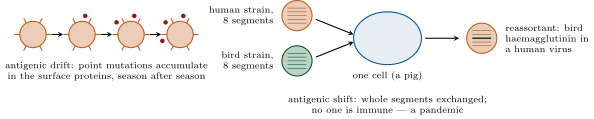
CoachRNA-dependent polymerases and reverse transcriptases have no proofreading, and RNA viruses mutate at to per nucleotide per replication — a thousand to a million times the rate of their hosts — so that a population of an RNA virus is a cloud of related genomes, a quasispecies, in which every single point mutant is present at all times if the population is large. Selection by antibodies drives antigenic drift: the surface proteins of influenza accumulate substitutions year by year, and last year’s immunity protects less each season. Antigenic shift is a jump: a segmented genome (influenza has eight RNA segments) can be reassorted when two strains infect one cell, and a segment encoding a haemagglutinin from a bird or pig virus, to which no human has immunity, produces a pandemic — 1918, 1957, 1968, 2009. Recombination within a genome does the same for unsegmented viruses, and the coronaviruses recombine freely. Most new human viruses are zoonoses, crossing from an animal reservoir — bats for the coronaviruses, Ebola and rabies; birds and pigs for influenza; primates for HIV — and the crossing is usually a matter of a few mutations in a receptor-binding protein.
Examples
Example 13.9 (Why HIV needed three drugs)
HIV’s reverse transcriptase errs about once in nucleotides, so each genome copied carries about mutations, and new genomes a day carry mutations among them: every one of the possible single point mutations arises many times every day, before any drug is given. A drug that a single mutation defeats — as one mutation defeats most reverse-transcriptase and protease inhibitors — is therefore defeated within weeks, which is what happened to AZT in 1987. Two independent mutations arise together at per genome, about once a day; three at , once in a thousand days — and a patient on three drugs whose load has fallen a thousandfold produces genomes a day, so the triple mutant never appears. That, and the theorem’s demonstration that the virus was replicating at full speed, made combination therapy from 1996 the treatment that turned AIDS into a chronic condition.