 Coach
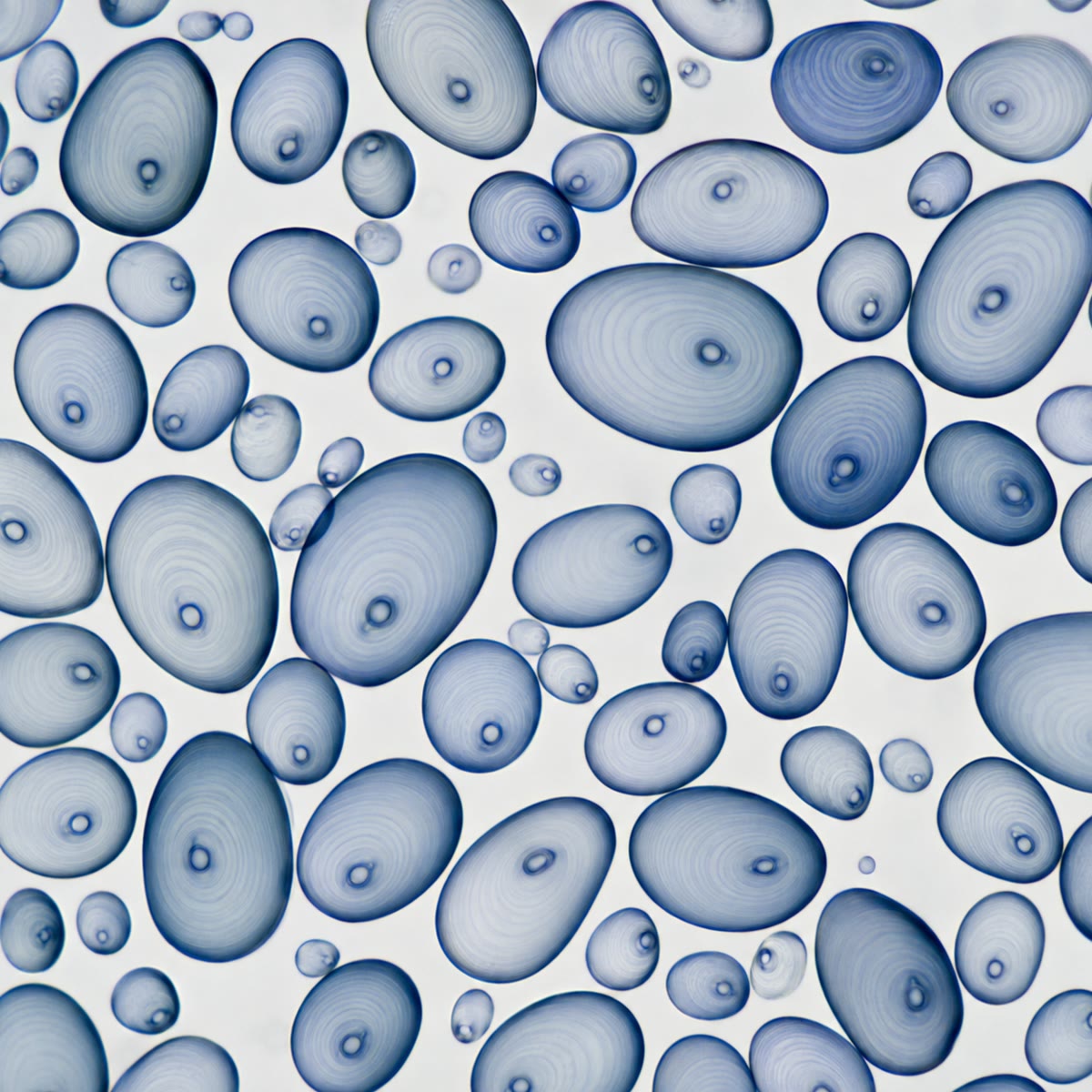
CoachA polysaccharide is a chain of hundreds to tens of thousands of monosaccharides joined by glycosidic bonds, linear or branched. Storage polysaccharides: starch in plants — amylose, unbranched glucose, , and amylopectin, with branches every residues, — packed in grains; glycogen in animals and fungi, like amylopectin but branched every residues, in cytosolic granules of the liver and muscles. Structural polysaccharides: cellulose, unbranched glucose, residues, in plant walls; chitin, N-acetylglucosamine, in the walls of fungi and the cuticles of arthropods; peptidoglycan, alternating N-acetylglucosamine and N-acetylmuramic acid cross-linked by short peptides, the one-molecule mesh that is the bacterial wall.
Examples
Example 10.9 (Why glycogen is branched)
Glycogen is degraded from its non-reducing ends, one glucose at a time, by glycogen phosphorylase. An unbranched chain of glucoses would have one such end and release one glucose per enzyme turnover; a glycogen particle of the same size, branched every twelve residues, has some ends and releases two thousand at once. Branching also keeps the particle compact and soluble. The liver’s hundred grams of glycogen can be mobilised at ten grams an hour; the same glucose stored as one long chain would take years to unwind.
Example 10.10 (Why not store glucose itself)
A hundred grams of glucose () dissolved in the of water of a liver’s cells would add to a cytosol at : the cells would swell to three times their volume and burst. As glycogen the same glucose is particles, , osmotically invisible. A polymer is a way of storing a great many molecules as one.
Example 10.4 (Sugars that are not )
Deoxyribose lacks the hydroxyl at C2 (Chapter 11); glucosamine and N-acetylglucosamine carry an amine instead of the C2 hydroxyl (chitin, peptidoglycan); glucuronic acid has a carboxyl at C6 (the matrix polysaccharides); sugar phosphates (glucose-6-phosphate, ribose-5-phosphate) are the forms in which sugars enter metabolism; sugar alcohols (glycerol, sorbitol) have no carbonyl. The core is the same: a small polyhydroxylated carbon chain that water loves.