
Biology · Glossary

What is Organelle, cytosol?

Also known as: organelle · cytosol

Definition 6.1 University Biology — Year 1 · Chapter 6 — Functional Organization of the Eukaryotic Cell

An organelle is a structure inside a cell with a definite composition and function; the membrane-bounded organelles are compartments whose interior differs in composition from the cytosol, the aqueous solution of the cytoplasm outside them. Membrane-bounded compartments: the nucleus, the endoplasmic reticulum, the Golgi apparatus, lysosomes, peroxisomes, mitochondria, and in plants the plastids and the vacuole. Organelles without a membrane: ribosomes, the centrosome, the cytoskeleton.
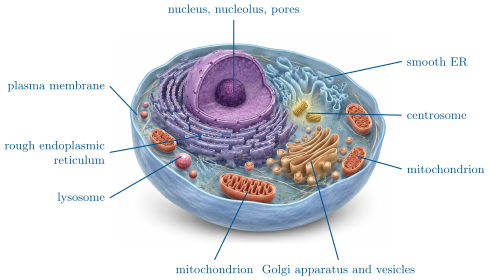
A generalised animal cell cut open. The nucleus at the centre; around it the rough endoplasmic reticulum continuous with the nuclear envelope, the smooth reticulum, the Golgi stack and its vesicles, mitochondria, lysosomes, and the centrosome from which the microtubules radiate.
Read in context →