 Coach
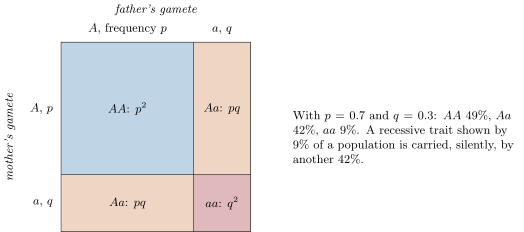
CoachA population is the set of individuals of one species living in the same place and breeding among themselves. Its genetic makeup is described by the frequencies of the alleles of each gene: for a gene with two alleles and , the fraction of all copies that are and the fraction that are . Evolution, at this scale, is a change of allele frequencies from one generation to the next.
Examples
Example 25.3 (Counting alleles)
Among 1000 people, 490 are , 420 and 90 . Copies of : out of 2000, so and — and the genotype counts are exactly , , of 1000: the population is at the reference state for this gene. A recessive disease affecting one newborn in 2500 () implies and carriers : the figures of Chapter 16, derived.
Example 25.8 (A founder effect)
An island community was founded by a few dozen settlers, one of whom carried an allele for a rare disorder of the eye. Ten generations later the allele’s frequency in the community is one in ten — a hundred times the mainland value — because one carrier among thirty founders is already 1.7% of the copies, and drift in a small, isolated population moved it further. The allele confers no advantage; its abundance is an accident of who boarded the boat.