High School Biology · Grades 10–12
25Selection, Drift and Speciation
In 1848 a black form of the peppered moth was caught near an industrial city where every tree trunk was coated with soot; by 1895 nearly every moth in the region was black. A century later, with the soot gone and the trunks pale again, the black form had almost vanished. Nobody bred the moths; the birds that eat them did the sorting. The last two chapters described how variation arises; this one is about what happens to it in a population — how some alleles become common and others rare, by selection and by chance — and how, in the end, one population becomes two species.
25.1 Populations and their alleles
Definition 25.1 (Population, allele frequency)
A population is the set of individuals of one species living in the same place and breeding among themselves. Its genetic makeup is described by the frequencies of the alleles of each gene: for a gene with two alleles and , the fraction of all copies that are and the fraction that are . Evolution, at this scale, is a change of allele frequencies from one generation to the next.
Proposition 25.2 (Frequencies without any force)
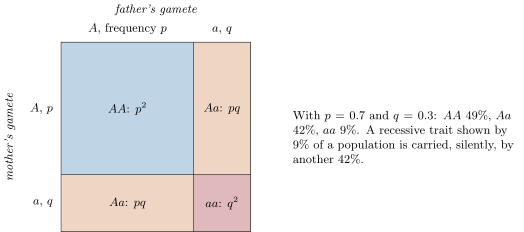
In a large population where mating is at random, where no allele gives an advantage, and where no mutation or migration occurs, the allele frequencies stay the same from generation to generation, and the genotypes appear in the proportions
This is the reference state: any departure from it, observed over the generations, is the sign that one of the conditions has failed — that selection, chance, migration or mutation is at work.
Proof. Each gamete carries with probability and with probability ; two gametes drawn at random give with probability , with , and with . Counting the alleles of the new generation: copies make up of the total. The frequency is unchanged. ∎
Example 25.3 (Counting alleles)
Among 1000 people, 490 are , 420 and 90 . Copies of : out of 2000, so and — and the genotype counts are exactly , , of 1000: the population is at the reference state for this gene. A recessive disease affecting one newborn in 2500 () implies and carriers : the figures of Chapter 16, derived.
25.2 Selection
Definition 25.4 (Natural selection)
Natural selection is the difference in reproduction between individuals that carry different alleles, in a given environment: the carriers of one allele leave, on average, more descendants than the carriers of another, and the allele’s frequency rises from generation to generation. What is selected is the whole individual — its survival, its mating, its fertility — and the alleles ride along.
Proposition 25.5 (Selection changes frequencies in a direction)
An allele whose carriers have even a slightly higher reproductive success spreads; one whose carriers have less becomes rare. The direction is set by the environment, and reverses if the environment does; the speed depends on the size of the advantage and on whether the allele is expressed in one copy (dominant, fast) or only in two (recessive, slow at first, and never quite eliminated, since its rare copies hide in heterozygotes).
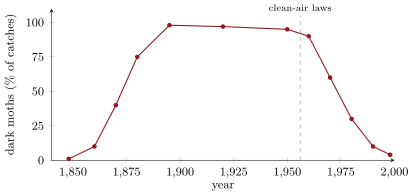
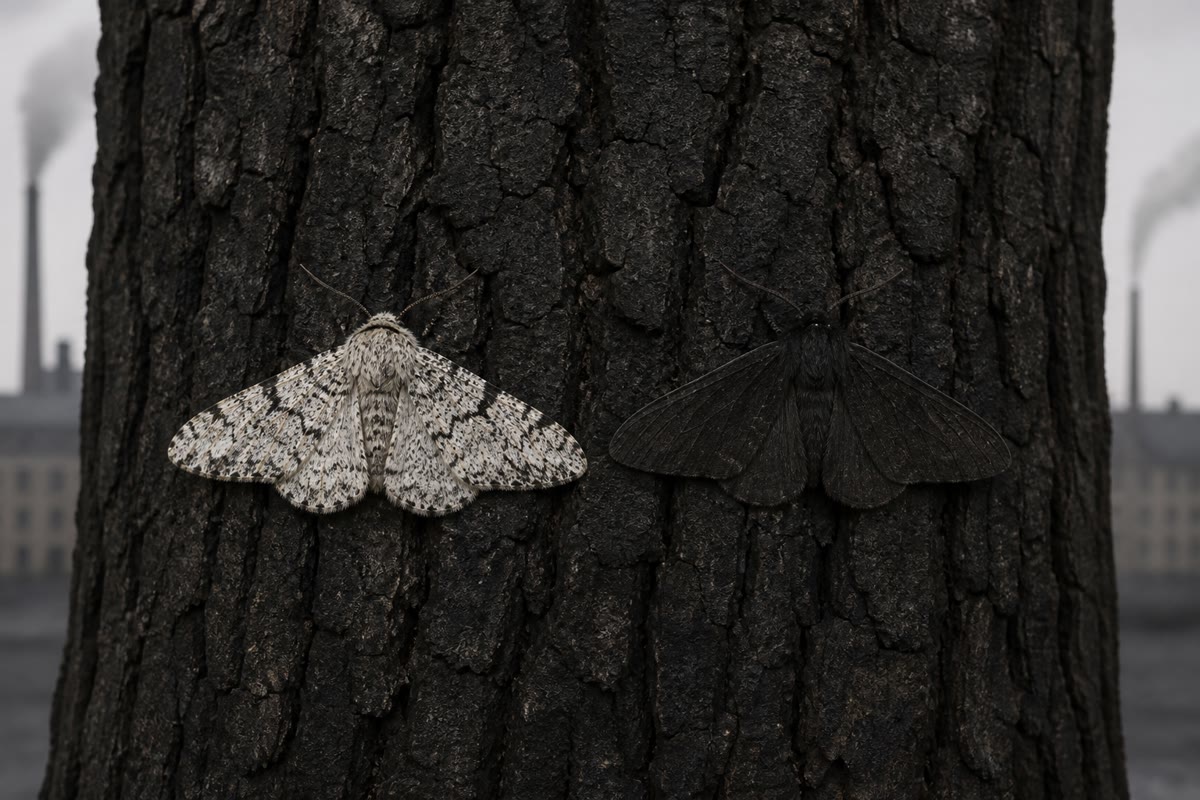
Evidence. The peppered moth: birds take the moths they see; on sooty trunks the pale form is seen, on clean ones the dark form; the frequency of the dark allele rose from near zero to 98% in fifty years of pollution and fell back below 10% in forty years of clean air, tracking the trunks. Antibiotic resistance (Chapter 18): the resistant allele’s carriers alone reproduce in the presence of the drug. Lactase persistence (Chapter 15): the allele is common exactly where milk has been a food for adults for millennia. In each case the allele’s fortune follows the environment. ∎
Example 25.6 (Selection by the other sex)
A peacock’s train makes it slower and more visible to predators, yet it is kept because peahens choose the males with the largest and most regular trains: an allele that improves the train is passed on more often, whatever it costs in survival. Sexual selection — the choice of mates — produces the ornaments, songs and contests of animals, and can push a trait in a direction that survival alone would never favour.
25.3 Chance: genetic drift
Proposition 25.7 (Genetic drift)
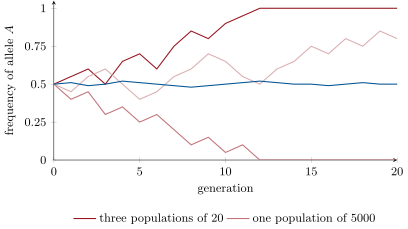
In any population of finite size, the alleles of one generation are a random sample of the previous one: which individuals happen to reproduce, and which alleles their gametes happen to carry, fluctuate by chance. Allele frequencies therefore wander from generation to generation without any advantage being involved — genetic drift. The smaller the population, the larger the wandering; in a small population an allele can be lost, or reach 100%, by chance alone within a few generations, whatever its value.
Evidence. Populations founded by a few individuals — an island colonised by a handful of birds, a human community descended from a few dozen settlers — carry a distorted sample of the source population’s alleles: a rare disease allele can be common in them, and much of the source’s diversity missing. Species that passed through a bottleneck of very few survivors (the cheetah of Chapter 5, the northern elephant seal reduced to twenty animals in 1890) show almost no genetic diversity today, even after recovering to thousands. And in the laboratory, many small replicate populations started at the same frequency scatter in every direction within a few generations, while large ones stay put. ∎
Example 25.8 (A founder effect)
An island community was founded by a few dozen settlers, one of whom carried an allele for a rare disorder of the eye. Ten generations later the allele’s frequency in the community is one in ten — a hundred times the mainland value — because one carrier among thirty founders is already 1.7% of the copies, and drift in a small, isolated population moved it further. The allele confers no advantage; its abundance is an accident of who boarded the boat.
Method 25.9 (Selection or drift?)
Faced with a change of allele frequency:
- Estimate the population’s size: drift is strong below a few hundred, negligible in millions.
- Look for a direction that tracks the environment (selection), or for a random walk (drift). Replicate populations moving the same way indicate selection; moving in different directions, drift.
- Look for a mechanism linking the allele to survival or reproduction; without one, suspect drift.
- Remember that both act at once: selection sets a tendency, drift adds noise, and in small populations the noise can drown the tendency.
25.4 From population to species
Proposition 25.10 (Speciation)
Two populations of one species that stop exchanging genes — separated by a barrier of geography, of behaviour or of timing — evolve apart: each accumulates its own mutations, is selected by its own environment and drifts its own way. When the divergence has gone far enough that individuals of the two populations no longer interbreed, or give sterile offspring, even when they meet again, two species exist where there was one. Speciation is this process; it usually takes thousands to millions of generations, though polyploidy (Chapter 24) achieves it in one.
Evidence. Islands: each of the Galápagos islands carries its own finches, descended from a mainland species and closest to those of the neighbouring islands. Lakes: a single ancestral cichlid fish has given hundreds of species in one African lake within a few hundred thousand years, separated by habitat and by the females’ choice of male colour. Ring species: populations of a gull spread around the Arctic, interbreeding with their neighbours all the way round, until the two ends meet in Europe as forms that do not interbreed — a species boundary caught in the act of forming. And species separated recently, such as polar and brown bears, still produce fertile hybrids occasionally: the boundary is a matter of degree. ∎
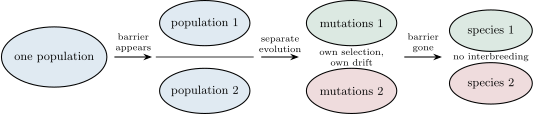
Proposition 25.11 (The species, reconsidered)
A species is a population, or a set of populations, whose members interbreed among themselves and are genetically isolated from other such sets — a definition that works for most animals and plants at a given moment, but has edges: populations in the process of separating, species that still hybridise, organisms that reproduce without sex. A species is not a fixed type but a lineage in time: it begins when a population becomes isolated, exists while its members keep interbreeding, and ends by extinction or by splitting into new species. The species alive today are the tips of a tree whose branches are the subject of Chapter 26.
Proof. Admitted at this level. ∎
Remark 25.12 (Evolution, assembled)
Mutation and the shuffle supply variation; duplication, transfer, polyploidy, regulation and symbiosis supply more; selection sorts it by the environment, drift by chance; isolation lets populations diverge until they are species; extinction removes them. None of these steps has a goal, and none looks ahead; together, over the four billion years of the fossil record, they have produced the diversity of Chapter 5. The theory that names these steps and their interplay is the theory of evolution, and every chapter of this year has been a piece of its evidence.
25.5 Exercises
Exercise 25.1 ★
Define allele frequency, and give the genotype proportions of a population at the reference state with .
Solution
Solution of Exercise 25.1.
The fraction of all copies of a gene in a population that are a given allele. With , : 64%, 32%, 4%.
Exercise 25.2 ★
Define natural selection and genetic drift, and state the essential difference between them.
Solution
Solution of Exercise 25.2.
Selection: a difference in reproduction between carriers of different alleles, set by the environment, changing frequencies in a direction. Drift: random fluctuation of frequencies from the sampling of a finite population, with no direction. Selection depends on what the allele does; drift does not.
Exercise 25.3 ★
From the moth figure, read the frequency of the dark form in 1880 and in 1980, and name the environmental change behind each.
Solution
Solution of Exercise 25.3.
About 75% in 1880, when soot had blackened the trunks; about 30% in 1980, after clean-air laws had let the trunks pale again.
Exercise 25.4 ★
Why does drift matter more in a small population?
Solution
Solution of Exercise 25.4.
The next generation’s alleles are a sample of the previous one’s; a small sample deviates more from the source than a large one, so the frequencies fluctuate more, and an allele can be lost by chance.
Exercise 25.5 ★
What is needed for one population to become two species?
Solution
Solution of Exercise 25.5.
An interruption of gene exchange between two populations, long enough for them to diverge until they can no longer interbreed.
Exercise 25.6 ★★
In a population of 500, 320 are , 160 and 20 . Compute and , then the expected genotype numbers at the reference state, and compare.
Solution
Solution of Exercise 25.6.
Copies of : of 1000, so , . Expected: , , — exactly the census: the population is at the reference state.
Exercise 25.7 ★★
A recessive allele has frequency 0.01. What fraction of the population shows the recessive trait, and what fraction carries the allele unseen? Why is the allele so hard to eliminate by selection against the trait?
Solution
Solution of Exercise 25.7.
: one in ten thousand shows the trait; : one in fifty carries it. Ninety-nine per cent of the copies sit in heterozygotes, on whom selection against the trait has no hold.
Exercise 25.8 ★★
From the drift figure, in how many generations was the allele fixed or lost in the two small populations that reached the ends? Why did the third not?
Solution
Solution of Exercise 25.8.
Both reached an end at generation 12, one fixed at 100%, the other lost. The third wandered without touching either boundary in 20 generations — chance again; given more time it would.
Exercise 25.9 ★★
Explain why the peppered moth’s dark allele did not reach 100% during the sooty decades, using the moths that live and breed in the countryside.
Solution
Solution of Exercise 25.9.
Pale moths kept breeding in unpolluted countryside, where they were favoured, and moths fly: migrants carried the pale allele back into the sooty region every generation, so it never disappeared.
Exercise 25.10 ★★
Twenty seals survived a bottleneck; the species now numbers 100 000 but shows almost no genetic diversity. Explain with drift.
Solution
Solution of Exercise 25.10.
Twenty individuals carry at most forty copies of each gene, a tiny sample of the original alleles; most were lost in the bottleneck, and drift in the small population that followed lost more. Numbers came back; the alleles cannot, except by new mutation.
Exercise 25.11 ★★
Apply Method 25.9 to two cases: an allele rising in ten separate lake populations at once after a new predator arrives; and an allele reaching 80% in one island population of thirty birds.
Solution
Solution of Exercise 25.11.
Ten populations moving the same way, after the same environmental change, with a plausible mechanism: selection. One tiny population of thirty, with no reported cause: drift is the default explanation until a mechanism is shown.
Exercise 25.12 ★★★
In a region with malaria, the sickle allele has frequency 0.15 although children rarely survive. Using the genotype proportions, compute the fractions of , and newborns, and explain how the advantage of against malaria keeps the allele common despite the loss of the .
Solution
Solution of Exercise 25.12.
, , . The die, removing copies of ; but the , a quarter of the population, survive malaria better than the and pass on their copies of . The loss from the is balanced by the advantage of the , and stays at 15%.
Exercise 25.13 ★★★
Two cichlid species in one lake differ mainly in the males’ colour, and females of each choose their own colour. In turbid water, where colours cannot be seen, the two hybridise freely. What isolates the species, and what does the turbid case say about how recent the separation is?
Solution
Solution of Exercise 25.13.
Mate choice by colour: a behavioural barrier. In turbid water the barrier fails and the species hybridise, so no genetic incompatibility has yet accumulated: the separation is recent and still reversible.
Exercise 25.14 ★★★
Explain why the ring species of gulls is an argument that speciation is gradual, and why the two ends meeting in Europe are nonetheless called two species.
Solution
Solution of Exercise 25.14.
Around the ring every population interbreeds with its neighbours, with only small differences between adjacent ones; the differences add up around the circle until the ends, meeting, do not interbreed. The whole gradient is visible at once: speciation is a matter of accumulated small steps. The two ends are called species because, where they meet, they behave as species: no gene exchange.
Exercise 25.15 ★★★
"Selection makes organisms better." Discuss in a paragraph: better at what, where, and compared with whom; and what drift, reversals and sexual selection add.
Solution
Solution of Exercise 25.15.
Selection makes carriers of some alleles reproduce more here and now: better at leaving descendants in this environment, compared with the other members of the population — not better in any absolute sense. When the environment changes, the direction reverses (the moths); drift makes populations differ for no reason of adaptation; sexual selection favours ornaments that hinder survival. Evolution has no direction of improvement, only local sorting.
25.6 Problem: The Mice of the Island
Problem 25.1
Weekend problem — a population of mice on an island: its allele frequencies computed, a new predator’s selection followed, the drift of a tiny colony simulated, and the birth of a species foreseen
On a rocky island, mice carry a coat-colour gene with two alleles: (dark, dominant) and (pale). A census of 2000 mice finds 720 dark mice of genotype , 960 dark , and 320 pale .
Part I — The population now.
- Compute the frequencies of and of by counting copies.
- Compute the genotype numbers expected at the reference state and compare with the census. Is the population at the reference state?
- What fraction of the dark mice are carriers of ?
- Explain, from the previous answer, why removing all the pale mice from the island for one generation would lower only a little. Compute the new after such a removal, if the remaining mice breed at random.
- Which of the four conditions of the reference state is most likely to fail on a small island, and with what effect?
Part II — A predator arrives. Owls colonise the island. On the pale rock, dark mice are seen and eaten twice as often: each generation, half the dark mice die before breeding while all the pale mice survive.
- Starting from the census numbers, compute the number of mice of each genotype that survive to breed in the first generation.
- Compute and among the survivors.
- If the survivors mate at random, compute the genotype proportions of the next generation, then apply the owls again and compute among its survivors.
- Repeat once more (two significant figures). Describe the trend of over the three generations.
- Explain why rises steadily, and why , unlike a recessive allele under the same selection, can be eliminated completely.
Part III — A colony of six. A storm carries six mice to a neighbouring islet: 2 , 3 , 1 .
- Compute in the colony and compare with the island.
- In the first litter, by chance, only the two and one breed. What are the possible values of in the next generation? What has happened to the population’s variation?
- Explain why, on the islet, an allele can vanish in a few generations without owls or any advantage.
- The islet has no owls. Predict the fate of there, and say why two neighbouring islands can end with different coat colours for no reason of adaptation.
- Give the name of the process, and the feature of the colony that makes it dominant there.
Part IV — Ten thousand years later. The islet’s mice, isolated, have diverged: smaller, paler, breeding in a different season. Brought together with island mice in the laboratory, they rarely mate, and the few hybrids are sterile.
- Are the islet’s mice a new species? Justify with the definition.
- Name the barrier that started the process and the two mechanisms that drove the divergence.
- The season of breeding differs between the two. Explain how such a difference, once present, reinforces the isolation.
- If the islet joined the island again tomorrow, would the two merge back into one population? Distinguish the case of question 17 from an earlier stage, say after 100 years.
- State the result: the frequency of on the island before and after three generations of owls, the fate of on the islet and the process responsible, and the number of species at the end.
Solution
Solution of Problem 25.1.
1. Copies of : ; of : ; out of 4000: , .
2. Expected , , : exactly the census. Yes.
3. .
4. Most copies of are in the dark carriers. After removal: 1680 mice, copies 2400, copies 960: — a fall from 0.40, but far from elimination.
5. Large size: a small island population drifts, so frequencies wander by chance (and migration from the mainland is absent, mutation negligible).
6. 360, 480, 320: 1160 breeders.
7. : ; : ; of 2320: , .
8. Next generation (per 2000): (535), (999), (466). After the owls: 267, 500, 466. : ; : ; .
9. With : 18% (353), 49% (974), 34% (673); survivors 176, 487, 673; : of 2672: . Trend: 0.40, 0.48, 0.58, 0.69 — rising by about 0.1 per generation.
10. Every carrier of is dark and exposed to the owls, so selection acts on every copy of at every generation; rises steadily. A recessive allele would hide in heterozygotes once rare, but a dominant one never hides: can be driven to zero.
11. : ; : ; , close to the island’s 0.40 by luck of the draw.
12. Among the breeders has 5 copies and 1: in the next generation is on average, but the single copy may be passed to none of the young () or to several; the genotype has already vanished, and with it much of the variation.
13. With so few breeders, which alleles are passed on is a matter of chance at every generation; a rare allele can be lost in a single unlucky litter.
14. will drift, and within some generations be fixed or lost — either outcome by chance. A neighbouring islet, from the same start, may end with the opposite allele: the two islands differ in coat colour for no adaptive reason.
15. Genetic drift; the tiny size of the colony.
16. Yes: they rarely interbreed with island mice and the hybrids are sterile — reproductive isolation.
17. The sea, a geographic barrier; selection in a different environment (no owls, other conditions) and genetic drift in a small population.
18. Mice that breed at different seasons never meet as partners: even without any barrier of geography, no genes flow, and the populations continue to diverge.
19. Not now: they are isolated by behaviour and sterility and would remain two species side by side. After only 100 years they would still have interbred freely and merged back into one population.
20. from 0.40 to about 0.69 after three generations of owls; on the islet was fixed or lost by genetic drift; two species in the end.