High School Biology · Grades 10–12
16Genetic Variation and Disease
A couple in perfect health have a first child who, from the first weeks, coughs, fails to gain weight, and has sweat so salty that a kiss on the forehead tastes of it. The diagnosis is cystic fibrosis: both parents, without knowing it, carried one non-working copy of the same gene, and the child received both. One in twenty-five people of European ancestry is such a carrier; the parents could have been told, before the pregnancy, by a test on a drop of blood. This chapter is about diseases written in the alleles: how they are inherited, how the risk is computed from a family tree, how a laboratory reads the gene, and why most common diseases are only partly genetic.
16.1 Diseases of a single gene
Definition 16.1 (Genetic disease, dominant and recessive)
A genetic disease is a disease caused by one or more mutant alleles. For a disease of a single gene, an allele is recessive if the disease appears only in people carrying two copies of it — a person with one copy is a healthy carrier — and dominant if one copy is enough. By convention the alleles of a gene are written with a letter: for the ordinary allele, for a recessive mutant one, so that a carrier is and an affected person .
Example 16.2 (Cystic fibrosis)
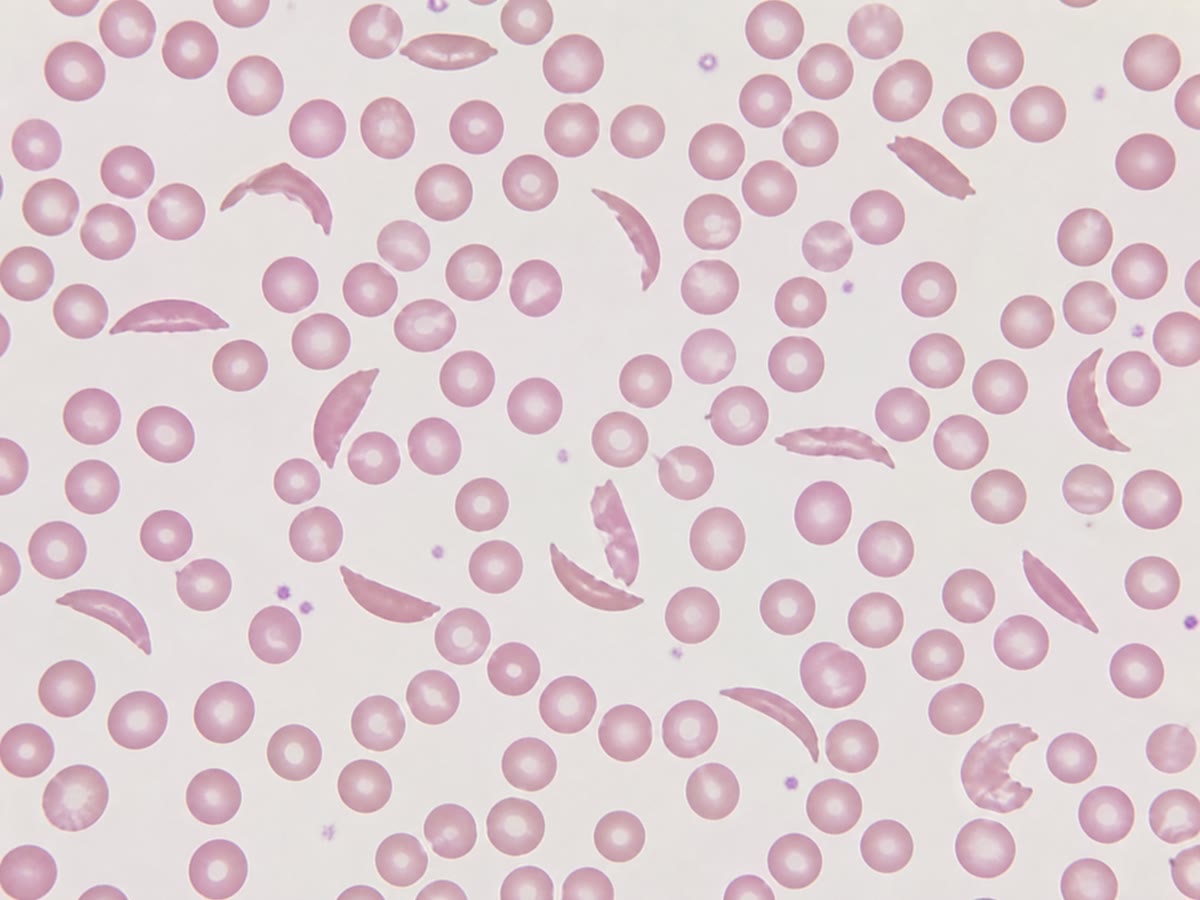
The CFTR gene encodes a protein that lets chloride ions cross the membrane of the cells lining the airways, the gut and the sweat glands. The commonest mutant allele lacks three nucleotides, hence one amino acid; the protein misfolds and is destroyed. Without it the mucus of the airways is thick and sticky, infections settle in the lungs, and the pancreas’s ducts clog. The disease is recessive: about one European in 25 is a healthy carrier, and one newborn in 2500 is affected. Sickle-cell disease (Chapter 15) is likewise recessive; Huntington’s disease, a degeneration of the brain beginning around forty, is dominant — one mutant allele suffices, and every affected person had an affected parent.
Proposition 16.3 (Transmission of a recessive disease)
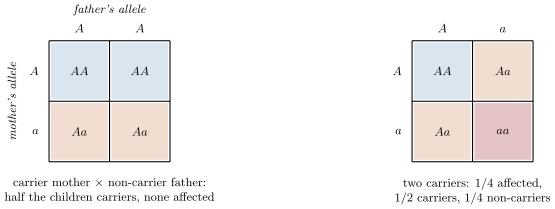
Each parent passes one of its two alleles, chosen at random, to each child. Two carriers therefore have, for each child, a chance of of an affected child , of a carrier , and of a non-carrier . A carrier and a non-carrier have no affected child and one chance in two of a carrier. An affected person and a non-carrier have only carrier children.
Proof. Admitted at this level. ∎
16.2 Reading a family tree
Definition 16.4 (Pedigree)
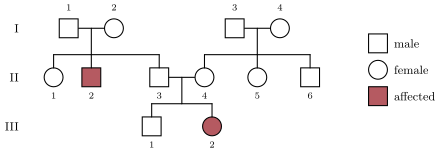
A pedigree is a diagram of a family over several generations: squares for males, circles for females, a horizontal line joining a couple, a vertical line down to their children, filled symbols for affected people. Generations are numbered I, II, III from the top; individuals are numbered from the left.
Method 16.5 (Analysing a pedigree)
- Dominant or recessive? An affected child of two healthy parents means recessive (the parents are carriers). An affected person with an affected parent in every generation suggests dominant.
- On a sex chromosome? If only males are affected and their mothers’ brothers or fathers are too, suspect the X chromosome (below). Otherwise the gene is on an ordinary chromosome.
- Assign genotypes: affected people in a recessive disease are ; their parents and children carry at least one ; healthy siblings of an affected person are or .
- Compute the risk for a planned child by combining the parents’ genotypes in a Punnett square; when a parent’s genotype is uncertain, weight each possibility by its probability.
Example 16.6 (The two-thirds)
Why is a healthy brother of an affected child a carrier with probability and not ? The parents are ; a child is , , or with equal chances. Knowing he is healthy removes : three cases remain, of which two are carriers. If he marries a woman of the general population (carrier with probability ), the risk of an affected first child is .
16.3 Genes on the X chromosome
Proposition 16.7 (X-linked inheritance)
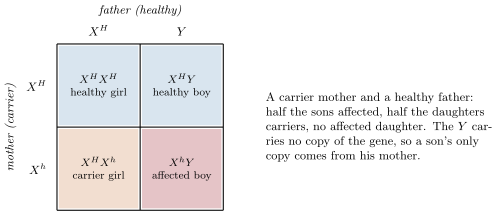
Females carry two X chromosomes, males one X and one Y. A recessive allele on the X chromosome is masked in a female by her second X, but a male, who has no second X, expresses it. Such a disease therefore affects mostly males; an affected male’s daughters are all carriers; a carrier mother passes the allele to half her sons, who are affected, and half her daughters, who are carriers. Haemophilia, in which the blood fails to clot, is the classic example; red-green colour blindness (Chapter 21) is another.
Proof. Admitted at this level. ∎
16.4 Reading the gene itself
Proposition 16.8 (Genetic testing)
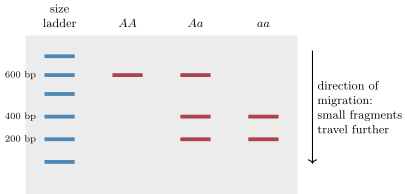
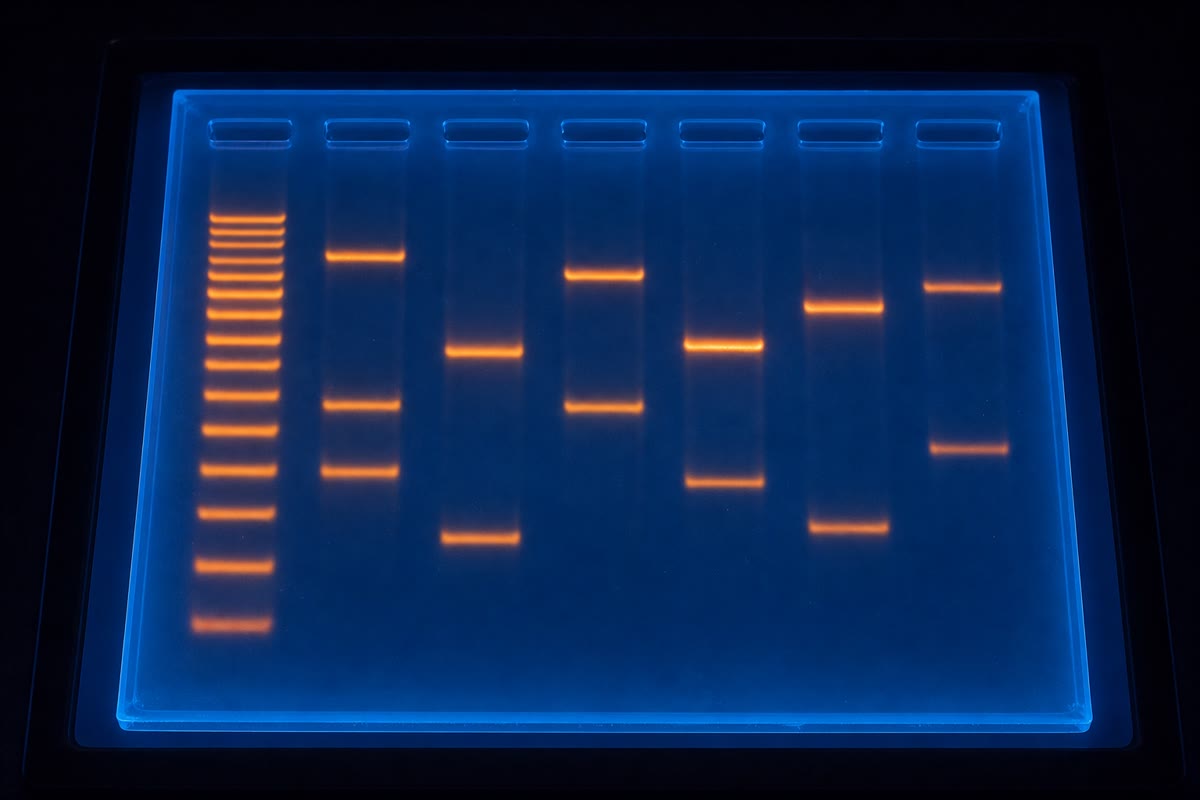
The alleles a person carries can be read directly from their DNA, extracted from a few cells (blood, saliva, and for a foetus a sample of the placenta or of the fluid around it). The region of the gene is copied millions of times by a reaction that mimics replication (Chapter 11) in a test tube, then either sequenced or cut by enzymes that recognise specific sequences and sorted by size in a gel: a mutant allele that has gained, lost or changed a cut site gives fragments of different lengths, visible as bands. Such tests identify carriers before any child is conceived, diagnose a foetus, and detect the mutation in a newborn before symptoms appear.
Proof. Admitted at this level. ∎
Example 16.9 (What a test can and cannot say)
A carrier test for cystic fibrosis looks for the fifty commonest mutant alleles and finds about 90% of carriers: a negative result lowers a person’s chance of being a carrier from to about , but does not make it zero. A prenatal diagnosis on a foetus of two known carriers is close to certain, and confronts the parents with a decision that the biology does not make for them. A test for Huntington’s disease tells a healthy thirty-year-old whether the disease will come; a third of those entitled to it choose not to know.
16.5 Diseases of many genes and of a way of life
Proposition 16.10 (Multifactorial diseases)
Most common diseases — type 2 diabetes, heart and artery disease, most cancers, asthma — are multifactorial: dozens or hundreds of alleles each shift the risk a little, and the environment (diet, activity, smoking, infections) shifts it a lot. Such a disease runs in families without following the rules of a single gene, and a genetic predisposition is a risk, not a sentence: the same alleles produce disease in one way of life and not in another.
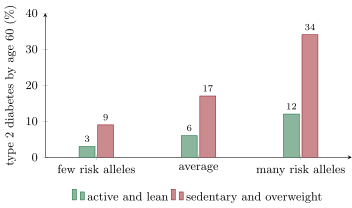
Evidence. Identical twins share all their alleles; when one has type 2 diabetes, the other has it in about 70% of cases — far above the population’s 8%, so genes matter — but not 100%, so genes do not decide. Populations that moved in a generation from a rural to an urban diet saw the disease rise several-fold with the same genes. Among people carrying many risk alleles, those who keep active and lean develop the disease at a fraction of the rate of those who do not. ∎
Remark 16.11 (What "genetic" means, then)
Cystic fibrosis is genetic in the strict sense: the genotype determines the disease, whatever the environment, and the environment only changes how it is lived. Type 2 diabetes is genetic in a weaker sense: the genotype sets a susceptibility that the environment realises or not. Between the two lie phenylketonuria, where a diet cancels the genotype’s effect, and the sickle-cell carrier, whose allele is a disease in one place and a protection in another. "Is it genetic?" is rarely a yes-or-no question; "how much, and under what conditions?" is the one to ask.
16.6 Exercises
Exercise 16.1 ★
Exercise 16.2 ★
Two carriers of cystic fibrosis have a child. Give the probability that the child is affected, a carrier, or neither.
Solution
Solution of Exercise 16.2.
Affected , carrier , neither .
Exercise 16.3 ★
In the pedigree figure, give the genotypes of I-1, I-2, II-2 and III-2.
Solution
Solution of Exercise 16.3.
I-1 , I-2 (parents of an affected child), II-2 , III-2 .
Exercise 16.4 ★
Why are X-linked recessive diseases much commoner in males?
Solution
Solution of Exercise 16.4.
A male has one X chromosome: a recessive allele on it is expressed, having no second copy to mask it. A female needs the allele on both of her X chromosomes.
Exercise 16.5 ★
What is a multifactorial disease? Give two examples.
Solution
Solution of Exercise 16.5.
A disease whose risk depends on many alleles of small effect and on the environment: type 2 diabetes, heart disease (also asthma, most cancers).
Exercise 16.6 ★★
A person with cystic fibrosis marries a non-carrier. What are their children? And the children of one of those with a carrier?
Solution
Solution of Exercise 16.6.
: all children , healthy carriers. A carrier child with a carrier: affected, carriers, non-carriers.
Exercise 16.7 ★★
In the pedigree figure, compute the probability that II-1 is a carrier, and the probability that a child of II-1 and a man from the general population is affected.
Solution
Solution of Exercise 16.7.
II-1 is a healthy child of two carriers: carrier with probability . Risk with a man of the population: .
Exercise 16.8 ★★
A man with Huntington’s disease (dominant, one mutant allele) and a healthy woman have four children. What is the probability that a given child inherits the disease? That none of the four does?
Solution
Solution of Exercise 16.8.
for each child. None of four: .
Exercise 16.9 ★★
A haemophiliac man marries a non-carrier woman. Describe their children’s genotypes and phenotypes, and those of the grandchildren through a daughter married to a healthy man.
Solution
Solution of Exercise 16.9.
: all daughters , healthy carriers; all sons , healthy. A carrier daughter with a healthy man: half her sons haemophiliac, half her daughters carriers.
Exercise 16.10 ★★
On the gel figure, what bands would show a person carrying two different mutant alleles, one adding the cut site and one deleting a further 100 base pairs from the 400 fragment?
Solution
Solution of Exercise 16.10.
One allele gives 400 and 200; the other, with the further deletion, gives 300 and 200. Bands at 400, 300 and 200 — and no 600.
Exercise 16.11 ★★
Explain why cystic fibrosis is a thousand times commoner in Europe than in eastern Asia although the mutation rate is the same.
Solution
Solution of Exercise 16.11.
The frequency of an allele in a population depends on its history, not only on the mutation rate: the European allele arose long ago and spread, perhaps because carriers had some advantage (resistance to a diarrhoeal disease is suspected); in eastern Asia it did not.
Exercise 16.12 ★★★
A couple’s first child has cystic fibrosis. Compute the probability that the second is affected, then that at least one of the next two is. Explain why "we have had our one in four" is a fallacy.
Solution
Solution of Exercise 16.12.
Each child is an independent draw: for the second. At least one of the next two: . The alleles are dealt afresh at each conception; a previous affected child does not lower the next one’s risk.
Exercise 16.13 ★★★
A carrier test detects 90% of mutant alleles. A woman from the general population tests negative. Compute her remaining probability of being a carrier, and the risk of an affected child with a partner who is a known carrier.
Solution
Solution of Exercise 16.13.
Before the test, carrier with probability ; the test misses 10% of carriers, so among 1000 women 40 are carriers and 4 test negative, while 960 non-carriers test negative: carrier probability . Risk with a known carrier: .
Exercise 16.14 ★★★
From the diabetes figure, compare the effect of moving from "many" to "few" risk alleles (impossible) with that of moving from sedentary to active (possible), for a person with many risk alleles. What should a genetic risk score be used for?
Solution
Solution of Exercise 16.14.
Many to few alleles, sedentary: 34% to 9%; sedentary to active, many alleles: 34% to 12%. The change one can make gives nearly the same reduction as the change one cannot. A risk score is useful to identify who gains most from changing their way of life, not as a verdict.
Exercise 16.15 ★★★
Discuss, in a paragraph, what a test for Huntington’s disease offers and costs a healthy young adult whose parent is affected, and why the decision is theirs.
Solution
Solution of Exercise 16.15.
The test offers certainty — freedom from a fifty-per-cent shadow if negative, the ability to plan a life and a family if positive — and costs, if positive, the knowledge of an incurable disease decades in advance, with effects on mood, insurance and relatives who share the gene. No treatment follows from the result, so the only reason to know is the person’s own; that is why the choice, and its timing, are theirs.
16.7 Problem: One Family, One Gene
Problem 16.1
Weekend problem — a family with cystic fibrosis followed over three generations: genotypes assigned, risks computed for each planned child, a laboratory test read, and the arithmetic of a carrier population
Léa and Tom, both healthy, have three children: Max (healthy), Zoé (cystic fibrosis) and Lou (healthy). Tom’s sister Ana is healthy and married to Karim, whose family has no history of the disease; they are expecting a child. In the population, one person in 25 is a carrier.
Part I — Genotypes.
- Is the disease dominant or recessive? Justify from the family.
- Give the genotypes of Léa, Tom and Zoé.
- What are the possible genotypes of Max, with what probabilities?
- What is the probability that Ana is a carrier? (Consider her parents.)
- What is the probability that Karim is a carrier?
Part II — Risks.
- Compute the probability that Ana and Karim’s child is affected.
- Léa and Tom consider a fourth child. Probability that it is affected? That it is a carrier?
- Max, adult, marries a woman from the general population. Probability of an affected first child?
- Zoé, adult, marries a man from the general population. Probability of an affected child? Of a carrier child?
- Lou marries a first cousin, a child of Ana and Karim. Compute the probability of an affected child. Why is it higher than for Max?
Part III — The test. The mutant allele carried in this family adds a cut site: the ordinary allele gives one fragment of 900 base pairs, the mutant one gives 600 and 300.
- Draw, or describe, the bands expected for Zoé, for Tom, and for a non-carrier.
- Max is tested: one band at 900. What is his genotype now, and the new risk for his first child (question 8)?
- Ana is tested: bands at 900, 600 and 300. Recompute the risk for her child.
- Karim’s test finds none of the fifty commonest mutant alleles, which cover 90% of carriers. Compute his remaining probability of being a carrier and recompute the risk.
- A prenatal test of Ana and Karim’s foetus shows bands at 900, 600 and 300. What is the foetus’s genotype and phenotype?
Part IV — The population.
- If one person in 25 is a carrier, what is the probability that both members of a random couple are carriers, and hence the frequency of affected newborns?
- Compare with the observed one in 2500. Comment.
- Almost all affected people used to die in childhood. Explain why the mutant allele nevertheless stayed at a frequency of one in 50 copies, using the number of copies carried by healthy carriers versus by affected people.
- Treatments now let most affected people reach adulthood and have children. Predict the effect on the allele’s frequency over the coming generations, and its size.
- State the result: the one-in-four of two carriers, the two-in-three of a healthy sibling, and what the gel added to the arithmetic for this family.
Solution
Solution of Problem 16.1.
1. Recessive: Zoé is affected and both her parents are healthy, so each carries one hidden mutant allele.
2. Léa , Tom , Zoé .
3. with probability , with (he is healthy, so is excluded).
4. Tom is a carrier, so one of his parents at least is; with no affected person in that generation, Ana received the allele from that parent with probability : (taking the other parent as a non-carrier).
5. , the population figure.
6. .
7. Affected ; carrier .
8. .
9. Zoé is ; her partner is with probability . Affected: . Carrier: every child receives from Zoé, so a carrier with probability .
10. Lou is a carrier with probability ; the cousin received from Ana ( carrier) with probability , i.e. is a carrier with probability (ignoring Karim): , four times higher than for Max, because the cousin comes from the same family and is far likelier than a stranger to carry the same allele.
11. Zoé: 600 and 300 only. Tom: 900, 600 and 300. Non-carrier: 900 only.
12. : he is not a carrier; the risk for his child falls from to zero (barring a new mutation).
13. Ana is : risk .
14. Among 1000 people like Karim, 40 are carriers of whom 4 test negative, and 960 non-carriers test negative: . Risk: .
15. : a healthy carrier, like its mother.
16. of couples are two carriers; a quarter of their children are affected: .
17. Exactly the observed frequency: the carrier frequency and the recessive rule account for it.
18. With a carrier frequency of and an affected frequency of , the mutant alleles carried by healthy carriers outnumber those in affected people by to , a hundred to one. Death of the affected removes only 1% of the copies per generation; the rest are transmitted invisibly by carriers.
19. The allele’s frequency will rise, but very slowly: the 1% of copies that used to be lost each generation are now kept, so the change is of the order of 1% of the frequency per generation.
20. Two carriers risk one affected child in four; a healthy sibling of an affected child is a carrier two times in three; the gel turned probabilities into genotypes — clearing Max, confirming Ana, reassuring but not clearing Karim — and identified the foetus as a healthy carrier.