University Biology — Year 1 · Bachelor Year 1
3Functional Organization of a Flowering Plant
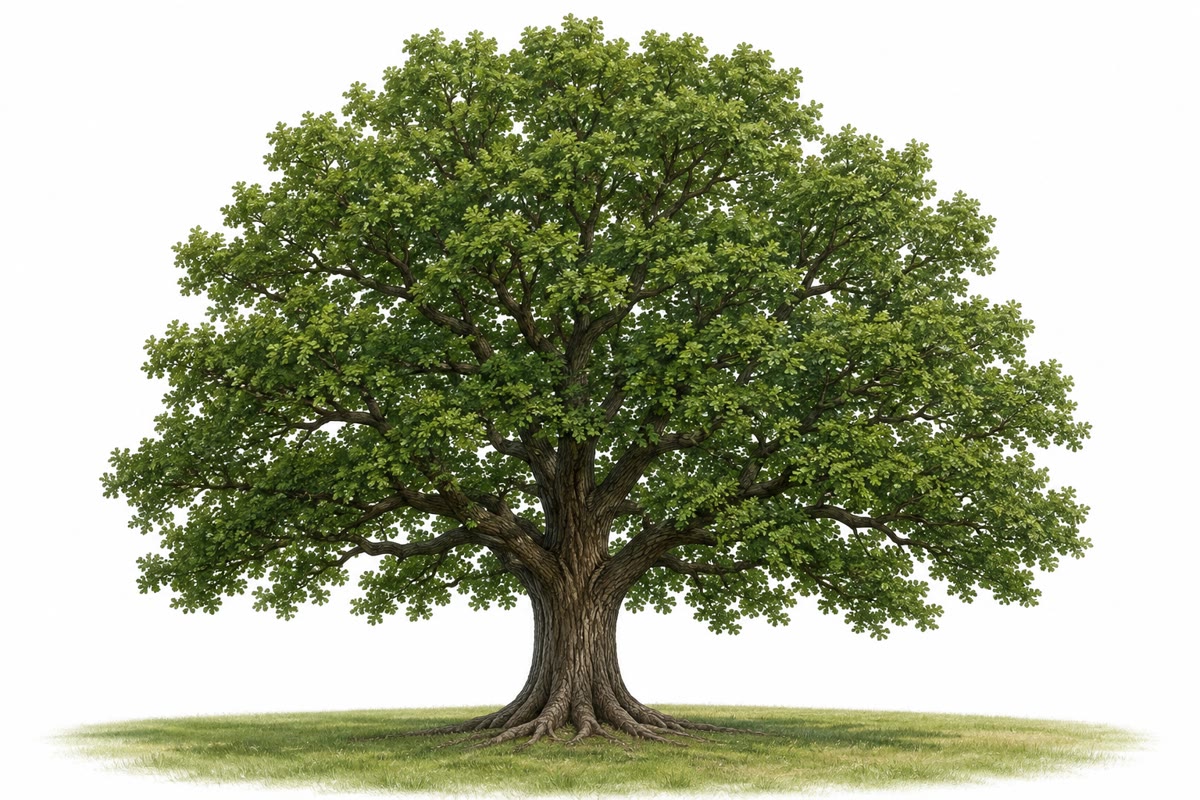
An oak two centuries old stands in the same square metre of ground it germinated in. It has never eaten, never moved, never held its temperature; yet it has built forty tonnes of wood, and every summer it spreads five hundred square metres of leaf into the air and a greater surface of root into the soil. A flowering plant is the other answer to the problem of Chapter 1: a fixed autotroph that meets its environment not by internalising its exchanges but by growing its exchange surfaces outward, indefinitely, wherever light and water are. This chapter describes how such a body is organised — its organs, its tissues, the surfaces it deploys, and the growth that builds them.
3.1 The vegetative body
Definition 3.1 (Root, stem, leaf)
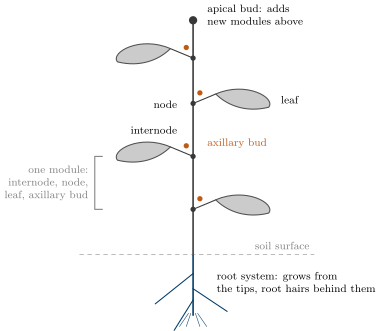
The vegetative body of a flowering plant is made of three kinds of organ. The root anchors the plant and absorbs water and mineral ions from the soil; it grows from its tip, branches, and bears root hairs just behind the tip. The stem carries the leaves toward the light and conducts between roots and leaves; it is built of repeated units, each a node bearing a leaf and an axillary bud, and an internode between two nodes. The leaf is the organ of photosynthesis: a flat blade of large surface and small thickness, held by a petiole. Roots form the root system; stems and leaves, the shoot system.
Proposition 3.2 (A modular, open body)
The plant body is modular: the shoot is a series of identical units (node, leaf, bud, internode) added one after another by an apical bud, and each axillary bud can start a new series. Growth is indeterminate: there is no adult size, and the plant keeps adding modules, and thus surface, for as long as it lives. The number and placement of the modules depend on the site — light, water, damage — so the same species takes different shapes in different places. A mammal’s body, by contrast, is closed: its organs are fixed in number and it stops growing at a set size.
3.2 The tissues of the primary body
Definition 3.3 (Dermal, ground and vascular tissues)
Every organ of the plant is built from three tissue systems. The dermal tissue is the epidermis, a single layer of cells covering the organ, coated in the air with a waxy cuticle and pierced by stomata, and extended in the root by root hairs. The ground tissue fills the organ: parenchyma (living, thin-walled cells for photosynthesis and storage), collenchyma (living cells with unevenly thickened walls, the flexible support of young stems) and sclerenchyma (cells with thick lignified walls, dead at maturity, the rigid support: fibres and stone cells). The vascular tissue conducts: xylem carries water and minerals upward in the hollow, lignified, dead tracheids and vessels (Chapter 24); phloem carries sugars in living sieve tubes kept alive by their companion cells.
Proposition 3.4 (Stem and root differ in the placement of the vascular tissues)
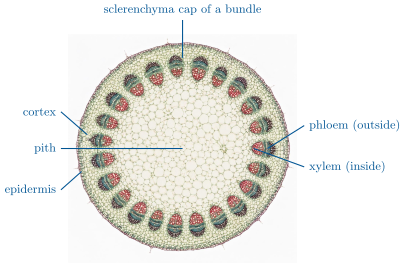
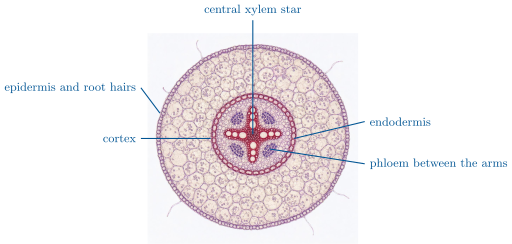
In the young stem the vascular tissues form bundles arranged in a ring (dicots) or scattered through the ground tissue (monocots), each bundle with xylem toward the centre and phloem toward the outside; there is no endodermis, and the ground tissue is divided into a central pith and an outer cortex. In the young root there is a single central cylinder: xylem forms a star (two to five arms in dicots, many in monocots), phloem lies between the arms, and the cylinder is bounded by the endodermis, a ring of cells whose radial walls carry a waterproof band (Chapter 23). The placement fits the function: a stem resists bending, and a ring of bundles near its surface is stiffest for its mass; a root resists pulling, and a central cylinder is the arrangement of a cable.
Method 3.5 (Identifying a plant section)
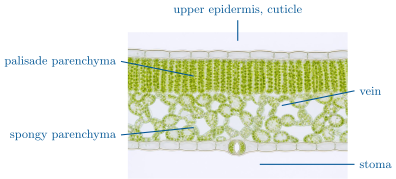
- A single central vascular cylinder with an endodermis: a root. Bundles in a ring or scattered, with a pith: a stem. A flat organ with two epidermises and a spongy layer: a leaf.
- Root with few xylem arms (2–5): dicot; many arms around a pith: monocot. Stem with bundles in one ring: dicot; scattered bundles: monocot.
- Xylem is recognised by its large, thick-walled, empty cells (red with the usual stains); phloem by small living cells with sieve tubes and companion cells (green or blue).
- In a stem section, the xylem points inward and the phloem outward. In a root, xylem and phloem alternate on the same radius.
Example 3.6 (Where the exchanges happen)
Carbon dioxide enters a leaf through its stomata, crosses the air spaces of the spongy layer and dissolves in the wet walls of the palisade cells; water arrives in the xylem of the veins and leaves, as vapour, through the same stomata. Water and ions enter the root through the root hairs and cross the cortex to the xylem at the centre. Both organs put their exchange surface on the outside and their conducting tissue in the middle.
3.3 The fixed life: surfaces
Definition 3.7 (Leaf area index)
The leaf area index of a plant cover is the total one-sided leaf area per unit area of ground. A meadow in June has , a deciduous forest , a tropical rain forest up to : several layers of leaf are stacked above every square metre of soil.
Proposition 3.8 (Light interception by a canopy)
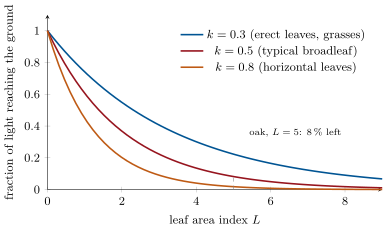
The fraction of the incident light that reaches the ground under a canopy of leaf area index falls off exponentially,
with an extinction coefficient between (erect leaves) and (horizontal leaves), typically . A canopy of with intercepts of the light.
Proof. Descending through the canopy, each thin layer of leaf area intercepts a fraction of the light reaching it, being the fraction of the horizontal area shaded by unit leaf area (which depends on leaf orientation). Hence , whose solution is the exponential. ∎
Proposition 3.9 (The root surface exceeds the leaf surface)
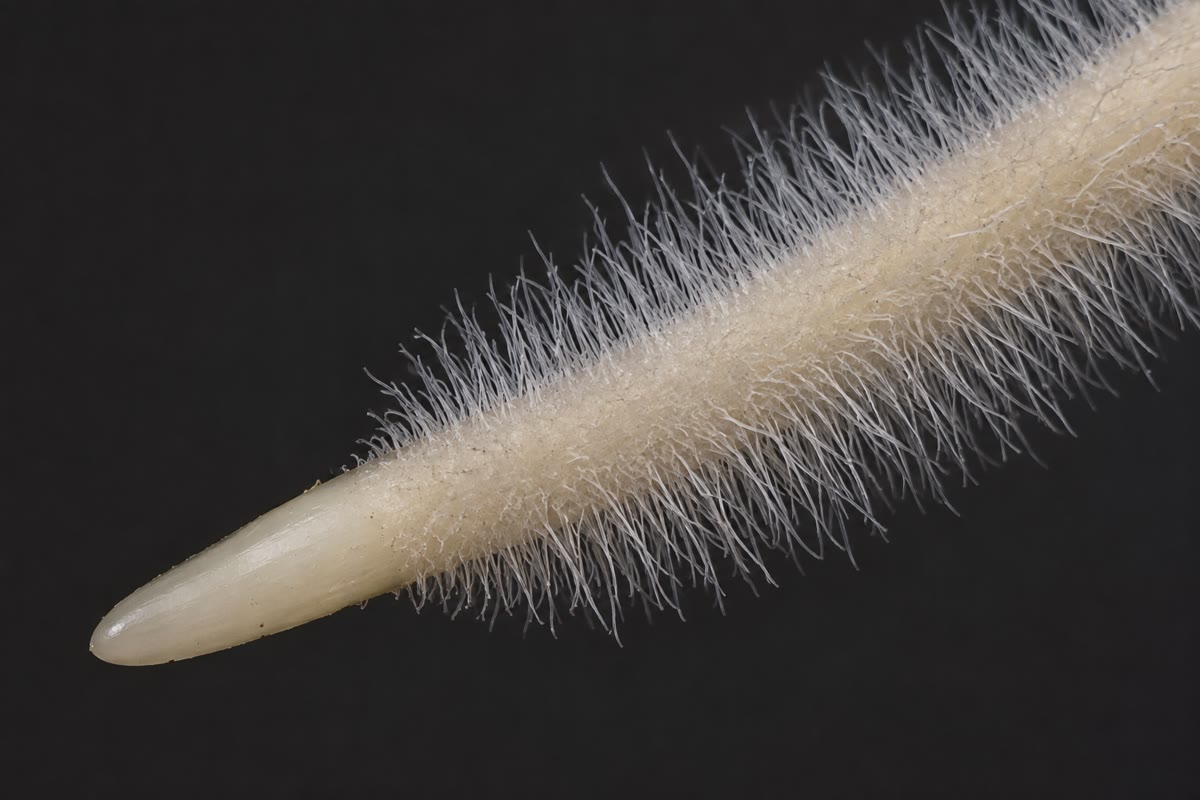
A single rye plant grown four months in a box of of soil produced of roots, of surface , and root hairs of a further : a surface some hundred times that of its leaves, spread through the soil at a density of ten kilometres of root per litre. Root hairs, each a tubular extension of one epidermal cell wide and up to a millimetre long, are where most of the absorption occurs; they live a few days and are replaced as the tip advances.
Evidence. Dittmer (1937) washed the entire root system of one rye plant out of its box, counted and measured samples of every root order and of the root hairs under the microscope, and scaled up: million roots totalling , and billion hairs totalling . Soil water and minerals move so slowly that a root must be within a millimetre of them to take them up; the enormous length is what puts a root within reach of every droplet. ∎
Example 3.10 (The oak’s two surfaces)
An oak whose crown shades at carries of leaf. Its fine roots, at a few kilometres per cubic metre through of soil, offer several hundred square metres, and their root hairs a thousand more: the absorbing surface underground is several times the photosynthetic surface above, over the same square metres of ground.
3.4 Growth and form
Definition 3.11 (Meristems, primary and secondary growth)
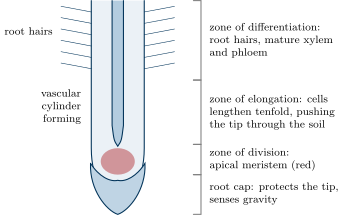
A meristem is a tissue of small, undifferentiated cells that keep dividing. The apical meristems at the tips of every shoot and root produce primary growth: elongation, and the primary tissues above. The lateral meristems — the vascular cambium between xylem and phloem, and the cork cambium under the epidermis — produce secondary growth: thickening, by adding wood (secondary xylem) inward and bark outward, in the stems and roots of trees and shrubs. The mechanisms of meristem activity belong to the Year 2 volume.
Proposition 3.12 (Form follows site)
Because its growth is modular and indeterminate, a plant shapes its body to its site (phenotypic plasticity): a tree grown in the open branches low and wide, the same species in a forest grows a tall bare trunk; a plant in dry soil allocates more of its growth to roots, in shade more to leaves. Species of dry habitats (xerophytes) carry thick cuticles, stomata sunk in pits or protected by hairs, small or succulent leaves and deep roots; species of wet habitats (hydrophytes) carry thin cuticles, stomata on the upper surface of floating leaves, and air-filled tissue (aerenchyma) that carries oxygen down to roots in anoxic mud.
Example 3.13 (Mammal and plant, side by side)
Nutrition: the mammal eats organic matter; the plant makes it from carbon dioxide, water and light. Exchange surfaces: internal, fixed in size, perfused by blood; external, growing, ventilated by the wind and the soil. Internal environment: regulated fluid at constant temperature and composition; none — the cells regulate their own contents and the plant’s temperature is the air’s. Growth: to a fixed adult form; open and modular, all life long. Movement: the animal goes to its food; the plant grows toward light and water. Coordination: nerves and hormones in seconds to hours; hormones alone, in hours to days. Each column is a consistent way of being an open system.
3.5 Exercises
Exercise 3.1 ★
Name the three vegetative organs of a flowering plant and the main function of each.
Exercise 3.2 ★
Define a module of the shoot and explain what “indeterminate growth” means.
Solution
Solution of Exercise 3.2.
A module is one node with its leaf and axillary bud, plus the internode below. Indeterminate growth: no adult size; the apical and axillary buds keep adding modules for as long as the plant lives.
Exercise 3.3 ★
For each tissue — epidermis, parenchyma, collenchyma, sclerenchyma, xylem, phloem — say whether its cells are alive at maturity and what it does.
Solution
Solution of Exercise 3.3.
Epidermis: alive; covering, cuticle, stomata, root hairs. Parenchyma: alive; photosynthesis, storage. Collenchyma: alive; flexible support. Sclerenchyma: dead; rigid support. Xylem conducting cells: dead; water transport. Phloem sieve tubes: alive (with companion cells); sugar transport.
Exercise 3.4 ★
From the light-interception figure, what fraction of the light reaches the ground under a meadow of with , and under a broadleaf forest of with ?
Solution
Solution of Exercise 3.4.
, i.e. ; , i.e. .
Exercise 3.5 ★★
A section shows a central star of xylem with four arms, phloem between the arms, a ring of cells with thickened radial walls around it, and a wide zone of rounded cells outside. Identify the organ and the group, giving the two features that decide each.
Solution
Solution of Exercise 3.5.
A root (single central cylinder, endodermis, xylem and phloem alternating on a radius) of a dicot (few xylem arms, no central pith).
Exercise 3.6 ★★
Explain, using the mechanics of a beam and of a cable, why the vascular tissue lies in a peripheral ring in the stem and in a central cylinder in the root.
Solution
Solution of Exercise 3.6.
A bent beam is stressed most at its surface and not at all along its axis, so material placed in a peripheral ring resists bending with the least mass (a tube). A cable under tension is stressed uniformly across its section and bends freely; a central strand carries the pull while the cortex stays flexible, and lateral roots can emerge through it.
Exercise 3.7 ★★
A crop has and . What fraction of the light does it intercept? By how much would the interception rise if went to 6? Comment on the return of the extra leaves.
Exercise 3.8 ★★
Dittmer’s rye plant had of roots and of root surface. Compute the mean root diameter. If its leaves totalled , what is the ratio of root-plus-hair surface to leaf surface?
Solution
Solution of Exercise 3.8.
: , about . .
Exercise 3.9 ★★
Root hairs are wide and long, at per millimetre of root. By what factor do they multiply the surface of a root in diameter?
Solution
Solution of Exercise 3.9.
Root surface per mm: . Hairs per mm: . Total : the hairs multiply the surface sixfold.
Exercise 3.10 ★★★
A tree in a forest has a bare trunk of and a small crown; the same species in a field is broad and branched from . Explain both forms from modular growth and the fate of axillary buds in shade and in light, and say what this plasticity costs and gains.
Solution
Solution of Exercise 3.10.
In the forest the lower axillary buds are shaded; the modules they would make cannot pay for themselves, so they stay dormant or their branches die, and growth is allocated to the apical bud racing upward toward the light. In the field every bud is lit and every branch pays, so the crown fills out low. The cost: a tall thin trunk is a large investment in unproductive wood, vulnerable to wind; the gain: the plant matches its form to where the light is, without any fixed plan.
Exercise 3.11 ★★★
A xerophyte has its stomata sunk in pits lined with hairs. Explain what this does to the gradient of water vapour between the leaf’s air spaces and the wind, and what it costs in carbon dioxide uptake. Why is this a good trade in a desert and a bad one in a rain forest?
Solution
Solution of Exercise 3.11.
The pit and hairs hold a layer of still, humid air above the pore; the vapour gradient from the air spaces to the moving air is spread over a longer path and transpiration falls. Carbon dioxide must diffuse in along the same longer path, so uptake falls too, though less, since the gradient is set by the atmosphere and the leaf’s consumption. In a desert water is the limiting resource and the trade saves the plant’s life; in a rain forest water is free and carbon gain is what competition rewards.
Exercise 3.12 ★★★
“A plant has no internal environment.” Discuss in a paragraph: what the plant lacks that the mammal has, what its cells face as a consequence, and what it does instead — surfaces, growth, and the regulation it does perform.
Solution
Solution of Exercise 3.12.
The plant has no regulated extracellular fluid held at constant temperature and composition between its cells and the outside: its cells meet soil water, air and sunlight directly, and its temperature is the air’s. Each cell therefore regulates its own contents (ions, water, pH) across its membrane and wall; the plant regulates its exchanges at the surface (stomata open and close, the endodermis selects what enters the xylem) and adjusts its body by growth (more roots in dry soil, more leaves in shade). It regulates, but the regulation is at the surfaces and in the form, not in a private fluid.
3.6 Problem: The Surfaces of an Oak
Problem 3.1
Weekend problem — an oak’s leaves counted by area, its stomata by the billion, its carbon and water by the kilogram, and its roots by the kilometre, ending on the exchange surface it spreads over each square metre of its ground
An oak’s crown shades of ground with a leaf area index and an extinction coefficient . Its lower leaf surfaces carry stomata per square millimetre; an open stomatal pore is by . Averaged over the whole canopy and a day, each square metre of leaf takes up of and loses of water vapour per second. Fine roots (diameter ) run at per cubic metre through depth of soil under the crown; root hairs ( by ) grow at per millimetre of fine root. Molar masses: , C , .
Part I — Leaves and light.
- Compute the total one-sided leaf area of the crown.
- Compute the fraction of light reaching the ground and the fraction intercepted.
- Compute the fraction intercepted if the oak had only , and if it had .
- Explain from these numbers why an oak stops at .
- The average leaf is . How many leaves does the crown carry?
Part II — Stomata and carbon.
- Compute the number of stomata on the crown.
- Compute the area of one open pore and the fraction of the lower leaf surface that the open pores represent.
- Compute the uptake of the crown in moles per second and in grams per second.
- Compute the taken up in one day, in kilograms, and the carbon it contains.
- Over a growing season of days, how much carbon does the crown fix? If half is respired by the tree itself, what mass of wood ( carbon) can it add?
Part III — Water.
- Compute the water lost by the crown in moles and in grams per second.
- Compute the daily water loss in litres.
- Compute the ratio of water molecules lost to molecules gained. Why is it so large?
- Rain of falls on the . How many days of transpiration does it cover, if all of it reaches the roots?
Part IV — Roots.
- Compute the volume of soil explored and the total length of fine roots.
- Compute the surface of the fine roots (cylinders).
- Compute the number of root hairs.
- Compute the surface of the root hairs.
- Compute the total absorbing surface underground, and its ratio to the one-sided leaf area.
- The fine roots are within of what fraction of the soil volume? (Take each root as the axis of a cylinder of radius .)
- Compare with the rye plant of the chapter ( of roots in ): which of the two plants explores its soil more thoroughly, and by what factor?
- Sum the two-sided leaf surface and the root surface. Divide by the of ground.
- Compare this with the ratio, for a human, of the folded exchange surfaces () to the outer surface ().
- Explain in two sentences why the plant’s ratio can keep rising through its life and the mammal’s cannot.
- State the result: the exchange surface an oak spreads per square metre of its ground, above and below, in square metres.
Solution
Solution of Problem 3.1.
1. . 2. reaches the ground; intercepted. 3. : ; : . 4. From 2 to 5 the crown gains of the light for of leaf; from 5 to 8 it would gain for another that cost as much to build and to keep supplied with water: the extra leaves do not pay. 5. leaves. 6. stomata. 7. ; per mm: , i.e. of the surface. 8. , i.e. . 9. of , containing of carbon. 10. of carbon; half, , into wood at carbon: of wood. 11. , i.e. . 12. , about . 13. water molecules per . The pore that lets in lets water out; the inside air is saturated while is only of the outside air, so the outward gradient of vapour is far steeper than the inward gradient of . 14. : half a day. 15. ; . 16. . 17. hairs. 18. Each ; total . 19. , times the leaf area. 20. Volume within : , i.e. of the soil. 21. Rye: of the box, i.e. : every point of the soil is within a millimetre of forty roots. The rye explores its soil more than two thousand times more thoroughly — a crop plant on a four-month budget against a tree exploring a hundred cubic metres. 22. ; per square metre of ground. 23. Human: ; the oak’s ratio is half that of the human’s folded surfaces, without any folding. 24. The oak adds modules, leaves and roots every year, so its surfaces grow with its age; the mammal’s surfaces are fixed organs, complete at adult size, and the only way to raise its ratio was to fold them during development. 25. About of exchange surface per square metre of ground: of leaf (both faces) above and of root and root hair below.