
Biology · Glossary

What is Stomata?

Also known as: stoma

Definition 28.2 High School Biology · Chapter 28 — Plant Life: Thriving While Rooted

A stoma is a pore in the skin of a leaf, bounded by two guard cells that open it by swelling and close it by shrinking. Through the open stomata carbon dioxide enters for photosynthesis and water vapour leaves — the transpiration that a plant cannot avoid while it feeds. A leaf carries one to three hundred stomata per square millimetre, mostly on its lower surface; they open in the light and close in the dark and in drought.
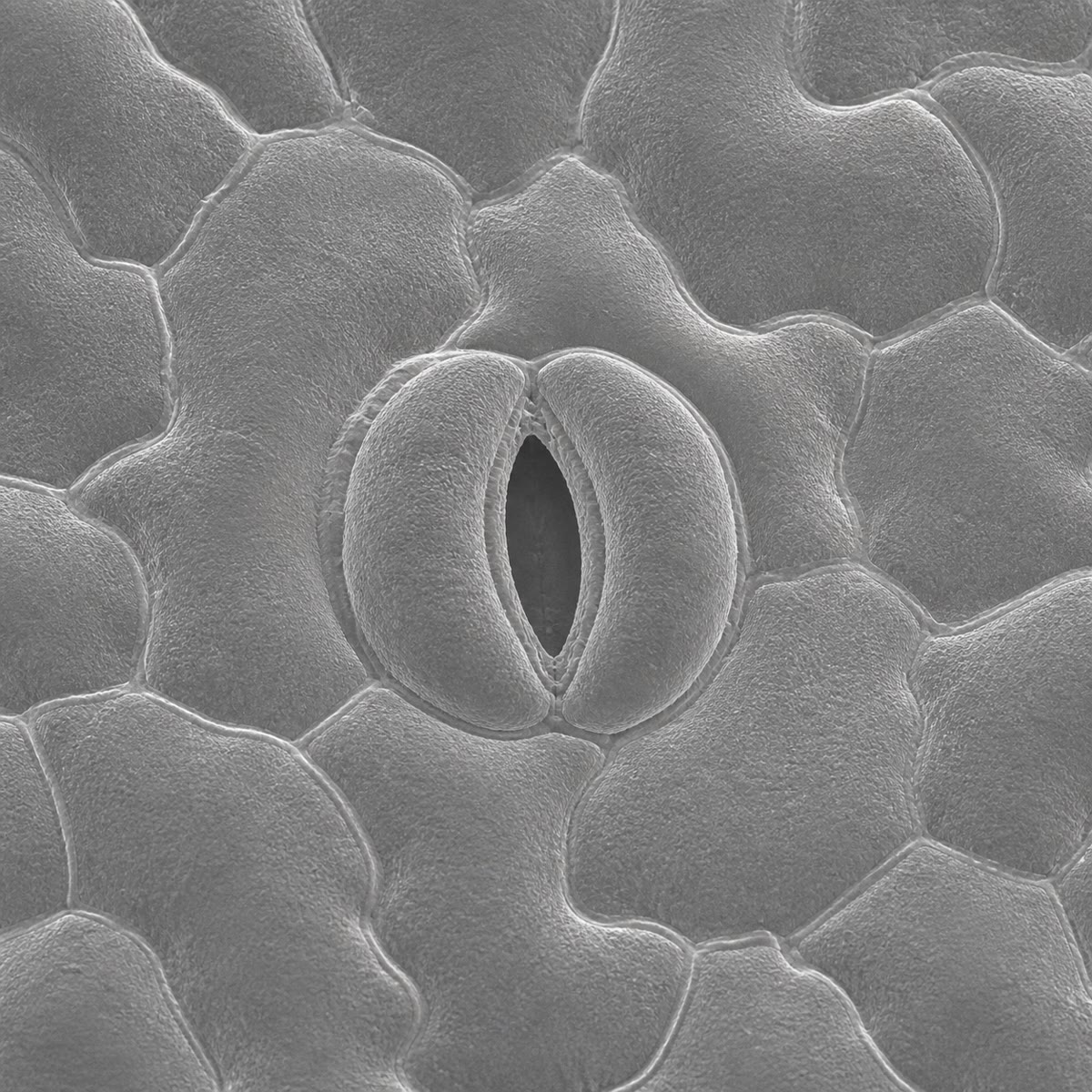
A stoma seen with the scanning electron microscope: the two kidney-shaped guard cells around the pore, among the flat cells of the leaf’s skin. The pore is a few micrometres wide.
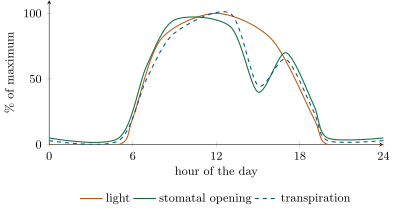
A summer day of a leaf. The stomata open with the light and close at night; on a hot afternoon they close partly to limit water loss, and transpiration — which follows their opening — dips with them.

Examples

Example 28.4 (The numbers of a tree)

A mature birch on a summer day transpires 300 to 400L300\text{ to }400\,\mathrm{L} of water, lifted 20m20\,\mathrm{m} through xylem tubes a tenth of a millimetre wide at 1 to 5m1\text{ to }5\,\mathrm{m} per hour. Less than 1% of that water is kept for photosynthesis; the rest is the price of open stomata. In return the leaves fix some 5kg5\,\mathrm{kg} of carbon dioxide into 3.5kg3.5\,\mathrm{kg} of sugar, of which the phloem delivers a share to every root tip and every ripening seed.

Read in context →