High School Biology · Grades 10–12
28Plant Life: Thriving While Rooted
An oak cannot walk to water, run from a caterpillar, or go looking for a mate. It stands where its acorn fell for three centuries, and in that time it lifts hundreds of tonnes of water from the soil, fends off thousands of species that would eat it, turns its leaves to follow the light, and sends its pollen and its acorns across the countryside by wind and by jay. A rooted life is not a passive one; it is a different set of solutions to the same problems — feeding, defending, moving, reproducing — and this chapter surveys them.
28.1 A body built for exchange
Proposition 28.1 (Two systems, two surfaces)
A flowering plant is organised in two systems: the root system in the soil, which absorbs water and mineral ions and anchors the plant, and the shoot system in the air — stems and leaves — which captures light and carbon dioxide. Each is a vast surface of exchange: the leaves of a large tree spread several hundred square metres of surface to the light, and its roots, extended by billions of microscopic root hairs, several hundred square metres to the soil. A plant is, above all, a way of spreading surface in two directions from a fixed point.
Evidence. A single rye plant grown for four months in a box of soil was found to have root hairs with a total length of over and a surface of about , ten times that of its leaves. A mature oak carries some 250 000 leaves; a hectare of forest presents of leaf surface to the sky. Cutting the root hairs off a seedling, or coating the leaves, stops its growth within days. ∎
Definition 28.2 (Stomata)
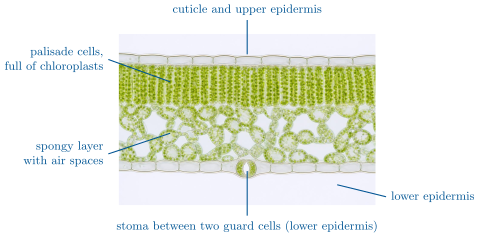
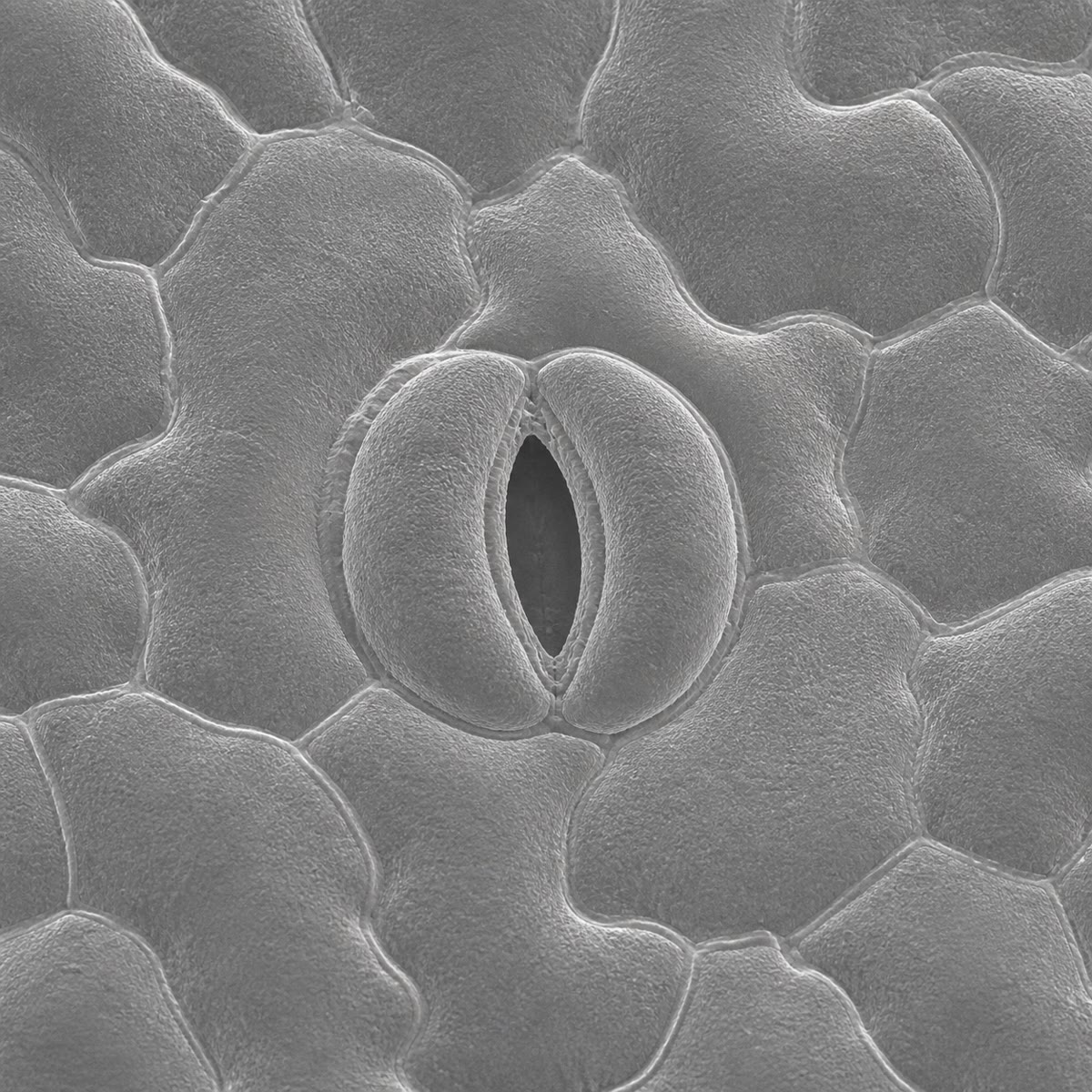
A stoma is a pore in the skin of a leaf, bounded by two guard cells that open it by swelling and close it by shrinking. Through the open stomata carbon dioxide enters for photosynthesis and water vapour leaves — the transpiration that a plant cannot avoid while it feeds. A leaf carries one to three hundred stomata per square millimetre, mostly on its lower surface; they open in the light and close in the dark and in drought.
28.2 Moving water and food without a heart
Proposition 28.3 (Two saps)
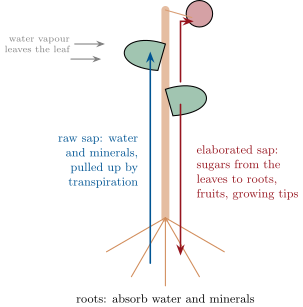
A plant has two transport systems, both made of long cells joined into tubes in the veins of every organ.
- The xylem carries raw sap — water and mineral ions absorbed by the roots — upwards to the leaves. The driving force is transpiration: water evaporating from the leaf cells pulls the continuous column of water in the xylem up from the roots, as a wick draws oil. No pump, no energy spent by the plant: the sun does the lifting.
- The phloem carries elaborated sap — water with the sugars made by the leaves — from the leaves to every organ that consumes or stores them: growing tips, roots, fruits, seeds, tubers. It flows from source to sink, in whichever direction the sinks lie.
Evidence. A cut stem placed in dyed water shows the dye rising in the xylem, faster in a transpiring shoot than in one enclosed in a bag; a shoot whose leaves are removed lifts nothing. A ring of bark (which contains the phloem) removed from a trunk stops sugar reaching the roots, which starve within months, while the leaves above the ring stay supplied with water; sugar accumulates above the ring and the bark swells. Aphids feeding on the phloem with their needle-like mouths yield, when cut off from the needle, a drop of sugary sap under pressure. ∎
Example 28.4 (The numbers of a tree)
A mature birch on a summer day transpires of water, lifted through xylem tubes a tenth of a millimetre wide at per hour. Less than 1% of that water is kept for photosynthesis; the rest is the price of open stomata. In return the leaves fix some of carbon dioxide into of sugar, of which the phloem delivers a share to every root tip and every ripening seed.
28.3 Standing one’s ground
Proposition 28.5 (Defences of a rooted organism)
Unable to flee, plants defend themselves in place.
- Structures: a waxy cuticle and bark against drying and infection; thorns, spines, stinging hairs and silica against herbivores; a thick wall of cellulose in every cell.
- Chemistry: tannins that make leaves indigestible, bitter alkaloids (caffeine, nicotine, morphine), toxins, resins and latex that seal wounds and poison insects; many are made only after an attack, and some are released as volatile signals that warn neighbouring leaves and attract the predators of the attacking insect.
- Tolerance and renewal: growing points at every node, so that a grazed shoot regrows; dormancy through winter or drought; seeds that wait in the soil for years.
Proof. Admitted at this level. ∎
Example 28.6 (A caterpillar’s meal, answered)
Within hours of a caterpillar’s first bites, a tomato plant makes, throughout its leaves, proteins that block the insect’s digestive enzymes; within a day, a chemical it releases into the air has drawn a parasitic wasp to the caterpillar. Neighbouring tomato plants, receiving the same airborne signal, start making the digestion blockers before any caterpillar reaches them. The plant does not move, but it is not defenceless, and it is not alone.
28.4 Growing towards, growing away
Proposition 28.7 (Growth as movement)
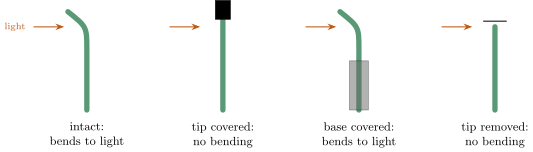
A plant moves by growing. Its shoots grow towards light and against gravity, its roots towards gravity and water: tropisms, directed growth responses. They are controlled by hormones, of which the first identified, auxin, is made in the growing tip of a shoot and transported down the stem; cells receiving more auxin elongate more. Light falling on one side of a shoot shifts the auxin to the shaded side, which grows faster and bends the shoot towards the light.
Evidence. Grass seedlings lit from one side bend towards the light; covered at the tip they do not bend, though the bending region is lower down; covered only at the base they bend normally: the tip perceives, the base responds, and something travels between them. A tip cut off and placed on a block of gel, then the gel placed on one side of a decapitated seedling, makes it bend away from the block in the dark — the substance in the gel, auxin, is enough. Measured directly, the shaded side of a lit seedling holds about twice the auxin of the lit side. ∎
28.5 Reproducing without moving
Proposition 28.8 (Flowers and their visitors)
The flower is the reproductive organ of most land plants: stamens that make pollen, the plant’s male gametes, and a pistil whose ovules hold the female gametes. Since neither parent moves, pollen must be carried from one flower to another — by wind, in the case of grasses and many trees, whose small, dull flowers shed pollen by the million, or by animals, in the case of most flowering plants, whose petals, scents and nectar are the payment offered to the insects, birds and bats that carry pollen as they feed. Flower and pollinator have often evolved together, each adapted to the other’s shape and habits.
Proof. Admitted at this level. ∎
Example 28.9 (Shapes that match)
A flower with a tube of nectar is visited by a moth with a tongue, and by nothing else; a red, scentless, tubular flower open by day is a bird’s flower; a pale flower opening at night with a heavy scent is a moth’s; a bowl of yellow petals with a landing platform is a bee’s. The plant pays in sugar for a service it cannot perform, and the pollinator’s specialisation guarantees that the pollen goes to another flower of the same species.
Proposition 28.10 (Fruits and dispersal)
After fertilisation the ovule becomes a seed — an embryo with a food store, dormant, in a protective coat — and the pistil a fruit that carries the seeds away from the parent: on the wind by wings and plumes; by water; on the fur of animals by hooks; and inside animals, when a fleshy fruit is eaten and its seeds are dropped elsewhere, unharmed, with a dose of fertiliser. The seed is the plant’s one mobile stage and its one means of waiting: it can travel kilometres and sleep years.
Proof. Admitted at this level. ∎
Method 28.11 (Reading an adaptation to rooted life)
For any feature of a plant, ask:
- Which need of a fixed organism does it serve — capturing light or carbon dioxide, absorbing water, transporting, defending, orienting, dispersing pollen or seeds?
- What surface, structure or substance does it use, and at what cost (water lost through stomata, energy spent on nectar or toxins)?
- Does it involve another organism (pollinator, disperser, root fungus, herbivore), and what does each partner gain?
- Is it built once (bark, thorns) or produced on demand (a toxin after attack, a bend towards light)?
Remark 28.12 (Half of life, standing still)
Plants make up most of the living mass of the Earth and feed almost all the rest. The chapters on photosynthesis and respiration that follow describe their chemistry; this one has described the body that runs it: a fixed point, from which surfaces spread into soil and air, saps flow without a pump, chemistry replaces flight, growth replaces movement, and animals are hired to do the travelling.
28.6 Exercises
Exercise 28.1 ★
Name the two systems of a flowering plant and the exchange surface of each.
Solution
Solution of Exercise 28.1.
The root system, whose root hairs present a vast surface to the soil, and the shoot system, whose leaves present a vast surface to light and air.
Exercise 28.2 ★
What is a stoma, what passes through it in each direction, and when is it open?
Solution
Solution of Exercise 28.2.
A pore in the leaf’s skin bounded by two guard cells. Carbon dioxide enters, water vapour (and oxygen) leaves. Open in the light, closed at night and in drought.
Exercise 28.3 ★
Distinguish raw sap from elaborated sap: contents, tubes, direction, driving force.
Solution
Solution of Exercise 28.3.
Raw sap: water and mineral ions, in the xylem, from roots to leaves, pulled by transpiration. Elaborated sap: water and sugars, in the phloem, from the leaves to the organs that use or store sugar, in either direction, pushed by the pressure of the sugar-loaded cells.
Exercise 28.4 ★
Give two structural and two chemical defences of plants.
Solution
Solution of Exercise 28.4.
Structural: cuticle and bark, thorns (also stinging hairs, silica, cell walls). Chemical: tannins, alkaloids (also toxins, resins, latex).
Exercise 28.5 ★
What is a tropism? Which hormone controls the bending of a shoot towards light, and where is it made?
Solution
Solution of Exercise 28.5.
A directed growth response to a stimulus (light, gravity, water). Auxin, made in the growing tip of the shoot.
Exercise 28.6 ★★
A leaf of carries 200 stomata per square millimetre on its lower surface. How many stomata does it have? How many on a tree of 200 000 leaves?
Exercise 28.7 ★★
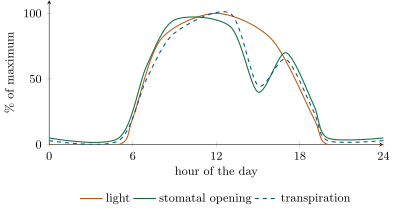
From the summer-day figure, at what hour is transpiration highest, and why does it dip in mid-afternoon although the light does not?
Exercise 28.8 ★★
A ring of bark is removed around a trunk in spring. Predict what happens to the leaves, the roots, and the bark just above the ring over the following months.
Solution
Solution of Exercise 28.8.
The leaves stay green and supplied with water (the xylem, inside the wood, is intact). The roots, cut off from the leaves’ sugar, exhaust their reserves over months and die, and the tree with them. Just above the ring the bark swells with the sugar that can no longer pass.
Exercise 28.9 ★★
In the seedling figure, explain what each of the four experiments rules in or out, and why all four are needed.
Solution
Solution of Exercise 28.9.
Intact: the response exists. Tip covered: the tip is where light is sensed. Base covered: the base need not be lit to bend — it responds to a signal, not to light. Tip removed: the tip is necessary; the signal comes from it. Together they separate sensing (tip) from responding (base) and show that something travels between them.
Exercise 28.10 ★★
A plant lifts of water a day to its leaves without spending energy on it. Explain where the energy comes from.
Exercise 28.11 ★★
Compare a wind-pollinated and an insect-pollinated flower on four points, and explain each difference by the carrier.
Solution
Solution of Exercise 28.11.
Wind flower: small, dull, scentless, no nectar, huge amounts of light pollen, feathery stigmas — the wind is blind and free, so the plant invests in quantity. Insect flower: large, coloured, scented, nectar-bearing, sticky pollen in modest amounts — the carrier must be attracted and paid, and delivers the pollen precisely.
Exercise 28.12 ★★★
A plant closes its stomata during a drought. Explain what it gains, what it loses, and why a long drought kills it even though it has stopped losing water.
Solution
Solution of Exercise 28.12.
It gains water, keeping its cells turgid and alive; it loses the entry of carbon dioxide, hence photosynthesis, and the cooling of transpiration. Closed stomata mean no sugar made: the plant lives on its reserves, and a long drought starves it before it dries it.
Exercise 28.13 ★★★
Caffeine is toxic to insects at the doses in a coffee leaf but present at a tenth of that dose in the nectar, where it improves bees’ memory of the flower. Read this with Method 28.11: what does the same molecule do in the two places?
Solution
Solution of Exercise 28.13.
In the leaf, a defence: a toxin against herbivores, built into the tissue. In the nectar, a recruitment: a low dose that makes the pollinator remember and return, paid alongside the sugar. One substance, two needs, dosed by place.
Exercise 28.14 ★★★
A moth with a tongue is the only pollinator of a flower with a nectar tube. Explain how such a match can evolve step by step, and what each partner risks if the other disappears.
Solution
Solution of Exercise 28.14.
Flowers with slightly longer tubes are pollinated only by moths that reach the bottom, so their pollen goes to flowers of their own kind; moths with slightly longer tongues get nectar others cannot; each small advantage is selected, and tube and tongue lengthen together over many generations. If the moth disappears the flower sets no seed; if the flower disappears the moth loses its only food.
Exercise 28.15 ★★★
"A plant is a passive organism." Rewrite the sentence correctly in a paragraph, with one example each of sensing, responding, defending and recruiting.
Solution
Solution of Exercise 28.15.
A plant senses light with the tip of its shoots and gravity with its roots; it responds by growing towards the one and along the other; it defends itself with bark and thorns, and makes toxins and digestion blockers within hours of an attack; and it recruits insects to carry its pollen, birds to carry its seeds and wasps to kill its caterpillars, paying in nectar, fruit and scent. It acts without moving.
28.7 Problem: An Oak’s Summer Day
Problem 28.1
Weekend problem — a tree’s exchanges reckoned: leaves and stomata counted, water lifted and sugar made, the phloem’s deliveries, and the seeds sent out
A mature oak carries 250 000 leaves of each. Its lower leaf surfaces bear 250 stomata per square millimetre. On a summer day each square metre of leaf transpires of water and fixes of carbon dioxide into sugar. Leaves are 90% water; photosynthesis uses of water per of sugar made.
Part I — Surfaces.
- Compute the total leaf area of the oak, in square metres.
- Compute the number of stomata on the tree.
- The tree’s crown covers of ground. How many square metres of leaf are stacked above each square metre of ground?
- The root hairs of such a tree present about to the soil. Compare with the leaves and explain why the two surfaces are of the same order.
- Why must the leaf surface be spread thin and stacked, rather than concentrated into one thick organ?
Part II — Water.
- Compute the volume of water the oak transpires in the day.
- Compute the mass of sugar made, and the mass of water used in making it. What fraction of the transpired water is that?
- Explain why the tree cannot keep the rest: what would happen if it closed its stomata to save it?
- The water rises through the xylem. What supplies the energy, and what would a pump of the tree’s own have cost it?
- On a hot, dry afternoon transpiration falls to a third while the light is at its maximum. What has the tree done, and what does it cost in sugar?
Part III — Sugar. The oak’s roots, trunk and growing shoots consume of sugar a day in respiration and growth; the acorns take another during their season.
- Compute the sugar made in the day and the fraction delivered to the roots, trunk and shoots, and to the acorns.
- Which tissue carries the sugar, and from what to what?
- What happens to the surplus sugar, and where can it be found the following spring?
- A ring of bark is cut in June. Which of the figures of question 11 change, and how?
- Explain why a tree that loses half its leaves to caterpillars in May can still produce acorns, if the season is good.
Part IV — Sending the next generation. The oak is wind-pollinated and produces, in a good year, 10 000 acorns; jays carry off and bury about 3000, of which they later eat most; squirrels and mice eat nearly all the rest.
- List three features you expect of the oak’s flowers, from its pollination by wind.
- Why does the tree "pay" the jays with acorns it will lose, rather than dropping the acorns beneath itself?
- If a jay forgets 5% of the acorns it buries and one buried acorn in 50 becomes a sapling, how many saplings does the year’s crop give?
- The oak lives 300 years and needs to be replaced by one adult tree. Compare with your previous answer and explain why the numbers make sense.
- State the result: the oak’s leaf area and number of stomata, the litres it lifts in a day for the kilograms of sugar it makes, and the two agents that do its moving for it.
Solution
Solution of Problem 28.1.
1. .
2. ; stomata.
3. square metres of leaf per square metre of ground.
4. About of root hairs against of leaves: comparable. Both are exchange surfaces sized to the same flows — the water the leaves lose must be absorbed by the roots.
5. Light is absorbed within a fraction of a millimetre of tissue, and carbon dioxide diffuses only over short distances: a thick organ would leave most of its cells in the dark and starved. Thin, stacked leaves put every cell near light and air.
6. .
7. of carbon dioxide, giving about of sugar (or simply: the sugar made from of is about ); water used : about 0.6% of the transpired.
8. Carbon dioxide enters through the same open stomata that let water out; closing them stops photosynthesis. The water is the price of the sugar.
9. The sun, evaporating water at the leaves. Lifting by is about of work — little in itself, but a biological pump would need tissues, ATP and maintenance the tree does not have to build.
10. It has partly closed its stomata against the dry heat; carbon dioxide entry and sugar production fall by a similar fraction — some of sugar lost over the afternoon.
11. About made; (60%) to roots, trunk and shoots, (15%) to the acorns.
12. The phloem, from the leaves (source) to the roots, trunk, shoots and acorns (sinks).
13. Stored as starch in the trunk and roots; next spring it is turned back into sugar to build the new leaves before they can feed themselves.
14. Sugar still reaches the shoots and acorns above the ring; the roots and lower trunk receive none: their share falls to whatever was stored, and they starve over the season.
15. The remaining leaves keep making sugar, the stored starch of the trunk and roots covers the shortfall, and the tree can put out new leaves from its many growing points; the acorns are a sink the tree can still fill if the summer’s sugar suffices.
16. Small, greenish flowers without petals, scent or nectar, hanging in catkins that shed clouds of light pollen; large feathery stigmas to catch it.
17. Acorns dropped beneath the parent grow, if at all, in its shade and compete with it; a jay carries them hundreds of metres and buries them at the right depth. Losing most of them is the price of placing a few well.
18. forgotten acorns; saplings.
19. Three saplings a year over a few decades of good crops give perhaps a hundred saplings in the tree’s life, of which one must survive to adulthood. The numbers are large because almost every seed and sapling is lost.
20. of leaf and some stomata; about lifted in a day for of sugar; the wind for its pollen and the jay for its acorns.