সব বই

পেশাদার

1 Markets I: The Ecosystem and Exchange-Traded Marketsবাজার অনলাইন 2 Markets II: Rates, FX and Creditবাজার অনলাইন 3 Markets III: Commodities, Energy and Cryptoবাজার অনলাইন 4 Quantitative Methodsপদ্ধতি অনলাইন 5 Derivatives and Volatilityডেরিভেটিভস অনলাইন 6 Rates, Credit, XVA and Riskসুদহার, ঋণ ও ঝুঁকি অনলাইন 7 Research Craft: Predictors, Backtests, Measurement, Portfoliosগবেষণা অনলাইন 8 Strategies I: Equities and Futuresকৌশল অনলাইন 9 Strategies II: Volatility, Relative Value, Macro and the Bank Desksকৌশল অনলাইন 10 Microstructure and Executionএক্সিকিউশন অনলাইন 11 Market Making and High-Frequency Tradingমার্কেট মেকিং অনলাইন 12 Machine Learning for Marketsমেশিন লার্নিং অনলাইন 13 Low-Latency Softwareপ্রযুক্তি অনলাইন 14 Networks, Hardware and Trading Infrastructureপ্রযুক্তি অনলাইন 15 Research, Data and Risk Platformsপ্রযুক্তি অনলাইন 16 The Desk and the Firmপ্রতিষ্ঠান অনলাইন 17 The Industry: Firms, Roles and Careersক্যারিয়ার অনলাইন 18 Interviews I: Maths, Probability and Speedক্যারিয়ার অনলাইন 19 Interviews II: Markets, Trading Games and the Final Roundক্যারিয়ার অনলাইন 20 Interviews III: Codeক্যারিয়ার অনলাইন
অ্যাপ পরিচিতি Coach সাইন ইন পড়া শুরু করো

বইগুলো এখনো বাংলা ভাষায় পাওয়া যায় না — ইংরেজি সংস্করণ দেখানো হচ্ছে।

Biology · পরিভাষা

The cochlea কী?

Definition 18.5 University Biology — Year 3 · অধ্যায় 18 — Sensory Systems

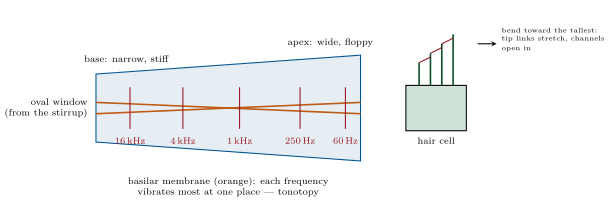
Sound is a pressure wave; the ear’s problem is to detect pressure changes of a few tens of micropascals in air and to sort them by frequency. The eardrum and the three middle-ear bones concentrate the force from the drum’s 55 mm255\,\mathrm{mm}^{2} onto the 3 mm23\,\mathrm{mm}^{2} of the oval window, raising the pressure some twentyfold — the impedance match between air and the fluid of the inner ear, without which most of the sound would reflect. Inside the cochlea, a coiled tube 35 mm35\,\mathrm{mm} long, the pressure wave travels along the basilar membrane, which is narrow and stiff at the base and wide and floppy at the apex; each frequency makes the membrane vibrate most at one place — high frequencies near the base, low near the apex — a tonotopic map that the brain reads as pitch. On the membrane sit the hair cells: 35003500 inner hair cells in a single row, each crowned with a bundle of stereocilia joined tip to tip by fine tip links; bending the bundle toward its tallest cilium stretches the links and pulls open cation channels within microseconds, without any second messenger, and potassium flows in from the endolymph, whose unusual composition and +80 mV+80\,\mathrm{mV} potential give a driving force of 150 mV150\,\mathrm{mV}. The inner hair cells signal the auditory nerve; the 12 00012\,000 outer hair cells, driven by the same motion, contract and lengthen with the sound through the motor protein prestin and pump energy back into the membrane’s vibration — an amplifier that sharpens tuning a hundredfold and is what fails in most deafness. Intensity is measured in decibels: L=10log⁡10(I/I0)L = 10\log_{10} (I/I_{0}), with I0=1×10⁻¹² W/m2I_{0} = 1 \times 10^{-12}\,\mathrm{W}/\mathrm{m}^{2} the threshold of hearing; the ear works over 120 dB120\,\mathrm{dB}, a trillionfold in intensity.

Left: the cochlea unrolled — the basilar membrane grades from stiff to floppy, and each frequency peaks at its own place. Right: a hair bundle, whose tip links open the transduction channels mechanically when the bundle is bent.
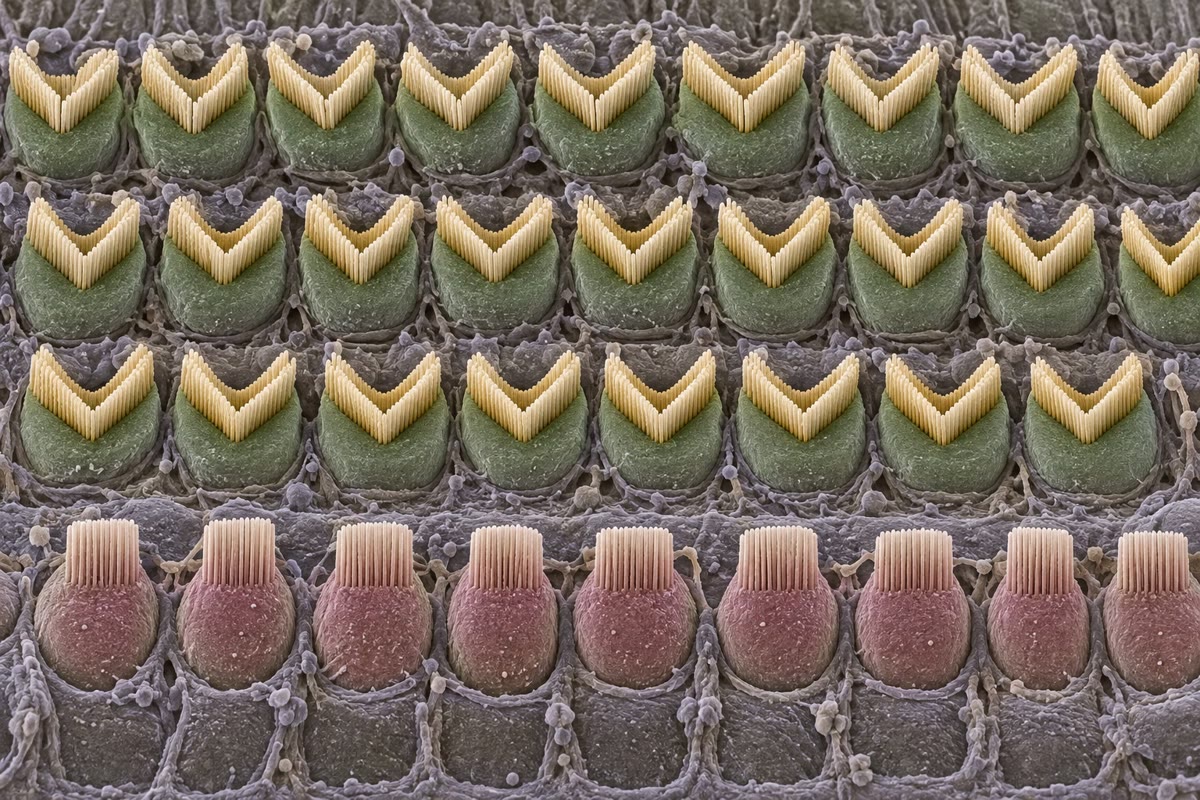
The organ of Corti from above: three rows of outer hair cells with V-shaped bundles, one row of inner hair cells. Each bundle’s tip links open the channels; the outer cells amplify, the inner cells report.

উদাহরণ

Example 18.6 (The ear’s numbers)

At the threshold of hearing the basilar membrane moves about 0.1 nm0.1\,\mathrm{nm} and the pressure amplitude is 20 µPa20\,\text{µ}\mathrm{Pa}, a two-billionth of atmospheric; at 120 dB120\,\mathrm{dB} the pressure is a million times greater and the membrane’s motion tens of nanometres. A young ear hears from 20 Hz20\,\mathrm{Hz} to 20 kHz20\,\mathrm{kHz} and separates tones 0.3 %0.3\,\% apart, the discrimination of the place code sharpened by the outer hair cells. The auditory nerve’s 30 00030\,000 fibres fire in step with the pressure wave up to about 4 kHz4\,\mathrm{kHz} (phase locking), carrying timing to a precision of tens of microseconds, from which the brain computes a sound’s direction from the difference in arrival at the two ears — as little as 10 µs10\,\text{µ}\mathrm{s}. The balance organs use the same hair cells: in the semicircular canals the fluid’s inertia bends them when the head turns (angular acceleration), and in the otolith organs a layer of calcium carbonate crystals loads them with gravity and linear acceleration.

প্রসঙ্গসহ পড়ো →