Coach
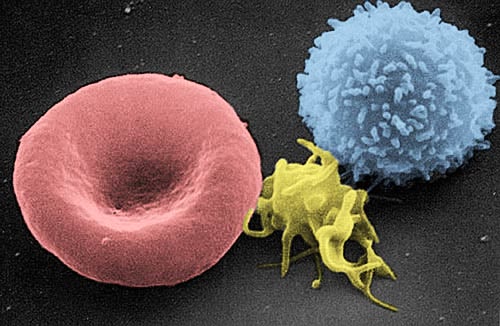
CoachBlood is a tissue in suspension: about in an adult, of body mass. Spun down, it separates into plasma (: water, of proteins — albumin, globulins, fibrinogen — and the salts, sugars, lipids, gases and hormones it carries) and cells (, the haematocrit): red cells ( per litre, biconcave discs of without a nucleus, each packed with million molecules of haemoglobin, living 120 days and made in the marrow at two million a second), white cells ( per litre: neutrophils, lymphocytes, monocytes, eosinophils, basophils, the mobile arm of immunity), and platelets ( per litre, fragments of marrow cells that plug wounds and start clotting). The red cells carry oxygen — per litre of blood at full saturation, seventy times what water dissolves — and the plasma carries everything else, including the of that is not in the cells, the heat of the muscles to the skin, and the hormones of Chapter 19 to their targets. Blood is also a solution under oncotic pressure: its proteins, which cannot leave the capillaries, hold about of osmotic pull, and that pull is what keeps the plasma in the vessels.