 Coach
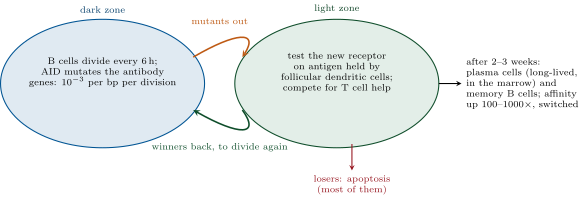
CoachIn a germinal centre, a structure that forms in a lymph node about a week into a response, activated B cells run an evolutionary algorithm. In its dark zone they divide every six hours and their antibody variable genes are mutated by the enzyme AID at about one change per thousand base pairs per division — somatic hypermutation, a million times the genomic rate, aimed at one kilobase. In the light zone each cell tests its new receptor against antigen held on follicular dendritic cells and competes for the help of T cells: cells that bind better take up more antigen, present more, receive more help and return to the dark zone to divide again; cells that bind worse, or have lost binding, die by apoptosis. Over two to three weeks of cycles the affinity of the surviving antibodies rises a hundred- to a thousandfold — affinity maturation — and the winners leave as plasma cells and memory cells, having also switched class. The secondary response is faster, larger and made of better antibody because it starts from this selected, expanded, switched population.
Examples
Example 16.7 (Kinetics of a response)
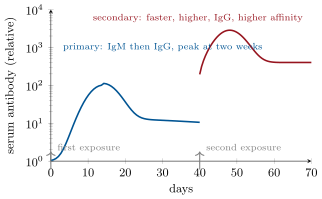
About one B cell in binds a given epitope, so a body’s B cells hold some precursors, of which perhaps a hundred meet the antigen in the draining node. Dividing every eight hours, a hundred cells become in a week. Antibody appears in the serum after four to six days, IgM first, peaks at about two weeks and declines with a half-life of three weeks for IgG as the short-lived plasma cells die, settling at the level the long-lived marrow plasma cells maintain for years. A second exposure starts from – memory cells of high affinity already switched to IgG: antibody rises within two days, ten- to a hundredfold higher, and neutralises the pathogen before it can establish itself — which is what a vaccine buys.