 Coach
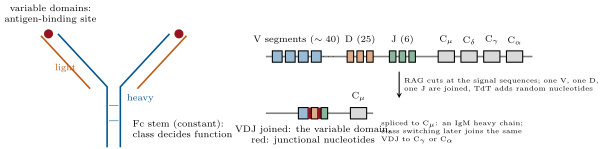
CoachAn antibody (immunoglobulin) is two identical heavy chains and two identical light chains, each with a variable domain at its end and constant domains behind; the two arms each bind an epitope through three hypervariable loops of the heavy and three of the light variable domain, and the stem (Fc) is what phagocytes, complement and mast cells recognise. Five classes differ in their heavy-chain constant region: IgM, the first made, a pentamer that activates complement well; IgG, the workhorse of blood and tissues, which crosses the placenta; IgA, a dimer secreted across mucosal surfaces into gut, airways and milk; IgE, bound by mast cells, against worms — and the cause of allergy; IgD. The variable domains are not encoded as such. The heavy-chain locus holds about functional V segments, D and J; a developing B cell chooses one of each and joins them by V(D)J recombination: the enzymes RAG1 and RAG2 cut at recombination signal sequences flanking the segments, and the ends are joined by the non-homologous end-joining machinery of Chapter 3, with nucleotides trimmed and added at random (by the enzyme TdT) at each junction — junctional diversity, which falls exactly in the third hypervariable loop. The light chains do the same with V and J. After the response begins the same variable domain is joined to a different constant region by a second rearrangement, class switching, changing the antibody’s function but not its specificity.
Examples
Example 16.7 (Kinetics of a response)
About one B cell in binds a given epitope, so a body’s B cells hold some precursors, of which perhaps a hundred meet the antigen in the draining node. Dividing every eight hours, a hundred cells become in a week. Antibody appears in the serum after four to six days, IgM first, peaks at about two weeks and declines with a half-life of three weeks for IgG as the short-lived plasma cells die, settling at the level the long-lived marrow plasma cells maintain for years. A second exposure starts from – memory cells of high affinity already switched to IgG: antibody rises within two days, ten- to a hundredfold higher, and neutralises the pathogen before it can establish itself — which is what a vaccine buys.
Example 16.9 (Hypersensitivity, deficiency, transplantation)
Allergy is a Th2 response to a harmless antigen — pollen, peanut, penicillin — that produces IgE; on re-exposure the antigen cross-links IgE on mast cells, which release histamine within minutes, and if the antigen is in the blood the systemic release is anaphylaxis, treated with adrenaline. Immunodeficiency: children lacking RAG or the enzyme ADA make no lymphocytes (severe combined immunodeficiency) and die of infection unless given marrow or gene therapy; HIV destroys CD4 T cells and with them the help every response needs. Transplantation: the recipient’s T cells see the donor’s HLA molecules as foreign, and up to a tenth of all T cells respond — far more than to any pathogen — so grafts are matched at the HLA loci and the recipient is immunosuppressed for life; a graft of marrow can attack its new host instead. And the deliberate uses: the monoclonal antibodies of Chapter 6, the checkpoint inhibitors that release T cells against tumours (Chapter 11), and T cells engineered with a chimaeric receptor for a tumour antigen (CAR-T), which have cured leukaemias that nothing else touched.