
সব বই

পেশাদার

1 Markets I: The Ecosystem and Exchange-Traded Marketsবাজার অনলাইন 2 Markets II: Rates, FX and Creditবাজার অনলাইন 3 Markets III: Commodities, Energy and Cryptoবাজার অনলাইন 4 Quantitative Methodsপদ্ধতি অনলাইন 5 Derivatives and Volatilityডেরিভেটিভস অনলাইন 6 Rates, Credit, XVA and Riskসুদহার, ঋণ ও ঝুঁকি অনলাইন 7 Research Craft: Predictors, Backtests, Measurement, Portfoliosগবেষণা অনলাইন 8 Strategies I: Equities and Futuresকৌশল অনলাইন 9 Strategies II: Volatility, Relative Value, Macro and the Bank Desksকৌশল অনলাইন 10 Microstructure and Executionএক্সিকিউশন অনলাইন 11 Market Making and High-Frequency Tradingমার্কেট মেকিং অনলাইন 12 Machine Learning for Marketsমেশিন লার্নিং অনলাইন 13 Low-Latency Softwareপ্রযুক্তি অনলাইন 14 Networks, Hardware and Trading Infrastructureপ্রযুক্তি অনলাইন 15 Research, Data and Risk Platformsপ্রযুক্তি অনলাইন 16 The Desk and the Firmপ্রতিষ্ঠান অনলাইন 17 The Industry: Firms, Roles and Careersক্যারিয়ার অনলাইন 18 Interviews I: Maths, Probability and Speedক্যারিয়ার অনলাইন 19 Interviews II: Markets, Trading Games and the Final Roundক্যারিয়ার অনলাইন 20 Interviews III: Codeক্যারিয়ার অনলাইন
অ্যাপ পরিচিতি Coach সাইন ইন পড়া শুরু করো

বইগুলো এখনো বাংলা ভাষায় পাওয়া যায় না — ইংরেজি সংস্করণ দেখানো হচ্ছে।

Biology · পরিভাষা

The prokaryotic cell কী?

অন্য নাম: prokaryote · nucleoid · plasmid · cell wall bacterial

Definition 1.7 University Biology — Year 2 · অধ্যায় 1 — Diversity of Unicellular Organisms

A prokaryote (the bacteria and the archaea, two domains as distinct from each other as either is from us) is a cell without a nucleus or membrane-bound organelles: a single circular chromosome in a nucleoid, often with small extra circles called plasmids, ribosomes free in a cytoplasm of 0.5 to 2 µm0.5\text{ to }2\,\text{µ}\mathrm{m}, a plasma membrane that carries the respiratory or photosynthetic chains, and a rigid cell wall that resists the turgor of a cytoplasm several bars above its surroundings. Shapes are few and named: coccus (sphere), bacillus (rod), spirillum and spirochaete (helices), vibrio (comma); cells may stay in pairs, chains, tetrads or clusters after dividing.
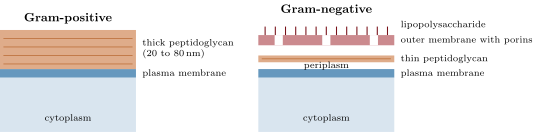
The two bacterial envelopes in section. Left: one membrane under a thick peptidoglycan coat. Right: a thin peptidoglycan layer in the periplasm between two membranes, the outer one studded with porins and coated with lipopolysaccharide.
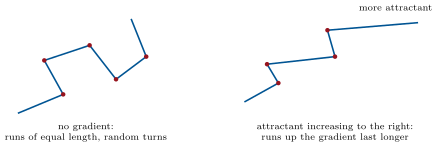
Run and tumble. Left: without a gradient the cell performs a random walk, each run (blue) ended by a tumble (red dot). Right: when an attractant increases along a run, tumbling is suppressed and the run lengthens; the walk drifts up the gradient.

উদাহরণ

Example 1.10 (Cyanobacteria and the heterocyst)

Cyanobacteria are the bacteria that photosynthesise as plants do, splitting water and releasing oxygen on stacked internal membranes (the thylakoids, which the chloroplast inherited from them). Many grow as filaments of cells sharing a sheath. In Anabaena, when combined nitrogen runs out, every tenth cell or so becomes a heterocyst: it dismantles its oxygen-producing photosystem, thickens its wall against oxygen, and fixes atmospheric nitrogen with an enzyme that oxygen would destroy, exporting glutamine to its neighbours in exchange for sugar. A filament of Anabaena is a first sketch of a division of labour between cells.

প্রসঙ্গসহ পড়ো →