Biology · Glossary

What is The respiratory chain?

Definition 15.8 University Biology — Year 1 · Chapter 15 — Cellular Respiration and Fermentation

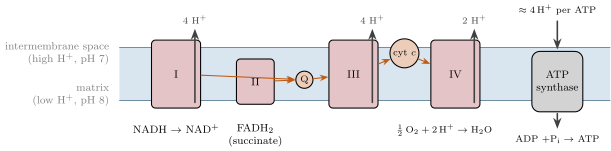
The respiratory chain is four protein complexes of the inner mitochondrial membrane and two mobile carriers. NADH gives its electrons to complex I, FADH2\mathrm{FADH_2} (via succinate dehydrogenase, complex II) gives its own; both reduce ubiquinone (Q), a lipid-soluble quinone diffusing in the membrane; Q passes them to complex III, which hands them to cytochrome cc, a small protein on the outer face; and complex IV (cytochrome oxidase) delivers them, four at a time, to O2\mathrm{O_2}, making water. At each of complexes I, III and IV the electrons drop in potential and the energy pumps protons from the matrix into the intermembrane space: about 4, 4 and 2 per pair of electrons, ten per NADH, six per FADH2\mathrm{FADH_2} (which enters below complex I).

The inner mitochondrial membrane. Electrons (orange) fall from NADH or FADH_2 through the complexes to oxygen; complexes I, III and IV pump protons outward (green); the ATP synthase lets them back in and makes ATP.
The inner mitochondrial membrane. Electrons (orange) fall from NADH or FADH2\mathrm{FADH_2} through the complexes to oxygen; complexes I, III and IV pump protons outward (green); the ATP synthase lets them back in and makes ATP.
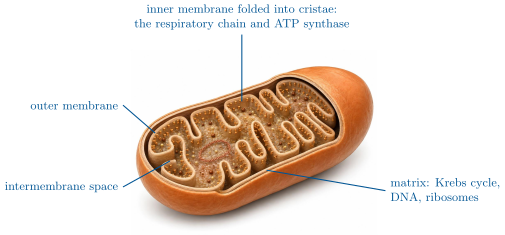
A mitochondrion cut open. The inner membrane’s folds multiply the area available for the chain and the synthase; the matrix within holds the Krebs cycle.
Read in context →