University Biology — Year 1 · Bachelor Year 1
15Cellular Respiration and Fermentation
A flask of yeast in sugar solution with the air excluded bubbles carbon dioxide and turns the sugar into alcohol; let air in and the bubbling slows, the alcohol stops, and the yeast grows ten times faster on the same sugar. Pasteur saw this in 1861 and could not explain it; the explanation took a century and runs through the whole of this chapter. Oxygen lets a cell extract from glucose fifteen times the energy it can get without it, and it does so by passing the electrons of the sugar down a chain of carriers to oxygen, pumping protons across a membrane as they fall, and letting the protons back through a turbine that makes ATP. This chapter describes glycolysis, the Krebs cycle, the respiratory chain and its chemiosmotic coupling, the fermentations that do without oxygen, and the burning of fats and proteins by the same machinery.
15.1 The oxidation of glucose
Proposition 15.1 (The overall reaction and its stages)
The complete oxidation of glucose,
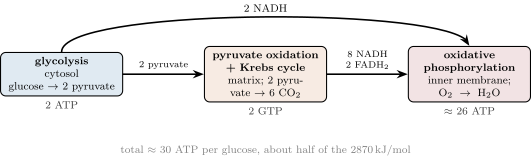
is carried out in three stages that never let the electrons meet the oxygen directly. Glycolysis, in the cytosol, splits glucose into two pyruvate and yields 2 ATP and 2 NADH. Pyruvate oxidation and the Krebs cycle, in the mitochondrial matrix, oxidise the pyruvate to , loading the electrons onto 8 NADH and 2 and making 2 GTP. Oxidative phosphorylation, in the inner mitochondrial membrane, passes those electrons to oxygen through a chain of carriers that pumps protons, and the proton gradient drives the synthesis of about 26 ATP. In all, some 30 ATP per glucose: about half the free energy of combustion captured, the rest released as heat.
Definition 15.2 (Electron carriers)
(nicotinamide adenine dinucleotide) accepts two electrons and one proton from a substrate to become NADH; FAD accepts two electrons and two protons to become . Both are coenzymes of dehydrogenases, and both are recycled: reduced by catabolism, re-oxidised by the respiratory chain. A cell holds only micromoles of them, turning over thousands of times an hour. Their redox potentials, for , place them far below oxygen (): each pair of electrons NADH hands to oxygen releases , enough for more than four ATP.
15.2 Glycolysis
Definition 15.3 (Glycolysis)
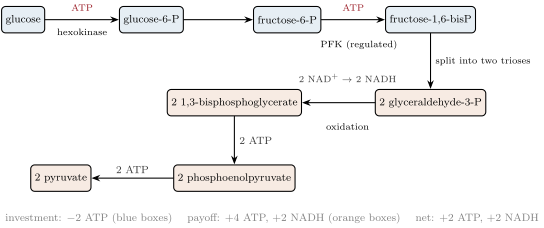
Glycolysis is a sequence of ten enzyme reactions in the cytosol that converts one glucose (C6) into two pyruvate (C3). In the investment phase two ATP are spent to phosphorylate the sugar (hexokinase, then phosphofructokinase, PFK) and the six-carbon diphosphate is split into two three-carbon phosphates. In the payoff phase each triose is oxidised by (the only oxidation of glycolysis) and its phosphates are transferred to ADP by substrate-level phosphorylation — a phosphate handed directly from a high-energy intermediate to ADP, with no membrane or oxygen involved. The balance:
It needs no oxygen; it is the oldest and most universal pathway of metabolism.
Proposition 15.4 (Control at phosphofructokinase)
PFK, the first irreversible step committed to glycolysis, is an allosteric enzyme (Chapter 13) inhibited by ATP and by citrate — the signals that energy and Krebs-cycle fuel are plentiful — and activated by AMP and ADP, the signals that they are not. When ATP is high the flux through glycolysis falls within seconds; when the cell spends ATP, AMP rises steeply (through adenylate kinase, ), and PFK opens. The cell’s energy charge regulates the pathway that fills it.
15.3 Pyruvate oxidation and the Krebs cycle
Definition 15.5 (Pyruvate dehydrogenase, acetyl-CoA)
Pyruvate enters the mitochondrion and is oxidised by the pyruvate dehydrogenase complex to acetyl-CoA — a two-carbon acetyl group carried by coenzyme A (Chapter 11) on a high-energy thioester bond — releasing one and one NADH. Acetyl-CoA is the common entry of all fuels into the cycle: carbohydrate through pyruvate, fats through -oxidation, many amino acids directly.
Definition 15.6 (The Krebs cycle)
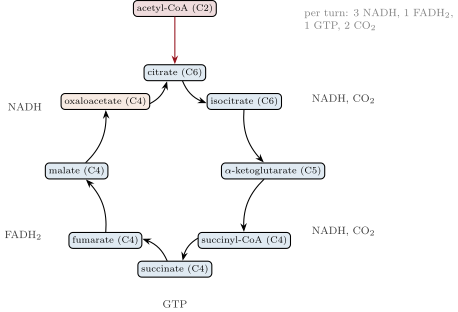
The Krebs cycle (citric acid cycle) in the mitochondrial matrix condenses acetyl-CoA (C2) with oxaloacetate (C4) into citrate (C6) and, in eight steps, oxidises the two carbons to while regenerating oxaloacetate. Per acetyl group: 3 NADH, 1 , 1 GTP (by substrate-level phosphorylation) and 2 . Per glucose (two acetyls): 6 NADH, 2 , 2 GTP, 4 — which with the 2 of pyruvate dehydrogenase makes the six of the overall equation. No oxygen is consumed in the cycle itself; it runs only as long as the respiratory chain re-oxidises its NADH. It is also amphibolic: its intermediates are drawn off for biosynthesis (Chapter 16) and replenished from amino acids and pyruvate.
Example 15.7 (Following the carbons)
Feed a cell glucose labelled with on carbon 1: the label appears in the methyl carbon of pyruvate, then of acetyl-CoA, enters citrate, and leaves as only on the second or third turn of the cycle — the two carbons released in a given turn belong to the oxaloacetate of the previous one. Krebs (1937) deduced the cycle from the observation that catalytic amounts of any of its acids stimulated the oxidation of far more pyruvate than they could account for themselves: they were being regenerated.
15.4 Oxidative phosphorylation
Definition 15.8 (The respiratory chain)
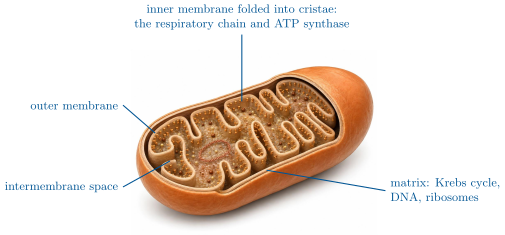
The respiratory chain is four protein complexes of the inner mitochondrial membrane and two mobile carriers. NADH gives its electrons to complex I, (via succinate dehydrogenase, complex II) gives its own; both reduce ubiquinone (Q), a lipid-soluble quinone diffusing in the membrane; Q passes them to complex III, which hands them to cytochrome , a small protein on the outer face; and complex IV (cytochrome oxidase) delivers them, four at a time, to , making water. At each of complexes I, III and IV the electrons drop in potential and the energy pumps protons from the matrix into the intermembrane space: about 4, 4 and 2 per pair of electrons, ten per NADH, six per (which enters below complex I).
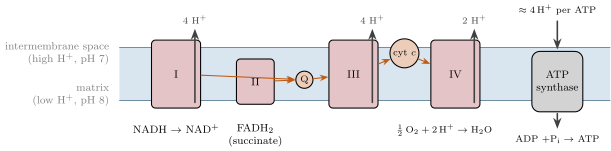
Theorem 15.9 (Chemiosmotic coupling)
The proton gradient built by the chain — about of membrane potential (matrix negative) plus one pH unit, a proton-motive force of about , or per mole of protons — is the sole link between electron transport and ATP synthesis. The ATP synthase, a rotary motor of the inner membrane, lets about through per ATP made, and one more is spent importing the phosphate and exporting the ATP: 4 per ATP. Hence the P/O ratio: ATP per NADH and per .
Evidence. Mitochondria make ATP only when their inner membrane is intact and closed; fragments that transport electrons but cannot hold a gradient make none. Uncouplers such as dinitrophenol, which shuttle protons across the membrane, abolish ATP synthesis while oxygen consumption continues and even accelerates, the energy leaving as heat — brown fat does this deliberately with its own uncoupling protein (Chapter 2), and dinitrophenol was once sold as a slimming drug that killed by hyperthermia. Inhibitors of the chain (cyanide on complex IV) stop both; inhibitors of the synthase (oligomycin) stop ATP synthesis and, with the gradient unable to discharge, stop respiration too, which an uncoupler then restores. An artificial pH gradient imposed on mitochondria in the dark drives ATP synthesis, as in chloroplasts (Chapter 14). ∎
Method 15.10 (The ATP balance sheet of a glucose)
- Glycolysis: ATP (net), NADH in the cytosol.
- Pyruvate dehydrogenase: NADH. Krebs cycle: NADH, , GTP ( ATP).
- Oxidative phosphorylation: ATP per mitochondrial NADH (8: 20 ATP), per (2: 3 ATP).
- Cytosolic NADH cannot cross the inner membrane; its electrons enter by a shuttle that delivers them to (1.5 each, in muscle and brain) or to (2.5 each, in liver and heart): 3 or 5 ATP.
- Total: , or with the better shuttle. Efficiency: under cellular conditions.
15.5 Fermentation
Definition 15.11 (Fermentation)
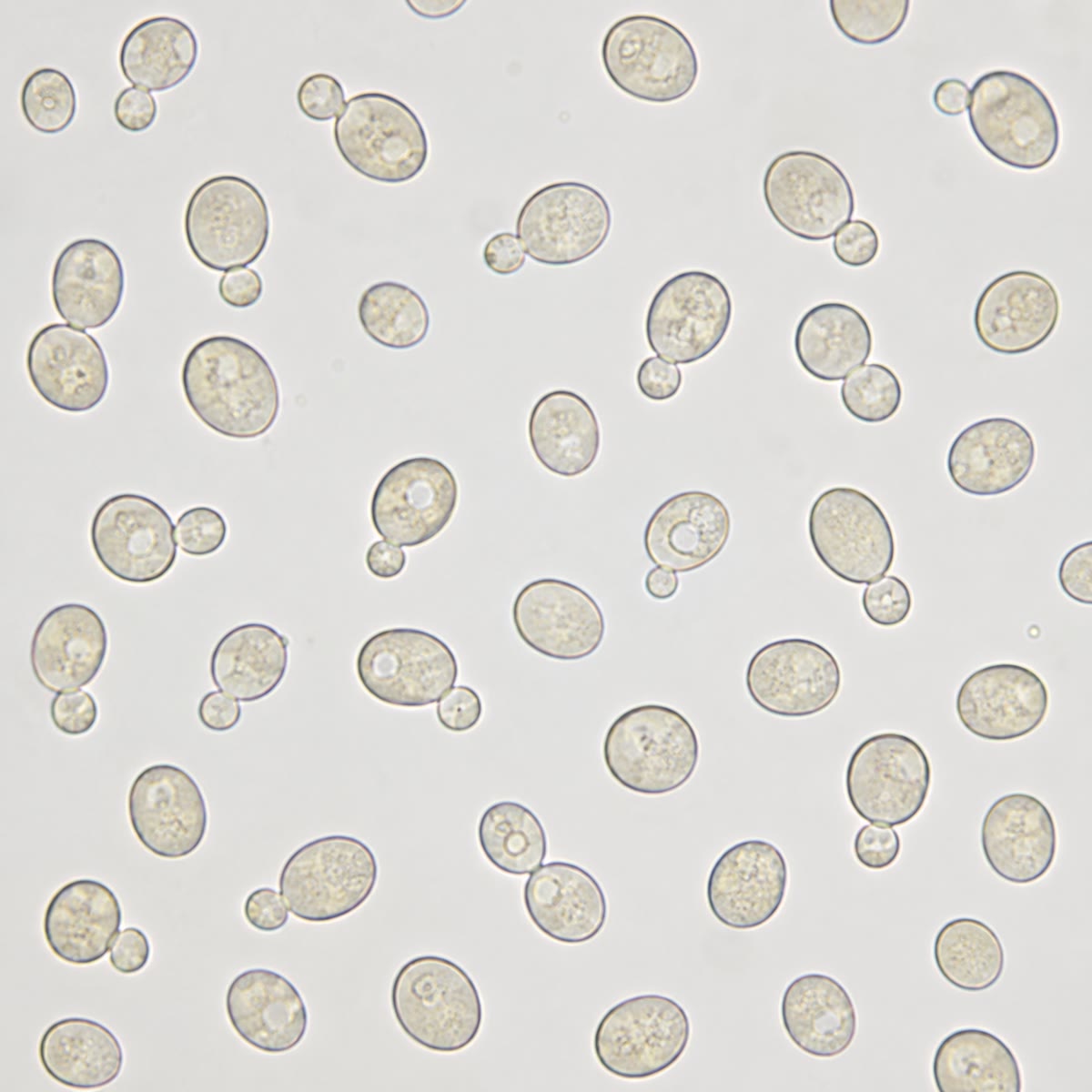
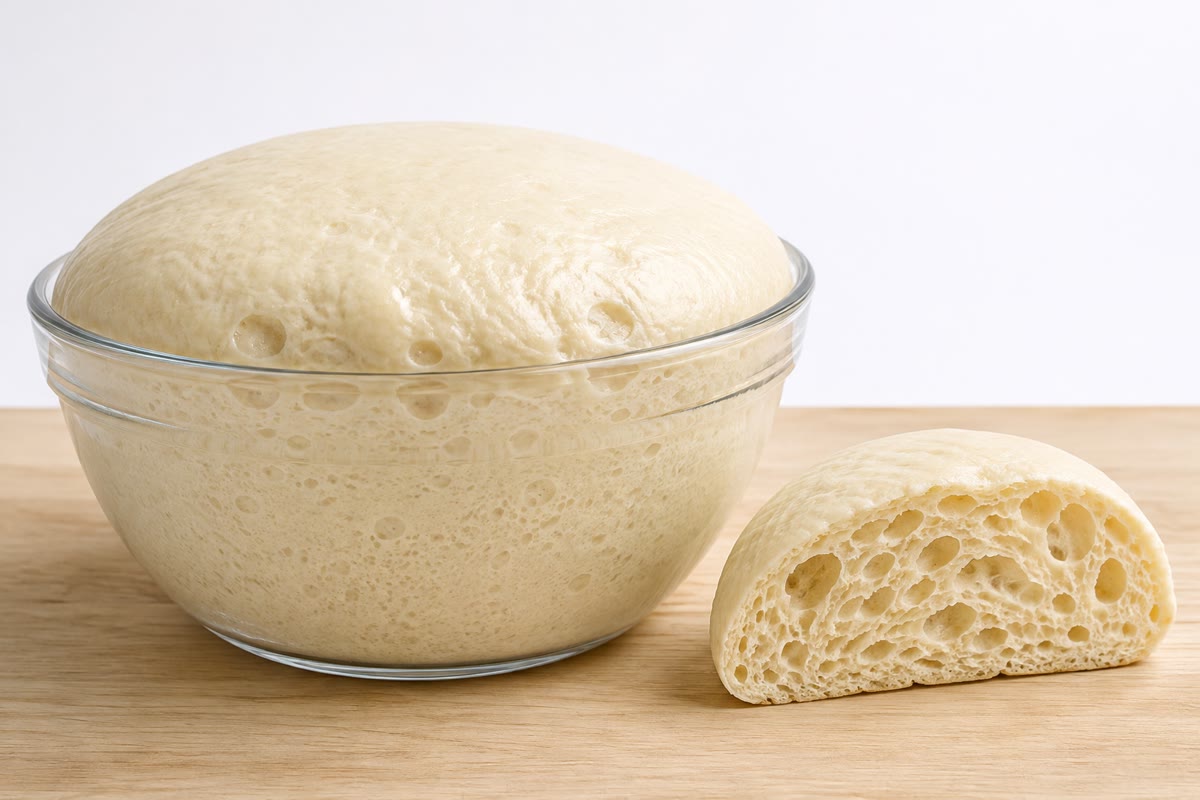
Without oxygen the respiratory chain stops, NADH cannot be re-oxidised, and glycolysis would halt within seconds for lack of . Fermentation regenerates it by using pyruvate itself as the electron acceptor: in lactic fermentation (muscle, red cells, lactic bacteria) pyruvate is reduced to lactate; in alcoholic fermentation (yeast, some plants) it is decarboxylated to acetaldehyde, which is reduced to ethanol, releasing . The yield is glycolysis’ own: 2 ATP per glucose, a fifteenth of respiration’s; the carbon is barely oxidised and the products still hold nearly all the fuel’s energy. Anaerobic respiration — an electron-transport chain ending on nitrate, sulfate or carbonate instead of oxygen, in many bacteria — is a different thing, treated in the Year 2 volume.
Proposition 15.12 (The Pasteur effect)
A cell that can respire consumes glucose far faster when deprived of oxygen than when supplied with it, and grows far less on it.
Evidence. Pasteur (1861) found yeast in an aerated vat consuming sugar slowly and multiplying, while in a sealed vat it consumed sugar ten times faster, multiplied little and made alcohol. The explanation is the ATP yield: to obtain the same ATP from 2 per glucose as from 30, the cell must run glycolysis fifteen times faster, and PFK, released from the inhibition by ATP and citrate that respiration maintains, lets it. A sprinting muscle shows the same effect over seconds: its glycogen falls twenty times faster than at rest, and lactate rises. ∎
Definition 15.13 (Respiratory quotient)
The respiratory quotient RQ is the ratio of produced to consumed, in moles. Carbohydrate gives 1.0 (six of each per glucose); fat about 0.7 (palmitate: , ), because its carbons are more reduced and need more oxygen per ; protein about 0.8. A fermenting culture releases without taking oxygen: its RQ is infinite, and a mixed culture’s RQ above 1 measures the share of fermentation. Measured on a whole animal by gas analysis, the RQ tells which fuel it is burning.
Example 15.14 (Reading an RQ)
A resting human after a carbohydrate meal: RQ 0.95, glucose burning. The same person after a night’s fast: 0.75, fat. A marathon runner at the thirtieth kilometre, glycogen gone: 0.72. A flask of yeast on glucose with a little air: RQ 4 — three quarters of its glucose is being fermented.
15.6 Other fuels and the regulation of the whole
Proposition 15.15 (Fats and proteins enter the same machinery)
Fatty acids are activated to acyl-CoA and, in the mitochondrial matrix, shortened two carbons at a time by -oxidation, each round yielding one acetyl-CoA, one NADH and one : palmitate (C16) gives 8 acetyl-CoA, 7 NADH and 7 — about 106 ATP, or ATP per carbon against glucose’s 5. Amino acids lose their nitrogen as ammonia (converted to urea in the liver) and their carbon skeletons enter as pyruvate, acetyl-CoA or Krebs-cycle intermediates. Every fuel converges on acetyl-CoA and the chain; the cell chooses among them by hormones and by the state of its ATP, as Chapter 16 describes.
Example 15.16 (A gram of each)
One gram of glucose () yields about of ATP; one gram of palmitate () about — the against of Chapter 9, turned into currency. The fat costs more oxygen per ATP, which is why a sprinter’s muscle, oxygen-limited, burns glycogen, and a migrating bird, oxygen-rich and mass-limited, burns fat.
15.7 Exercises
Exercise 15.1 ★
Name the three stages of respiration, their location, and what each produces.
Solution
Solution of Exercise 15.1.
Glycolysis, cytosol: 2 pyruvate, 2 ATP, 2 NADH. Pyruvate oxidation and Krebs cycle, mitochondrial matrix: 6 , 8 NADH, 2 , 2 GTP. Oxidative phosphorylation, inner membrane: water from oxygen, about 26 ATP.
Exercise 15.2 ★
Write the balance of glycolysis and explain “substrate-level phosphorylation”.
Solution
Solution of Exercise 15.2.
Glucose pyruvate . Substrate-level phosphorylation: a phosphate is transferred directly from a high-energy intermediate (1,3-bisphosphoglycerate, phosphoenolpyruvate) to ADP by an enzyme, without a membrane gradient or oxygen.
Exercise 15.3 ★
From the Krebs cycle figure, list in order the products released in one turn, and say where the two come from.
Solution
Solution of Exercise 15.3.
NADH and (isocitrate to -ketoglutarate), NADH and (-ketoglutarate to succinyl-CoA), GTP (succinyl-CoA to succinate), (succinate to fumarate), NADH (malate to oxaloacetate). The two come from the two decarboxylations of the six- and five-carbon acids.
Exercise 15.4 ★
What does fermentation achieve for a cell without oxygen, and what does it not achieve?
Solution
Solution of Exercise 15.4.
It regenerates so that glycolysis can continue and yield its 2 ATP per glucose. It does not oxidise the carbon, extract the remaining energy (the product keeps nearly all of it) or make more than a fifteenth of respiration’s ATP.
Exercise 15.5 ★★
Compute for the transfer of two electrons from NADH () to oxygen (), and to ubiquinone (). How many ATP could each step pay for in principle?
Exercise 15.6 ★★
Draw up the ATP balance of one glucose in a muscle cell (glycerol phosphate shuttle) and in a liver cell (malate shuttle), using P/O ratios of 2.5 and 1.5.
Solution
Solution of Exercise 15.6.
Muscle: (GTP) (mitochondrial NADH) () (cytosolic NADH via FAD) . Liver: the cytosolic NADH gives : 32.
Exercise 15.7 ★★
A culture consumes of and releases of per hour on glucose. Compute the RQ, and the fractions of the glucose respired and fermented.
Solution
Solution of Exercise 15.7.
RQ . Respired glucose : , ; : , , . Fermented of the glucose, respired .
Exercise 15.8 ★★
Explain what happens to oxygen consumption, ATP synthesis and heat production when dinitrophenol is added to respiring mitochondria, and why the drug was lethal.
Solution
Solution of Exercise 15.8.
Oxygen consumption rises (the chain, freed from the back-pressure of the gradient, runs at full speed), ATP synthesis stops (no gradient to drive the synthase), and all the energy of the electrons appears as heat. Patients burned their fat fast and died of a body temperature that nothing could bring down.
Exercise 15.9 ★★
Cyanide blocks complex IV. Predict its effect on the respiratory chain, on the Krebs cycle and on glycolysis in a cell, and explain why lactate accumulates in the blood of the poisoned.
Solution
Solution of Exercise 15.9.
The chain backs up: every carrier becomes reduced, no protons are pumped, no ATP is made. NADH is not re-oxidised, so the Krebs cycle and pyruvate dehydrogenase stop for lack of . Glycolysis, released from ATP inhibition, runs fast and must regenerate its by reducing pyruvate to lactate, which floods the blood.
Exercise 15.10 ★★★
Compute the ATP yield of palmitate (8 acetyl-CoA, 7 NADH, 7 , minus 2 ATP for activation) and its yield per carbon; compute the oxygen consumed per ATP for palmitate and for glucose. Which fuel should a diving seal prefer, and which a hummingbird?
Solution
Solution of Exercise 15.10.
ATP; per carbon. Oxygen: palmitate 23 for 106 ATP, per ATP; glucose 6 for 30, per ATP. Per unit of oxygen glucose is better: the seal, oxygen-limited underwater, prefers carbohydrate; per unit of mass fat is twice as good: the hummingbird, mass-limited in flight, migrates on fat.
Exercise 15.11 ★★★
A muscle fibre holds of ATP and uses per second in a sprint. How long would its ATP last alone? Its phosphocreatine () regenerates ATP one for one; its glycogen through fermentation gives 3 ATP per glucose unit at up to of glucose units per second. Compute the time each store can sustain the sprint, and explain why a 100 m race is run almost entirely without oxygen.
Solution
Solution of Exercise 15.11.
ATP alone: . Phosphocreatine: . Fermentation: of ATP per second, enough for the demand, for as long as glycogen and tolerance to lactate last (tens of seconds). Oxygen delivery takes a minute or more to rise and supplies at most about of ATP per second in a fibre: a ten-second race is over before respiration has begun to help, and is paid for by phosphocreatine and fermentation.
Exercise 15.12 ★★★
“The mitochondrion is a battery charged by electrons and discharged through a turbine.” Discuss in a paragraph: what the gradient stores, what the synthase does, where the analogy is exact and where it is loose.
Solution
Solution of Exercise 15.12.
The gradient stores energy as a difference of proton concentration and of electrical potential across an insulating membrane — exactly a charged capacitor plus a concentration cell; the chain is the charger, driven by the fall of electrons; the synthase is a motor turned by the proton current, exactly a turbine, coupling the flow to a mechanical rotation that makes ATP. The analogy is loose in that the “battery” holds only milliseconds of the cell’s consumption and must be charged continuously, that the same membrane’s other transporters also draw on it, and that the turbine can run backward, hydrolysing ATP to pump protons when the chain fails.
15.8 Problem: Yeast With and Without Air
Problem 15.1
Weekend problem — Pasteur’s vats revisited: ATP counted, glucose consumed, biomass grown and gases measured, ending on the ratio of ATP yields and the P/O ratio
Yeast is grown on glucose in two identical flasks, one aerated and one sealed. Use P/O ratios of 2.5 (NADH) and 1.5 (), the shuttle for cytosolic NADH, a growth yield of of dry biomass per mole of ATP, and glucose at .
Part I — ATP counted.
- List the ATP, GTP, NADH and produced from one glucose by glycolysis, pyruvate dehydrogenase and the Krebs cycle.
- Compute the protons pumped by the chain per glucose (10 per mitochondrial NADH, 6 per ; cytosolic NADH enters as ).
- Compute the ATP made by the synthase at per ATP, and the total ATP per glucose with air.
- Compute the ATP per glucose without air.
- Compute the ratio of the two yields.
- Compute the free energy captured with air () as a fraction of , and without air as a fraction of the and of the energy actually released by fermentation (glucose to two ethanol and two : ).
Part II — Glucose consumed, biomass grown. The sealed flask must make ATP at the same rate as the aerated one to maintain its cells: of ATP per hour.
- Compute the glucose consumed per hour in each flask.
- Compute the ethanol and produced per hour in the sealed flask, and the and exchanged in the aerated one.
- Compute the biomass the sealed flask can build per mole of glucose, and per gram of glucose.
- The aerated flask builds of biomass per gram of glucose. Compute the ATP this would represent at , and compare with the 30 ATP available. What limits the aerobic yield?
- Explain the Pasteur effect from questions 7 and 9, and name the enzyme whose regulation implements it.
Part III — Gases measured. A third flask, poorly aerated, releases of and consumes of per hour.
- Convert both to millimoles and compute the RQ.
- Let be the glucose respired and the glucose fermented per hour. Write the and balances and solve for and .
- What fraction of the glucose is fermented? What fraction of the ATP comes from fermentation?
- The same flask on palmitate instead of glucose (aerobic): compute the RQ.
- A student measures an RQ of 0.7 in a resting animal after a night’s fast and 1.0 after a meal. Interpret.
Part IV — The turbine.
- Compute the free energy of one mole of protons crossing a proton-motive force of .
- Compute the energy of and the efficiency of the synthase at per ATP.
- Compute the free energy released by two electrons falling from NADH to (), the energy stored in the ten protons pumped, and the efficiency of the chain.
- Combine the two efficiencies and compare with 2.5 ATP over .
- An uncoupler is added to the aerated flask. Predict the changes in oxygen consumption, ATP yield, glucose consumption, heat output and growth.
- Oligomycin, which blocks the synthase, is added instead. Predict the changes, and what happens if an uncoupler is then added on top.
- A mutant yeast lacks complex I; its NADH enters the chain through an alternative enzyme that pumps no protons. Compute its P/O ratio for NADH and its ATP per glucose.
- Explain why the cell keeps the mitochondrial NADH pool almost fully reduced when oxygen is absent, and what this does to the Krebs cycle.
- State the result: the ATP per glucose with and without air, their ratio, and the P/O ratios of NADH and .
Solution
Solution of Problem 15.1.
1. Glycolysis: 2 ATP, 2 NADH (cytosolic). Pyruvate dehydrogenase: 2 NADH. Krebs: 6 NADH, 2 , 2 GTP. 2. Mitochondrial NADH ; ; cytosolic NADH as : 104 protons. 3. ATP; total . 4. 2 ATP. 5. 15. 6. With air : of 2870. Without: , of 2870 but of the 235 released — fermentation is efficient at capturing what it releases; it just releases little. 7. Aerated of glucose per hour; sealed . 8. Sealed: of ethanol and of per hour. Aerated: of released and of consumed. 9. per mole, per gram of glucose. 10. per mole, i.e. ATP’s worth against 30 available: ATP is in excess; the yield is limited by carbon (half the glucose is oxidised to to make the ATP, and biomass needs carbon skeletons and reducing power), and the surplus ATP is spent on maintenance. 11. To get the same ATP the sealed culture consumes fifteen times more glucose (question 7) and grows a fifth as much per gram (question 9): fast sugar consumption, little growth, alcohol — Pasteur’s observation. Phosphofructokinase, inhibited by ATP and citrate under aeration, is released when respiration stops. 12. ; : RQ . 13. : , . : , , . 14. Fermented of the glucose. ATP from fermentation against from respiration: . 15. . 16. Fasted, the animal burns fat (RQ 0.7); fed, it burns the carbohydrate of the meal (1.0). 17. . 18. per ATP of : . 19. ; ten protons store : — the chain wastes little; the losses are at the synthase and the transporters. 20. ; : the same figure by both routes. 21. Oxygen consumption rises, ATP yield falls toward that of fermentation (2 per glucose from glycolysis, and PFK is released, so glucose consumption rises), heat output rises, growth collapses. 22. ATP synthesis stops; the gradient cannot discharge, the chain stalls against it, oxygen consumption stops, the cell ferments what it can. Adding an uncoupler then lets protons leak back: the chain and oxygen consumption resume, still with no ATP. 23. NADH pumps only through complexes III and IV: ; per glucose ATP. 24. With no oxygen the chain cannot take electrons, so NADH is not re-oxidised and the pool stays reduced; the three NAD-dependent dehydrogenases of the cycle have no and the cycle stops — which is why fermentation must regenerate in the cytosol for glycolysis to go on. 25. 30 ATP with air, 2 without: a ratio of 15; P/O 2.5 for NADH (10 protons over 4 per ATP) and 1.5 for (6 over 4).