
All books

Professional

Apps About Coach Log in Start reading

Chemistry · Glossary

What is Annulation?

Also known as: Robinson annulation

Definition 26.9 University Chemistry — Year 2 · Chapter 26 — Conjugated Carbonyls: Michael and Robinson

An annulation builds a new ring onto an existing molecule. The Robinson annulation builds a cyclohex-2-en-1-one: a Michael addition of a ketone’s enolate to an α,β\alpha,\beta-unsaturated ketone (typically but-3-en-2-one), followed by an intramolecular aldol condensation of the 1,5-diketone formed.
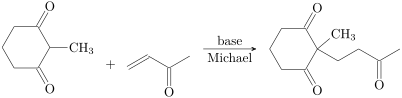
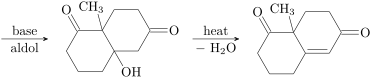
The Robinson annulation that makes the Wieland–Miescher ketone. The enolate of 2-methylcyclohexane-1,3-dione adds to but-3-en-2-one (Michael): a triketone. The enolate of the side-chain methyl ketone attacks a ring carbonyl (intramolecular aldol), closing a six-membered ring; dehydration gives the conjugated enone. The angular methyl group sits on the carbon shared by the two rings, the only stereocentre. The Robinson annulation that makes the Wieland–Miescher ketone. The enolate of 2-methylcyclohexane-1,3-dione adds to but-3-en-2-one (Michael): a triketone. The enolate of the side-chain methyl ketone attacks a ring carbonyl (intramolecular aldol), closing a six-membered ring; dehydration gives the conjugated enone. The angular methyl group sits on the carbon shared by the two rings, the only stereocentre.
The Robinson annulation that makes the Wieland–Miescher ketone. The enolate of 2-methylcyclohexane-1,3-dione adds to but-3-en-2-one (Michael): a triketone. The enolate of the side-chain methyl ketone attacks a ring carbonyl (intramolecular aldol), closing a six-membered ring; dehydration gives the conjugated enone. The angular methyl group sits on the carbon shared by the two rings, the only stereocentre.
Read in context →