All books

Professional

Apps About Coach Log in Start reading

Chemistry · Glossary

What is Complex, central atom, ligand?

Also known as: complex · central atom · ligand

Definition 12.1 University Chemistry — Year 1 · Chapter 12 — Complexation

A complex is a species made of a central atom or ion, usually a metal cation acting as a Lewis acid, bound by dative bonds to molecules or ions acting as Lewis bases, the ligands. Its formula is written in square brackets, with its total charge: [Cu(NHX3)X4]2+[\ce{Cu(NH3)4}]^{2+}, [Fe(CN)X6]4−[\ce{Fe(CN)6}]^{4-}, [Ag(NHX3)X2]+[\ce{Ag(NH3)2}]^{+}, [FeSCN]2+[\ce{FeSCN}]^{2+}.

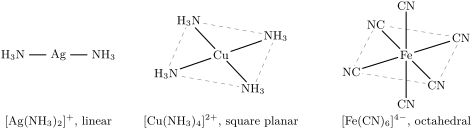
Three complexes and their shapes. Each line is a dative bond from the lone pair of the ligand (the N of ammonia, the C of cyanide) to the metal ion; dashed lines outline the square of four ligands. The shapes of complexes are explained in the Year 2 volume.

Examples

Example 12.9 (Two ligands for iron(III))

A drop of thiocyanate in an iron(III) solution gives the blood-red [FeSCN]2+[\ce{FeSCN}]^{2+}; fluoride ions decolourise it:

[FeSCN]2++FX−⇌[FeF]2++SCNX−,K=β(FeF)β(FeSCN)=106.85−2.96=103.89.[\ce{FeSCN}]^{2+} + \ce{F-} \rightleftharpoons [\ce{FeF}]^{2+} + \ce{SCN-}, \qquad K = \frac{\beta(\ce{FeF})}{\beta(\ce{FeSCN})} = 10^{6.85 - 2.96} = 10^{3.89} .

The stronger complex (larger β\beta) takes the metal ion, exactly as the stronger acid gives its proton to the stronger base.

Read in context →