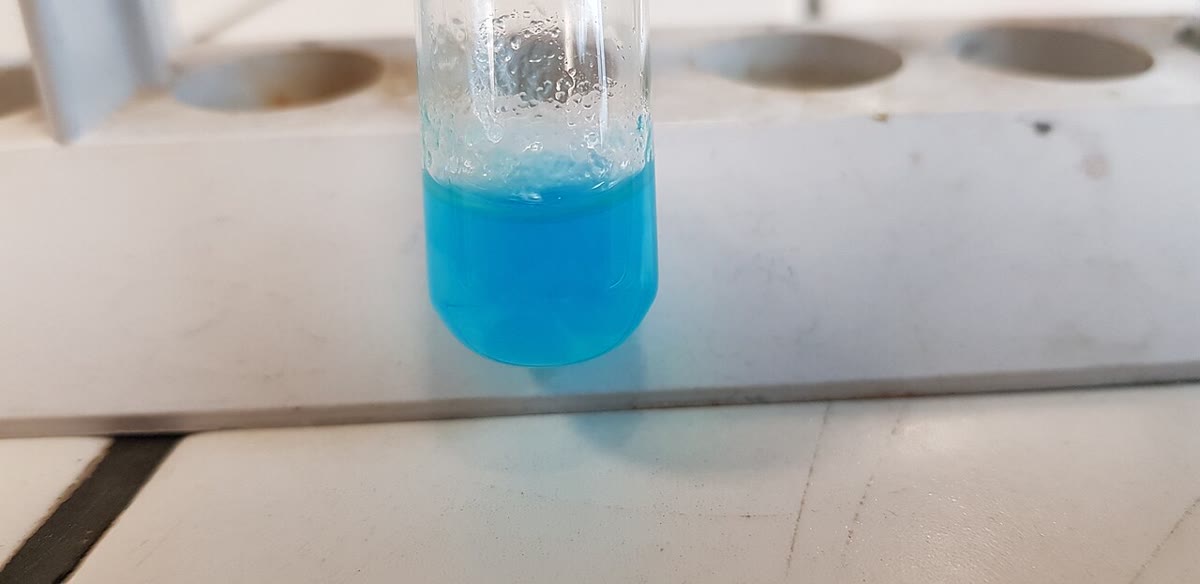
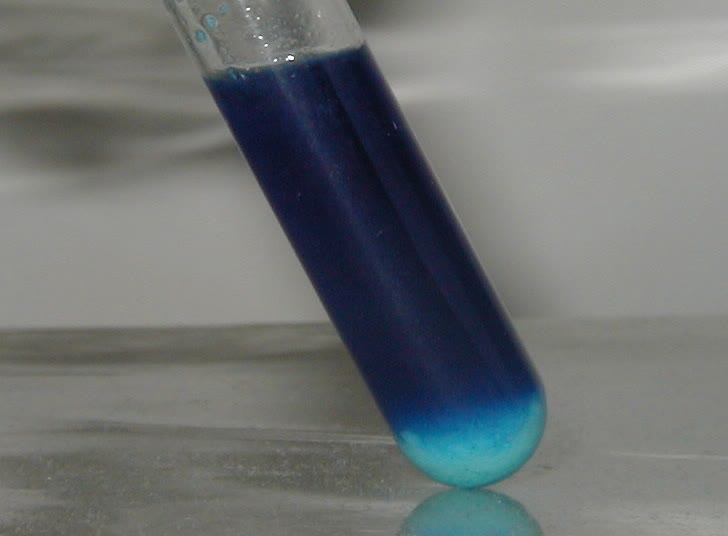
Pour a little ammonia solution into pale blue copper(II) sulfate: a pale blue precipitate forms at once. Pour more, and the precipitate dissolves into a solution of a deep, almost ink-like blue. Nothing in the acid–base or precipitation chapters explains the second step. The ammonia molecules have bound to the copper ion through their lone pairs and made a new species, a complex, more stable than the hydroxide and of a different colour. Complexes carry oxygen in the blood, hold the metal in chlorophyll and in vitamin B12, soften hard water and dissolve metals that nothing else will. This chapter treats them as one more exchange of particles in water, with its own constants and diagrams.
Left: a suspension of pale blue copper(II) hydroxide (photograph Alvy16, CC BY 4.0). Right: with more ammonia the solid dissolves into the deep blue tetraamminecopper(II) ion; some undissolved hydroxide is still at the bottom of the tube (photograph Chemicalinterest, public domain). Both Wikimedia Commons.
12.1 Complexes and ligands
Definition 12.1(Complex, central atom, ligand)
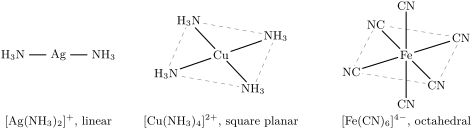
A complex is a species made of a central atom or ion, usually a metal cation acting as a Lewis acid, bound by dative bonds to molecules or ions acting as Lewis bases, the ligands. Its formula is written in square brackets, with its total charge: [Cu(NHX3)X4]2+, [Fe(CN)X6]4−, [Ag(NHX3)X2]+, [FeSCN]2+.
The charge of the complex is the sum of the charges of the central ion and of the ligands: Fe2+ and six CNX− make [Fe(CN)X6]4−. A ligand needs at least one lone pair: NHX3, HX2O, OHX−, ClX−, CNX−, SCNX− (bound through S or N). Every metal ion in water is in fact already a complex with water molecules as ligands, [Cu(HX2O)X6]2+ or [Fe(HX2O)X6]3+; forming another complex means exchanging those water molecules for other ligands, and the water ligands are left out of the formulas, as HX3OX+ is written for the hydrated proton.
Three complexes and their shapes. Each line is a dative bond from the lone pair of the ligand (the N of ammonia, the C of cyanide) to the metal ion; dashed lines outline the square of four ligands. The shapes of complexes are explained in the Year 2 volume.
Definition 12.2(Polydentate ligand, chelate)
A ligand that binds the same central ion through several of its atoms at once is a polydentate ligand; the complex it forms, in which the ligand closes rings around the metal ion, is a chelate. Ethylenediamine HX2N−CHX2−CHX2−NHX2 binds through two N atoms, the oxalate ion CX2OX4X2− through two O atoms, and the ethylenediaminetetraacetate ion (edta, written YX4−) through two N and four O atoms.
Left: the edta ion YX4−, with its two N atoms and four carboxylate groups. Right: the calcium–edta chelate[CaY]2−, schematic: the six donor atoms (blue bonds) sit at the corners of an octahedron around the ion, the two N atoms side by side, and the carbon chains of the ligand (orange) close five rings of five atoms each, the chelate rings.
The edta ion holds a calcium ion firmly enough to be the reagent of the titration of water hardness (Chapter 15).
12.2 Formation and dissociation constants
Definition 12.3(Formation and dissociation constants)
For a central ion M and a ligand L (charges omitted), the overall formation constant of MLn is the constant βn of M+nL⇌MLn,
βn=[M][L]n[MLn].
The successive formation constantKi is that of the addition of one ligand, MLi−1+L⇌MLi. The dissociation constant is the inverse, Kd=1/Ki, and pKd=logKi, so that a complex/ligand pair is described exactly like an acid–base pair, with the ligand in place of the proton.
Proposition 12.4(Overall and successive constants)
βn=K1K2⋯Kn, that is logβn=∑i=1nlogKi and logKi=logβi−logβi−1 (with β0=1).
Proof. The formation of MLn from M is the sum of the n successive additions; the constant of a sum of reactions is the product of their constants (Chapter 7). Directly: K1K2⋯Kn=[M][L][ML][ML][L][ML2]⋯[MLn−1][L][MLn], and the intermediate concentrations cancel. ∎
Formation constants at 25∘C. The ammine, hydroxo, thiocyanato and fluoro constants are computed from tabulated standard Gibbs energies of formation; the edta constants are critically selected values at zero ionic strength, as are the pKa of edta used below, 2.23, 3.15, 6.80 and 11.24.
The successive constants of the copper ammines decrease, K1>K2>K3>K4: each ammonia molecule added leaves fewer sites and makes the complex a little less eager for the next one. This is the usual order. Silver is an exception: K2>K1, with consequences drawn in the weekend problem.
12.3 Predominance in pL
Definition 12.5(pL scale)
For a ligand L, pL=−log[L], where [L] is the concentration of the free ligand. A pL scale is an axis of pL on which the domains of predominance of the central ion and of its complexes are drawn, as the domains of acids and bases are drawn on a pH axis.
Proposition 12.6(Boundaries in pL)
For the pair MLi/MLi−1,
pL=logKi+log[MLi][MLi−1],
so that MLi−1 predominates for pL>logKi and MLi for pL<logKi. When the logKi decrease with i, the diagram is a sequence of domains: MLn at small pL (much ligand), then MLn−1, down to M at large pL.
Proof. Take the logarithm of Ki=[MLi]/([MLi−1][L]): logKi=log[MLi−1][MLi]+pL. The two forms are equal at pL=logKi, and the ratio moves by a factor ten per unit of pL. The domain of MLi lies between logKi+1 and logKi, which exists only if logKi+1<logKi. ∎
Method 12.7(Drawing a pL diagram)
From the logβn, compute the successive logKi.
If they decrease, place each at its boundary on the pL axis: the complex with the most ligands on the left (small pL), the free ion on the right.
If some logKi+1>logKi, the complexMLi has no domain: it reacts with itself into MLi−1 and MLi+1. Remove it and draw a single boundary between MLi−1 and MLi+1 at 21(logKi+logKi+1).
Top: fractions of copper(II) present as CuX2+ and as [Cu(NHX3)Xn]2+ (n=1 to 4) against pNH3. Middle: the predominance diagram of the copper ammines, boundaries at the logKi. Bottom: silver, where logK2=3.90>logK1=3.32 (dotted): [AgNHX3]+ has no domain and a single boundary lies at 21logβ2=3.61.
Example 12.8(Copper in 0.010mol/L ammonia)
At free [NHX3]=0.010mol/L, pNH3=2.0 lies in the domain of [Cu(NHX3)X3]2+ but close to the boundary 2.03 with [Cu(NHX3)X4]2+: the two are nearly equal. The fractions are proportional to βn[NHX3]n=10logβn−2n, that is 1:102.10:103.51:104.33:104.36, so 48% of [Cu(NHX3)X4]2+, 45% of [Cu(NHX3)X3]2+, 7% of [Cu(NHX3)X2]2+ and almost no free CuX2+.
12.4 Competitions
A ligand can be claimed by two metal ions, a metal ion by two ligands, and both are also engaged in precipitation and acid–base equilibria. Each competition is one more reaction whose constant combines the constants already known; the predominant-reaction method of Chapter 10 then applies unchanged.
Example 12.9(Two ligands for iron(III))
A drop of thiocyanate in an iron(III) solution gives the blood-red [FeSCN]2+; fluoride ions decolourise it:
The stronger complex (larger β) takes the metal ion, exactly as the stronger acid gives its proton to the stronger base.
Proposition 12.10(Complexation against precipitation)
A solid MX dissolves in a ligand L by MX(s)+nL⇌MLn+X, of constant K=βnKs. If the complex is the only form of M in solution and the free ligand concentration is [L], the solubility is s=K[L]n/2.
Proof. The reaction is the sum of the dissolution (constant Ks) and of the formation of MLn (βn). At saturation [MLn]=[X]=s and K=s2/[L]n. ∎
Method 12.11(Dissolving a precipitate by complexation)
Write the dissolution reaction into the complex and compute K=βnKs.
If K is large, the dissolution is quantitative as long as enough ligand is present; if it is small, compute the free ligand concentration needed for the amount of solid to dissolve: [L]n=s2/K.
Add the ligand bound in the complex, ns, to obtain the total ligand to introduce.
Check that the free metal ion is negligible: [M]=Ks/s≪s.
With ammonia, silver chloride (K=107.22−9.75=10−2.53) dissolves in moderately concentrated solution while silver iodide (K=10−8.85) does not: the weekend problem uses this to tell the halides apart.
Proposition 12.12(Complexation against acidity)
If the ligand is a base L of an acid HL (and possibly more protonated forms), only the fraction [L]/cL=1/α of the ligand not bound to the metal is available, with
α=1+Kan[HX3OX+]+KanKa(n−1)[HX3OX+]2+⋯
(Kan the last acidity constant). At a fixed pH the complexation then behaves as if its constant were the conditional constant β′=β/α, smaller the lower the pH.
Proof. The ligand not bound to the metal is shared among L, HL, HX2L and so on, with [HL]=[L][HX3OX+]/Kan and similar relations for the next forms (Chapter 10). Summing gives cL=α[L], and β=[ML]/([M][L])=α[ML]/([M]cL), so [ML]/([M]cL)=β/α. ∎
For edta at pH 10, α=1+1011.24−10+1011.24+6.80−20=18.4, so the calcium complex keeps logβ′=12.69−1.26=11.43; at pH 7 it falls to 8.24 (Exercise 12.9). This is why a titration of calcium with edta is run in an ammonia buffer at pH 10. Ammonia, too, is a base: in acid it becomes NHX4X+, which has no lone pair, and the ammine complexes fall apart. Adding nitric acid to [Ag(NHX3)X2]+ in the presence of chloride brings back the white precipitate of silver chloride.
Photographic fixers do the same with another ligand of the silver ion, the thiosulfate ion SX2OX3X2−: they dissolve the silver halide that light has not touched, so that the picture no longer darkens. Its constants are not among the data of this volume; ammonia shows the same chemistry with silver chloride.
12.5 Exercises
Exercise 12.1★
For each complex give the central ion, its charge, the ligands and the atom through which each ligand binds: [Cu(NHX3)X4]2+, [Fe(CN)X6]4−, [Fe(CN)X6]3−, [Ag(NHX3)X2]+, [FeSCN]2+, [Zn(OH)X4]2−, [CaY]2−.
Solution
Solution of Exercise 12.1.
[Cu(NHX3)X4]2+: CuX2+, four NHX3 bound through N. [Fe(CN)X6]4−: FeX2+, six CNX− bound through C; [Fe(CN)X6]3−: the same with FeX3+. [Ag(NHX3)X2]+: AgX+, two NHX3 through N. [FeSCN]2+: FeX3+, one SCNX−, bound through N in spite of the way the formula is written. [Zn(OH)X4]2−: ZnX2+, four OHX− through O. [CaY]2−: CaX2+, one edta ion through two N and four O.
Exercise 12.2★
From the logβn of the copper ammines, compute the four logKi and the four pKd. Write the dissociation reaction to which the last pKd refers.
Solution
Solution of Exercise 12.2.
logKi=logβi−logβi−1: 4.10, 3.41, 2.82, 2.03, and pKd,i=logKi takes the same values. The last refers to [Cu(NHX3)X4]2+⇌[Cu(NHX3)X3]2++NHX3.
Exercise 12.3★
Draw the pL diagram of the copper ammines. Which copper species predominates at [NHX3]=1.0, 3.2×10⁻³, 3.2×10⁻⁴ and 1.0×10⁻⁵mol/L?
Solution
Solution of Exercise 12.3.
Domains: [Cu(NHX3)X4]2+ below pNH3 2.03, then n=3 up to 2.82, n=2 up to 3.41, n=1 up to 4.10, CuX2+ above. pNH3 = 0: [Cu(NHX3)X4]2+; 2.5: [Cu(NHX3)X3]2+; 3.5: [CuNHX3]2+; 5.0: CuX2+.
Exercise 12.4★
A solution contains iron(III) at 1.0×10⁻³mol/L and thiocyanate at 0.10mol/L. Neglecting the thiocyanate bound, what fraction of the iron is present as [FeSCN]2+?
Solution
Solution of Exercise 12.4.
[FeSCNX2+]/[FeX3+]=β1[SCNX−]=102.96×0.10=91: the fraction complexed is 91/92=98.9%.
Exercise 12.5★★
Prove that in a solution of a metal ion M and its complexesMLn, the fraction of MLn is βn[L]n/∑kβk[L]k. Show that, if only MLi−1, MLi and MLi+1 are present in significant amounts, the fraction of MLi is largest where [MLi−1]=[MLi+1], at pL=21(logKi+logKi+1), and compute this pNH3 for [Cu(NHX3)X2]2+.
Solution
Solution of Exercise 12.5.
Each [MLk]=βk[M][L]k; dividing by the sum over k (the total metal) eliminates [M]. With three species, fi=1/(1+[MLi−1]/[MLi]+[MLi+1]/[MLi])=1/(1+1/(Kix)+Ki+1x) with x=[L]. The denominator is smallest when its derivative −1/(Kix2)+Ki+1 vanishes, x2=1/(KiKi+1), where the two neighbours are equal, and pL=21(logKi+logKi+1). For [Cu(NHX3)X2]2+: 21(3.41+2.82)=3.12.
Exercise 12.6★★
To the red solution of Exercise 12.4, sodium fluoride is added until [FX−]=0.010mol/L (free). Compute the constant of the exchange of ligands and the ratio [FeFX2+]/[FeSCNX2+]. What does one see?
Solution
Solution of Exercise 12.6.
[FeSCN]2++FX−⇌[FeF]2++SCNX−, K=106.85−2.96=103.89. Ratio =K[FX−]/[SCNX−]=103.89×0.010/0.10=780: the red complex is almost entirely replaced and the colour fades.
Exercise 12.7★★
Calcium ions are added to a solution of [MgY]2−, in equal amount. Write the exchange reaction, compute its constant and the fraction of magnesium set free.
Solution
Solution of Exercise 12.7.
[MgY]2−+CaX2+⇌[CaY]2−+MgX2+, K=1012.69−10.90=101.79=62. With equal amounts, x2/(1−x)2=62, x/(1−x)=7.9, x=0.89: 89% of the magnesium is set free.
Exercise 12.8★★
Silver oxide AgX2O is a brown solid: AgX2O(s)+HX2O2AgX++2OHX− has pK=15.43. Write its dissolution in ammonia into [Ag(NHX3)X2]+, compute the constant, and explain why the brown precipitate formed by a little ammonia in silver nitrate dissolves in more ammonia.
Solution
Solution of Exercise 12.8.
AgX2O(s)+HX2O+4NHX32[Ag(NHX3)X2]X++2OHX−, K=β22×10−15.43=1014.44−15.43=10−0.99. The constant is not small: as soon as the free ammonia reaches a few tenths of a mole per litre, the brown oxide formed by the first drops (the ammonia acting as a base) dissolves into the silver ammine.
Exercise 12.9★★
Compute α and the conditional constant logβ′ of [CaY]2− at pH 10 and at pH 7 (Proposition 12.12). Why is a titration of calcium by edta impossible in neutral solution if a conditional constant of at least 1010 is required?
Solution
Solution of Exercise 12.9.
pH 10: α=1+101.24+10−1.96=18.4, logβ′=12.69−1.26=11.43. pH 7: α=1+104.24+104.04+100.19+⋯=104.45, logβ′=8.24. At pH 7 the conditional constant is below 1010: the reaction of calcium with edta is not complete enough for a titration, because most of the edta is protonated.
Exercise 12.10★★★
Copper(II) oxide CuO is the solid that copper(II) hydroxide turns into on standing; CuO(s)+HX2OCuX2++2OHX− has pK=20.64.
Write the dissolution of CuO in ammonia into [Cu(NHX3)X4]2+ and compute its constant.
In 1.0mol/L ammonia alone, the pH is fixed by ammonia (pKa(NHX4X+)=9.25). Compute the pH and the concentration of copper dissolved.
Same question in a buffer of ammonia and ammonium chloride, both at 1.0mol/L. Conclude.
Solution
Solution of Exercise 12.10.
1. CuO(s)+HX2O+4NHX3[Cu(NHX3)X4]X2++2OHX−, K=β4×10−20.64=1012.36−20.64=10−8.28. 2. pH=7+21(9.25+log1.0)=11.63, [OHX−]=10−2.37, and [Cu(NHX3)X4X2+]=10−8.28/10−4.75=3.0×10−4mol/L: very little dissolves. 3. pH=9.25, [OHX−]=10−4.75, and the formula gives 10−8.28+9.50=101.22, far more than the ammonia can carry: the oxide dissolves until the ammonia, not the equilibrium, runs out. The ammonium ions consume the hydroxide that the dissolution releases; this is why ammonium salts help ammonia dissolve copper compounds.
Exercise 12.11★★★
Silver and ammonia.
Show that [AgNHX3]+ reacts with itself, 2[AgNHX3]X+AgX++[Ag(NHX3)X2]X+, and compute the constant.
Compute the largest fraction of silver ever present as [AgNHX3]+, and the pNH3 where it occurs.
Solution
Solution of Exercise 12.11.
1. The reaction is the second formation minus the first: K=K2/K1=103.90−3.32=100.58=3.8>1, so [AgNHX3]+ reacts with itself when it is the main species. 2. By Exercise 12.5, the largest fraction is at pNH3=21(3.32+3.90)=3.61, where β1x=10−0.29=0.51 and β2x2=1.0: f=0.51/(1+0.51+1.0)=0.20. Never more than 20% of the silver is [AgNHX3]+.
Exercise 12.12★★★
A solution of edta, 0.10mol/L of YX4− at high pH, is used to dissolve calcium carbonate scale.
Write the reaction and compute its constant.
What mass of calcium carbonate can one litre dissolve?
Why must the solution be basic? (The carbonate and the edta ions are both bases.)
Solution
Solution of Exercise 12.12.
1. CaCOX3(s)+YX4−[CaY]X2−+COX3X2−, K=βKs=1012.69−8.30=104.39. 2. x2/(0.10−x)=104.39 gives x=0.10mol/L to within 4×10⁻⁷: all the edta is used, 10.0g of calcium carbonate per litre. 3. In acid, edta is protonated (pKa4=11.24) and its conditional constant drops; the carbonate is also protonated, which helps, but the complex is what holds the calcium. Keeping the pH high keeps the edta as YX4−.
12.6 Problem: Ammonia and the Three Silver Halides
Problem 12.1
Weekend problem — the silver ammines and their inverted constants, dissolving silver chloride, bromide and iodide in ammonia, the confirmatory test, and the least ammonia that dissolves one gram of silver chloride
An analyst has three white-to-yellow precipitates and must say which is the chloride, the bromide and the iodide of silver; then she must dissolve 1.0g of silver chloride in 1.00L with as little ammonia as possible. Data at 25∘C: logβ1=3.32 and logβ2=7.22 for the silver ammines; pKs of AgCl 9.75, AgBr 12.27, AgI 16.07; pKa(NHX4X+)=9.25; molar masses AgCl143.4g/mol, AgBr187.8g/mol, AgI234.8g/mol.
Part I — The silver ammines.
Write the formation reactions of [AgNHX3]+ and [Ag(NHX3)X2]+ and the expressions of β1 and β2.
Compute logK1 and logK2.
Draw the pL diagram naively with these two boundaries. What is wrong with it?
Write the reaction of [AgNHX3]+ with itself and compute its constant.
Draw the correct diagram; where is its single boundary?
At [NHX3]=0.10mol/L, compute [Ag(NHX3)X2X+]/[AgX+].
Check that free AgX+ is negligible in this solution.
What is the least total concentration of ammonia that dissolves 1.0g of silver chloride in 1.00L?
Solution
Solution of Problem 12.1.
1.AgX++NHX3[AgNHX3]X+, β1=[AgNHX3X+]/([AgX+][NHX3]); AgX++2NHX3[Ag(NHX3)X2]X+, β2=[Ag(NHX3)X2X+]/([AgX+][NHX3]2). 2.logK1=3.32, logK2=7.22−3.32=3.90. 3.[AgNHX3]+ would predominate between pNH3 3.90 and 3.32, an interval that runs backwards: it has no domain. 4.2[AgNHX3]X+AgX++[Ag(NHX3)X2]X+, K=K2/K1=100.58=3.8. 5.[Ag(NHX3)X2]+ below and AgX+ above 21logβ2=3.61. 6.β2[NHX3]2=107.22−2.00=105.22=1.7×10⁵. 7.pKd=logβ2=7.22. 8.AgCl(s)+2NHX3[Ag(NHX3)X2]X++ClX−, K=β2Ks=107.22−9.75=10−2.53. 9.s=K[NHX3]=10−1.265×1.0=0.054mol/L. 10. In water s=10−4.875=1.3×10⁻⁵mol/L: about 4000 times more. 11.0.0543×143.4=7.8g. 12.[AgX+]=Ks/[ClX−]=10−9.75/0.054=3.3×10−9mol/L≪s. 13.s=K(1.0−2s), s=0.0543/(1+2×0.0543)=0.049mol/L. 14.1.0mol/L ammonia has pH 11.6, more than 9.25+1: only 0.4% of it is NHX4X+. 15.K=107.22−12.27=10−5.05. 16.s=10−2.525=3.0×10⁻³mol/L, 0.56g/L. 17.K=10−8.85, s=10−4.425=3.8×10⁻⁵mol/L, 8.8mg/L. 18. Treat each precipitate with dilute ammonia: only the chloride dissolves. Concentrated ammonia dissolves the bromide, more slowly and partly; the iodide does not dissolve. 19.s=1.0/187.8=5.3×10−3mol/L; [NHX3]=s/K=5.3×10−3/10−2.525=1.8mol/L. 20.s=4.3×10⁻³mol/L and [NHX3]=4.3×10⁻³/10−4.425=113mol/L, twice the concentration of water in pure water (55mol/L): impossible. Ammonia cannot dissolve silver iodide. 21.[Ag(NHX3)X2]X++ClX−+2HX3OX+AgCl(s)+2NHX4X++2HX2O, K=102.53×(109.25)2=1021.03: the white precipitate reappears, which confirms silver chloride. 22.s=1.0/143.4=6.97×10−3mol/L; [NHX3]=s/K=6.97×10−3/10−1.265=0.128mol/L. 23.2s=0.0139mol/L. 24.[AgX+]=10−9.75/6.97×10−3=2.6×10−8mol/L, negligible beside s. 25.0.128+0.014=0.142mol/L of ammonia: 0.142mol in the litre dissolves exactly 1.0g of silver chloride.
![Left: the edta ion Y4-, with its two N atoms and four carboxylate groups. Right: the calcium–edta chelate [ CaY]2-, schematic: the six donor atoms (blue bonds) sit at the corners of an octahedron around the ion, the two N atoms side by side, and the carbon chains of the ligand (orange) close five rings of five atoms each, the chelate rings.](/images/onecourse/chapters/chemistry-2/b1-complexation/fig-e4fa677171e8.svg)
![Left: the edta ion Y4-, with its two N atoms and four carboxylate groups. Right: the calcium–edta chelate [ CaY]2-, schematic: the six donor atoms (blue bonds) sit at the corners of an octahedron around the ion, the two N atoms side by side, and the carbon chains of the ligand (orange) close five rings of five atoms each, the chelate rings.](/images/onecourse/chapters/chemistry-2/b1-complexation/fig-1f4a03e82922.svg)
![Top: fractions of copper(II) present as Cu2+ and as [ Cu(NH3)_n]2+ (n = 1 to 4) against pNH_3. Middle: the predominance diagram of the copper ammines, boundaries at the K_i. Bottom: silver, where K_2 = 3.90 > K_1 = 3.32 (dotted): [ AgNH3]+ has no domain and a single boundary lies at 1/2 _2 = 3.61.](/images/onecourse/chapters/chemistry-2/b1-complexation/fig-ae192210aea0.svg)
![Top: fractions of copper(II) present as Cu2+ and as [ Cu(NH3)_n]2+ (n = 1 to 4) against pNH_3. Middle: the predominance diagram of the copper ammines, boundaries at the K_i. Bottom: silver, where K_2 = 3.90 > K_1 = 3.32 (dotted): [ AgNH3]+ has no domain and a single boundary lies at 1/2 _2 = 3.61.](/images/onecourse/chapters/chemistry-2/b1-complexation/fig-7147bfb7db47.svg)