 Coach
CoachA Lewis acid is a species able to accept a pair of electrons into a vacant place of its valence shell (, , , metal cations); a Lewis base is a species with a lone pair it can share (, , ). When the base gives the pair to the acid, the bond formed is a dative bond: a covalent bond whose two electrons both came from one partner.
Examples
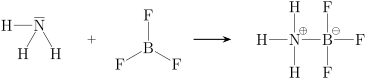
Example 3.9 (Ammonia and boron trifluoride)
. In the adduct, boron completes its octet; nitrogen, which now shares its lone pair, carries the formal charge and boron . Once formed, the bond is an ordinary covalent bond.