সব বই

পেশাদার

1 Markets I: The Ecosystem and Exchange-Traded Marketsবাজার অনলাইন 2 Markets II: Rates, FX and Creditবাজার অনলাইন 3 Markets III: Commodities, Energy and Cryptoবাজার অনলাইন 4 Quantitative Methodsপদ্ধতি অনলাইন 5 Derivatives and Volatilityডেরিভেটিভস অনলাইন 6 Rates, Credit, XVA and Riskসুদহার, ঋণ ও ঝুঁকি অনলাইন 7 Research Craft: Predictors, Backtests, Measurement, Portfoliosগবেষণা অনলাইন 8 Strategies I: Equities and Futuresকৌশল অনলাইন 9 Strategies II: Volatility, Relative Value, Macro and the Bank Desksকৌশল অনলাইন 10 Microstructure and Executionএক্সিকিউশন অনলাইন 11 Market Making and High-Frequency Tradingমার্কেট মেকিং অনলাইন 12 Machine Learning for Marketsমেশিন লার্নিং অনলাইন 13 Low-Latency Softwareপ্রযুক্তি অনলাইন 14 Networks, Hardware and Trading Infrastructureপ্রযুক্তি অনলাইন 15 Research, Data and Risk Platformsপ্রযুক্তি অনলাইন 16 The Desk and the Firmপ্রতিষ্ঠান অনলাইন 17 The Industry: Firms, Roles and Careersক্যারিয়ার অনলাইন 18 Interviews I: Maths, Probability and Speedক্যারিয়ার অনলাইন 19 Interviews II: Markets, Trading Games and the Final Roundক্যারিয়ার অনলাইন 20 Interviews III: Codeক্যারিয়ার অনলাইন
অ্যাপ পরিচিতি Coach সাইন ইন পড়া শুরু করো

বইগুলো এখনো বাংলা ভাষায় পাওয়া যায় না — ইংরেজি সংস্করণ দেখানো হচ্ছে।

Chemistry · পরিভাষা

Complex, central atom, ligand কী?

অন্য নাম: complex · central atom · ligand

Definition 12.1 University Chemistry — Year 1 · অধ্যায় 12 — Complexation

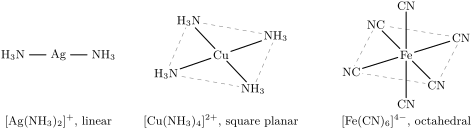
A complex is a species made of a central atom or ion, usually a metal cation acting as a Lewis acid, bound by dative bonds to molecules or ions acting as Lewis bases, the ligands. Its formula is written in square brackets, with its total charge: [Cu(NHX3)X4]2+[\ce{Cu(NH3)4}]^{2+}, [Fe(CN)X6]4−[\ce{Fe(CN)6}]^{4-}, [Ag(NHX3)X2]+[\ce{Ag(NH3)2}]^{+}, [FeSCN]2+[\ce{FeSCN}]^{2+}.

Three complexes and their shapes. Each line is a dative bond from the lone pair of the ligand (the N of ammonia, the C of cyanide) to the metal ion; dashed lines outline the square of four ligands. The shapes of complexes are explained in the Year 2 volume.

উদাহরণ

Example 12.9 (Two ligands for iron(III))

A drop of thiocyanate in an iron(III) solution gives the blood-red [FeSCN]2+[\ce{FeSCN}]^{2+}; fluoride ions decolourise it:

[FeSCN]2++FX−⇌[FeF]2++SCNX−,K=β(FeF)β(FeSCN)=106.85−2.96=103.89.[\ce{FeSCN}]^{2+} + \ce{F-} \rightleftharpoons [\ce{FeF}]^{2+} + \ce{SCN-}, \qquad K = \frac{\beta(\ce{FeF})}{\beta(\ce{FeSCN})} = 10^{6.85 - 2.96} = 10^{3.89} .

The stronger complex (larger β\beta) takes the metal ion, exactly as the stronger acid gives its proton to the stronger base.

প্রসঙ্গসহ পড়ো →