
全部书籍

专业

应用 关于 Coach 登录 开始阅读

书籍暂未推出简体中文版——当前显示英文版。

Chemistry · 术语表

什么是 Covalent radius, ionic radius?

又称: covalent radius · ionic radius

Definition 2.6 University Chemistry — Year 1 · 第 2 章 — Periodicity

The covalent radius of an element is half the length of a single bond between two of its atoms: for chlorine, half the Cl−Cl\ce{Cl-Cl} distance of ClX2\ce{Cl2}. The ionic radius of an ion is the share of the distance between neighbouring cations and anions in ionic crystals attributed to it, from a convention that fixes the radius of one reference ion (OX2−\ce{O^{2-}}); it depends slightly on the number of neighbours.
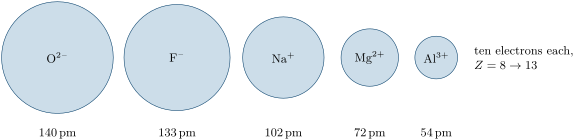
The isoelectronic series 1 s2 2 s2 2 p6, drawn to scale (ionic radii for six neighbours). The same ten electrons shrink as the nuclear charge grows.
The isoelectronic series 1s22s22p61\text{s}^2 2\text{s}^2 2\text{p}^6, drawn to scale (ionic radii for six neighbours). The same ten electrons shrink as the nuclear charge grows.

示例

Example 2.7 (The halogens)

The bond lengths of FX2\ce{F2}, ClX2\ce{Cl2}, BrX2\ce{Br2} and IX2\ce{I2} are 141.2, 198.8, 228.1 and 266.6 pm266.6\,\mathrm{pm}, so the covalent radii are 71, 99, 114 and 133 pm133\,\mathrm{pm}: each step down the group adds a shell and about 20 pm20\,\mathrm{pm} or more.

在原文中阅读 →