University Chemistry — Year 1 · Bachelor Year 1
2Periodicity
Lithium, sodium and potassium are soft, shiny metals that tarnish in air and react with water; fluorine, chlorine and bromine are coloured, corrosive non-metals that snatch electrons from almost anything. Each trio sits in one column of the periodic table, and the members of a column resemble one another while neighbours along a row do not. The previous chapter explained why: elements of one column have the same configuration of valence electrons. This chapter turns that explanation into numbers — radii, ionisation energies, electron affinities, electronegativities — and into the trends that let a chemist predict, from the position of an element alone, how large its atoms are, how easily they give up or accept electrons, and which way the electrons of a bond lean.
You already know
Every period begins with the filling of an s subshell and ends with a filled p subshell; the s, p, d and f blocks have the widths 2, 6, 10 and 14 (Proposition 1.23). Book 1 (grade 11) described electronegativity as the tendency of an atom to attract the electrons of a bond.
2.1 The table built from configurations
Definition 2.1 (Period, group, block)
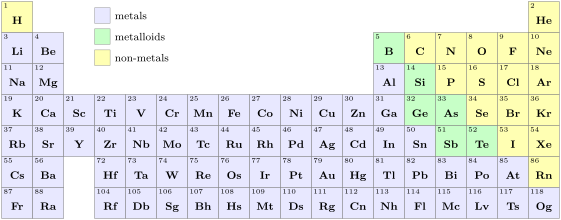
In the periodic table the elements are listed by increasing atomic number . A period is a row: the elements whose valence shell has the same principal number . A group is a column, numbered 1 to 18: the elements with the same valence configuration. A block is the set of elements whose last-filled subshell is of one kind, s, p, d or f.
Example 2.2 (Reading a position)
Selenium, , is in period 4 (valence shell ), in the p block, and in group 16 (two s electrons, ten d and four p: ); its valence configuration is that of oxygen and sulfur above it.
Definition 2.3 (Metal, non-metal, metalloid)
A metal is an element whose solid conducts electricity and whose atoms readily lose electrons to form cations; a non-metal is an element that does not conduct (with exceptions such as graphite) and readily gains electrons or shares them. A metalloid is an element of intermediate character, a semiconductor: boron, silicon, germanium, arsenic, antimony and tellurium.
2.2 Size: atomic and ionic radii
Definition 2.4 (Screening, effective nuclear charge)
In an atom with several electrons, an electron is attracted by the nucleus, of charge , and repelled by the other electrons. The inner electrons partly cancel the attraction of the nucleus: this is screening. The valence electron behaves as if it felt a reduced nuclear charge , the effective nuclear charge, with . Electrons of an inner shell screen almost completely; electrons of the same shell screen only a little.
Remark 2.5 (A qualitative tool)
In this book is used qualitatively: along a period, increases by one at each step while the added electron, in the same shell, screens only a little, so felt by the valence electrons increases; down a group, changes little but the valence shell grows. Rules to compute from the configuration (Slater’s rules) are given in the Year 2 volume.
Definition 2.6 (Covalent radius, ionic radius)
The covalent radius of an element is half the length of a single bond between two of its atoms: for chlorine, half the distance of . The ionic radius of an ion is the share of the distance between neighbouring cations and anions in ionic crystals attributed to it, from a convention that fixes the radius of one reference ion (); it depends slightly on the number of neighbours.
Example 2.7 (The halogens)
The bond lengths of , , and are 141.2, 198.8, 228.1 and , so the covalent radii are 71, 99, 114 and : each step down the group adds a shell and about or more.
Proposition 2.8 (Trends in radius)
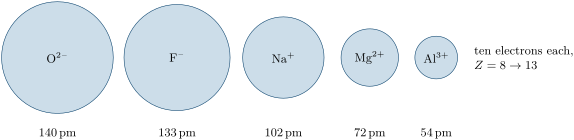
Atomic radii decrease from left to right along a period and increase from top to bottom down a group. A cation is smaller than its atom, an anion larger; in an isoelectronic series (ions with the same configuration) the radius decreases as increases.
Reasoning. The size of an atom is the size of its valence orbitals, which shrink when grows and swell when grows. Along a period is fixed and grows: the atoms contract. Down a group grows by one at each step, which outweighs the small change of . A cation has lost its valence shell, or electrons that repelled one another; an anion has gained an electron that repels the others. In an isoelectronic series the same electrons are held by a nucleus of growing charge. ∎
2.3 Energies: ionisation and electron affinity
Definition 2.9 (Ionisation energies)
The first ionisation energy of an element is the energy needed to remove one electron from the isolated atom in its ground state, in the gas phase:
The successive ionisation energies remove the second, the third electron… from , … They are given in electronvolts per atom or in kilojoules per mole ().
Proposition 2.10 (Trends in ionisation energy)
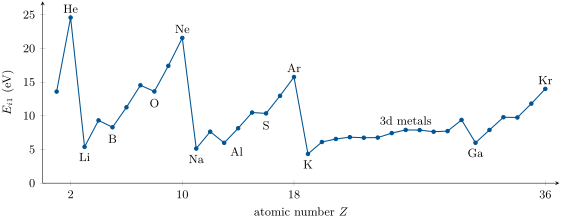
The first ionisation energy increases along a period, from the alkali metal to the noble gas, and decreases down a group. Successive ionisation energies always increase, , and jump by a large factor when the electron removed belongs to an inner shell.
Reasoning. Removing an electron is easier when it is far from the nucleus and feels a small : along a period grows and the radius shrinks; down a group the radius grows. Each successive electron is pulled from an ion of higher charge and smaller size, so costs more; once the valence shell is empty the next electron comes from a shell of smaller , much closer to the nucleus and hardly screened at all. ∎
Example 2.11 (Magnesium)
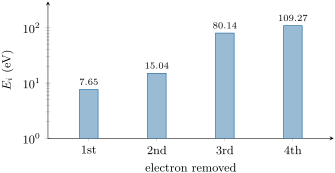
The successive ionisation energies of magnesium are 7.65, 15.04, 80.14 and . The ratio is moderate; is a jump: the third electron comes from the 2p core. Magnesium gives up its two 3s electrons and stops at , the noble-gas configuration of neon.
Proposition 2.12 (Two dips along a period)
Along periods 2 and 3, the first ionisation energy drops slightly from group 2 to group 13 ( to , to ) and from group 15 to group 16 ( to , to ).
Reasoning. In and the electron removed is the first p electron, higher in energy than the s electrons of and . In and the electron removed is the fourth p electron, the first to share an orbital ( ): its repulsion with its partner makes it easier to remove than an electron of the half-filled subshell of or (
 ). ∎
). ∎
Definition 2.13 (Electron affinity)
The electron affinity of an element is the energy released when an isolated atom in its ground state captures an electron in the gas phase,
It is positive when the anion is more stable than the atom and the free electron.
Example 2.14 (Halogens and their neighbours)
The electron affinities of , , and are 3.40, 3.61, 3.36 and , the largest of all elements; those of and are 1.44 and , of , of . Atoms that complete a subshell by capturing an electron (the halogens) release much energy. Nitrogen, beryllium, magnesium and the noble gases form no stable gaseous anion: the extra electron would have to pair in a half-filled p subshell or enter a new subshell. Fluorine’s affinity is smaller than chlorine’s because the added electron is crowded into the small 2p shell.
2.4 Electronegativity and polarisability
Definition 2.15 (Electronegativity)
The electronegativity of an element measures the tendency of its atoms, in a molecule, to attract the electrons of the bonds they form. Two scales are in use.
On the Pauling scale, differences are defined from bond energies :
and the scale is anchored by .
- On the Mulliken scale, , in electronvolts.
Remark 2.16 (Why the extra bond energy)
If the two atoms of a bond A–B attracted its electrons equally, the bond energy would be about the average of those of A–A and B–B. When one atom is more electronegative, the bond acquires a partial ionic character, , whose electrostatic attraction adds energy: measures the unequal sharing. The Mulliken definition says the same thing from the atoms’ side: an atom that holds its own electrons tightly ( large) and welcomes an extra one ( large) attracts the electrons of a bond.
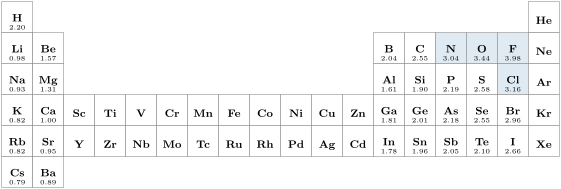
Proposition 2.17 (Trends in electronegativity)
Electronegativity increases along a period and decreases down a group: fluorine is the most electronegative element, caesium and francium the least. The difference between two bonded atoms gives the character of the bond: nearly non-polar covalent, polar covalent, mainly ionic — three regions of a continuum, not sharp classes.
Example 2.18 (Three bonds)
: , nearly non-polar; : , polar, the oxygen carrying a partial negative charge; : , ionic.
Definition 2.19 (Polarisability)
The polarisability of an atom, ion or molecule measures how easily its electron cloud is deformed by an electric field — the field of a neighbouring ion or dipole. A polarisable species acquires, in a field, an induced dipole moment proportional to the field.
Proposition 2.20 (Trends in polarisability)
Polarisability grows with the size of the electron cloud and with the number of electrons, and decreases with the charge of the nucleus that holds them: it increases down a group (), anions are much more polarisable than cations, and large soft anions such as are the most polarisable common species.
Example 2.21 (Why polarisability matters)
The London attraction between molecules, the subject of Chapter 4, grows with polarisability: diiodine is a solid at room temperature, dichlorine a gas. In an ionic crystal, a small highly charged cation polarises a large anion and gives the bond some covalent character, the failure of the simple ionic model met in Chapter 6.
History — Pauling’s scale, 1932
In 1932 the American chemist Linus Pauling noticed that the energy of a bond between two different atoms is almost always larger than the average of the energies of the two symmetric bonds, and built from that excess the first scale of electronegativity. Revised as better bond energies were measured, his scale is still the one in every table. Pauling received the Nobel Prize in Chemistry in 1954, for his work on the chemical bond, and the Nobel Peace Prize in 1962.

2.5 Trends in chemical character
Proposition 2.22 (Reducing and oxidising character)
Elements of low ionisation energy and low electronegativity, on the left of the table and at the bottom of their groups, readily lose electrons: they are reducing metals (the alkali metals most of all). Elements of high electronegativity and electron affinity, in the upper right, readily gain electrons: they are oxidising non-metals (fluorine, oxygen and chlorine most of all). The noble gases, with a high ionisation energy and no affinity for an extra electron, do neither.
Method 2.23 (Predicting a trend from the position)
To compare two elements for a property tied to the hold of the nucleus on the valence electrons (radius, , , ):
- if they are in the same group, the one lower down has the larger : larger radius, smaller and ;
- if they are in the same period, the one further right has the larger : smaller radius, larger and ;
- otherwise compare each with the element at the crossing of its row and the other’s column;
- check for subshell effects (start of a p subshell, first paired p electron) before concluding on ionisation energies.
Example 2.24 (Lithium in a battery)
Lithium has the lowest electronegativity of period 2 and loses its 2s electron easily, while it is the lightest metal: it carries the most transferable charge per gram of any element, the reason it powers rechargeable batteries. Its first ionisation energy, , is larger than that of sodium (5.14) or potassium (4.34), yet in water it is the most reducing alkali metal, a paradox resolved by the strong hydration of the small ion (Chapter 13).
2.6 Exercises
Exercise 2.1 ★
Give the period, the group and the block of calcium, iron, selenium and iodine (), from their configurations.
Exercise 2.2 ★
In each pair, which species is larger, and why? or ; or ; or ; or .
Solution
Solution of Exercise 2.2.
is larger than : same period, smaller . is larger than , which has lost its 3s shell. () is larger than (): one more shell. () is larger than (): same ten electrons, nuclear charge 11 against 12.
Exercise 2.3 ★
The first ionisation energies of , , , , and are 5.14, 7.65, 5.99, 10.49, 10.36 and . Rank them and point out the two departures from the general trend.
Solution
Solution of Exercise 2.3.
. The general increase along the period is broken twice: below (the electron removed is the first 3p electron, higher in energy than 3s) and below (the electron removed is the first paired 3p electron).
Exercise 2.4 ★
Define the polarisability of a species. Which is more polarisable, or ? or ? Justify.
Solution
Solution of Exercise 2.4.
The polarisability measures how easily the electron cloud is deformed by an electric field. is more polarisable than : it is larger and its outer electrons are farther from the nucleus. (18 electrons held by ) is far more polarisable than (10 electrons held by ), as anions are than cations.
Exercise 2.5 ★★
The first four ionisation energies of an element of period 3 are 5.99, 18.83, 28.45 and . Compute the successive ratios, identify the element and the ion it forms.
Solution
Solution of Exercise 2.5.
Ratios: , , . The jump comes after the third electron: three valence electrons, group 13, period 3: aluminium. It forms , .
Exercise 2.6 ★★
Explain why chlorine has a larger electron affinity than fluorine, and why nitrogen and magnesium form no stable gaseous anion.
Solution
Solution of Exercise 2.6.
The added electron of enters the small 2p shell, where it is strongly repelled by the seven valence electrons already there; in the larger 3p shell of chlorine the repulsion is smaller, so more energy is released. In nitrogen (, ) the extra electron would have to pair in a half-filled subshell; in magnesium () it would have to start the higher 3p subshell. In neither case is the anion more stable than the atom and a free electron.
Exercise 2.7 ★★
Compute the Mulliken electronegativities of sodium (, ) and chlorine (, ). What do they say of the bond in ?
Solution
Solution of Exercise 2.7.
; . The difference is large: the electron pair of a bond belongs almost entirely to chlorine, and sodium chloride is ionic, .
Exercise 2.8 ★★
With the Pauling values of Example 2.18 and , classify the bonds , , , () and , and give the sign of the partial charge on each atom.
Solution
Solution of Exercise 2.8.
: , at the border of the ionic region (in practice a very polar covalent bond), . : 0.35, nearly non-polar. : 2.23, ionic, . : 0.61, polar covalent, . : 1.24, polar covalent, .
Exercise 2.9 ★★
The first ionisation energies of , and are 5.39, 5.14 and . Explain the trend and predict whether that of rubidium is above or below .
Solution
Solution of Exercise 2.9.
Down the group the valence electron is in a shell of larger , farther from the nucleus and screened by more core electrons; it is removed more easily. Rubidium, one shell further, has a first ionisation energy below .
Exercise 2.10 ★★★
Zinc () has a first ionisation energy of and gallium () of ; arsenic () and selenium () . Explain both drops using the configurations.
Solution
Solution of Exercise 2.10.
Zinc is : its electron comes from a filled 4s; gallium, , loses its single 4p electron, higher in energy and screened by the full 4s and 3d. Arsenic, , loses an electron from a half-filled subshell; selenium, , loses the paired electron, pushed up by the repulsion of its partner: its ionisation energy is slightly lower.
Exercise 2.11 ★★★
Take , , and , with . Use Pauling’s definition to estimate the bond energy . Why is it so much larger than the mean of the two symmetric bonds?
Solution
Solution of Exercise 2.11.
. Then . The large excess is the extra attraction between the partial charges and , due to the large electronegativity difference.
Exercise 2.12 ★★★
Pauling electronegativities are tabulated for krypton (3.00) and xenon (2.60) but not for helium, neon or argon. Using the definition of the scale, explain why a value can only be given for an element that forms bonds, and why the heavier noble gases are the ones that do.
Solution
Solution of Exercise 2.12.
Pauling’s scale is defined from the energies of bonds A–B: an element that forms no bond has no Pauling value. Helium, neon and argon form no stable compounds. Krypton and especially xenon have larger, more polarisable valence shells and lower ionisation energies ( for krypton against for argon); they are oxidised by fluorine and oxygen and form compounds such as , so their bond energies can be measured.
2.7 Problem: Pauling’s Arithmetic
Problem 2.1
Weekend problem — an unknown element from its ionisation energies, a series of ions of the same size of cloud, two scales of electronegativity, and Pauling’s number for the H–Cl bond
Data: per particle corresponds to .
Part I — An unknown element. The first four ionisation energies of an element X of period 3 are 7.65, 15.04, 80.14 and .
- Why is each ionisation energy larger than the previous one?
- Compute the ratios , and .
- Deduce the group of X, then identify it.
- Which ion does X form in its compounds? Give its configuration.
- Is X a metal or a non-metal? Justify from its position.
- Why does the third electron cost so much more than the second?
Part II — Ten electrons. The ionic radii (six neighbours) of , , , and are 140, 133, 102, 72 and .
- Show that these ions have the same configuration.
- Explain the ranking of the radii.
- Which of the five ions is the most polarisable, and why?
- Compute the ratio of the largest to the smallest radius.
- The bond length of is and the radius of . Compute the covalent radius of chlorine and compare.
- Without further data, rank , and by size.
Part III — Mulliken’s scale.
| element | |||||
|---|---|---|---|---|---|
| (eV) | 17.42 | 12.97 | 11.81 | 13.62 | 11.26 |
| (eV) | 3.40 | 3.61 | 3.36 | 1.44 | 1.26 |
| Pauling | 3.98 | 3.16 | 2.96 | 3.44 | 2.55 |
- Compute the Mulliken electronegativities of the five elements.
- Rank them on each scale. Which element is placed differently?
- Compute the ratio for the three halogens. What do you notice?
- Suggest why oxygen departs from the rule of the halogens (look at its electron affinity).
- Which atom carries the partial negative charge in ? in ?
- With the tabulated values (), is the bond non-polar, polar covalent or ionic?
Part IV — Pauling’s number for H–Cl. The standard enthalpies of formation of , and at are 218.0, 121.3 and ; those of and are zero. The bond energy of a molecule is taken as the enthalpy of its dissociation into atoms.
- Compute from .
- Compute .
- Compute from .
- Compute Pauling’s excess energy in kJ/mol, and show that it equals .
- Convert into electronvolts.
- Compute and compare it with the difference of the tabulated values, .
Solution
Solution of Problem 2.1.
1. Each electron is removed from an ion that is more positive and smaller than the previous one, which holds its electrons more strongly. 2. ; ; . 3. The jump comes after two electrons: X has two valence electrons, group 2; in period 3 it is magnesium. 4. , , the configuration of neon. 5. A metal: group 2, on the left of the table, with low first ionisation energies. 6. The third electron comes from the 2p core, of smaller , much closer to the nucleus and hardly screened, and is removed from a doubly charged ion.
7. All have ten electrons: . 8. The same ten electrons are held by nuclear charges 8, 9, 11, 12, 13: the cloud contracts as grows. 9. : the largest, with the lowest nuclear charge for its ten electrons, and an anion. 10. . 11. ; the anion is times larger than the covalent radius.
12. : the two cations are isoelectronic (charge 12 against 11), and has a third shell. 13. = 10.41 (), 8.29 (), 7.59 (), 7.53 (), 6.26 (), in eV. 14. Mulliken: ; Pauling: . Oxygen moves from fourth to second. 15. , , : nearly constant, about 0.38; for the halogens the two scales are proportional. 16. The electron affinity of oxygen is small () because the added electron must pair in the compact 2p shell; the Mulliken value of the free atom underrates the pull oxygen exerts in its bonds, which Pauling’s scale, built from bonds, measures directly. 17. Chlorine in ; fluorine in . 18. : polar covalent. 19. . 20. . 21. . 22. . In symbols, while the mean of the symmetric bonds is , so . 23. . 24. , against in the tables: Pauling’s arithmetic, done with modern data, gives the tabulated difference to within 0.02.