
All books

Professional

Apps About Coach Log in Start reading

Chemistry · Glossary

What is Kinetic isotope effects?

Also known as: kinetic isotope effect · primary kinetic isotope effect · secondary kinetic isotope effect

Definition 12.11 University Chemistry — Year 3 · Chapter 12 — Theories of Reaction Rates

The kinetic isotope effect of a step is the ratio klight/kheavyk_{\mathrm{light}}/k_{\mathrm{heavy}} of its rate constants for two isotopologues, most often kH/kDk_{\mathrm H}/k_{\mathrm D}. It is a primary kinetic isotope effect when the bond to the substituted atom is made or broken in the step, a secondary kinetic isotope effect when it is not.
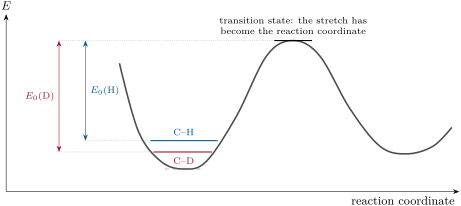
Origin of the primary kinetic isotope effect. In the reactant, the C–H stretch holds more zero-point energy than the C–D stretch (levels above the bottom of the well, dashed); in the transition state this vibration has become the reaction coordinate, and both isotopologues reach the same top. The barrier is larger for D by the difference of the zero-point energies.
Maximum primary kinetic isotope effect against temperature for the loss of a C–H, N–H or O–H stretch (fundamentals of CH4, NH3 and H2O; the deuterium wavenumbers from the reduced masses). At 298\, K it is 6.5 for C–H; it decreases towards 1 as the temperature rises.
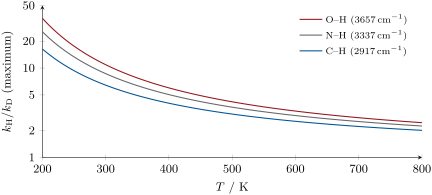
Maximum primary kinetic isotope effect against temperature for the loss of a C–H, N–H or O–H stretch (fundamentals of CHX4\ce{CH4}, NHX3\ce{NH3} and HX2O\ce{H2O}; the deuterium wavenumbers from the reduced masses). At 298 K298\,\mathrm{K} it is 6.5 for C–H; it decreases towards 1 as the temperature rises.
Read in context →