
All books

Professional

Apps About Coach Log in Start reading

Chemistry · Glossary

What is Optical activity, specific rotation?

Also known as: optical activity · dextrorotatory · laevorotatory · specific rotation

Definition 16.13 University Chemistry — Year 1 · Chapter 16 — Stereochemistry in Depth

A substance shows optical activity if it rotates the plane of polarisation of linearly polarised light passing through it. Seen by an observer facing the light, a dextrorotatory substance, written (+)(+), rotates it clockwise, a laevorotatory one, (−)(-), anticlockwise. The specific rotation is [α]=α/(ℓc)[\alpha] = \alpha/(\ell c), where α\alpha is the measured angle in degrees, ℓ\ell the path length in decimetres and cc the mass concentration in g/mL\mathrm{g}/\mathrm{mL}; it depends on the wavelength (usually the yellow sodium line), the temperature and the solvent.
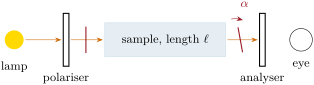
A polarimeter. The polariser lets through light vibrating in one plane; the chiral sample rotates that plane by ; the analyser is turned until the light is extinguished again, which measures .
A polarimeter. The polariser lets through light vibrating in one plane; the chiral sample rotates that plane by α\alpha; the analyser is turned until the light is extinguished again, which measures α\alpha.
Read in context →