 Coach
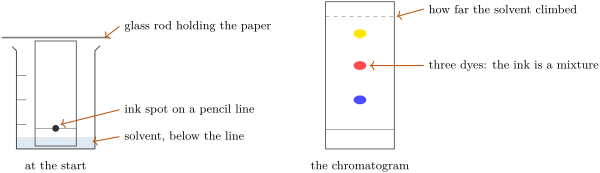
CoachPaper chromatography separates the dyes of a mixture. A small spot of the mixture is put on a line drawn near the bottom of a strip of paper; the bottom of the strip dips into a solvent, which slowly climbs up the paper and carries each dye with it, some faster than others. When the solvent has climbed almost to the top, the strip is taken out and dried: it is the chromatogram.
Examples
Example 10.9 (The dyes of sweets)
The coloured coatings of sweets are scraped into a little water and spotted on a strip, beside spots of the food dyes allowed in sweets. The chromatogram shows that the green coating holds a yellow dye and a blue dye, both found among the allowed dyes.