
All books

Professional

Apps About Coach Log in Start reading

Chemistry · Glossary

What is Peptides?

Also known as: peptide bond · peptide · peptide coupling · coupling agent

Definition 30.4 University Chemistry — Year 2 · Chapter 30 — Biomolecules: Amino Acids, Sugars, Lipids and Nucleotides

The amide bond formed between the carboxylic group of one amino acid and the amino group of another is a peptide bond; a chain of amino acids joined by peptide bonds is a peptide (a protein when it is long), written from its free amino end (N-terminus) to its free carboxylic end (C-terminus). A peptide coupling forms a peptide bond in the laboratory with a coupling agent, a reagent that converts the carboxylic group into an activated derivative under mild conditions (a carbodiimide, for instance).
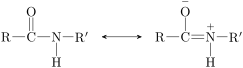

The two resonance structures of the peptide bond. The nitrogen lone pair is shared with the carbonyl: the C-N bond has a partial double-bond character, and the six atoms C, C, O, N, H, C lie in one plane.
The two resonance structures of the peptide bond. The nitrogen lone pair is shared with the carbonyl: the C−N\ce{C-N} bond has a partial double-bond character, and the six atoms C, C, O, N, H, C lie in one plane.
Eggs frying. The proteins of the white unfold on heating and bond to one another: the translucent liquid turns into an opaque white solid. No peptide bond breaks; the change is in the way the chains are folded (illustration).
Read in context →